

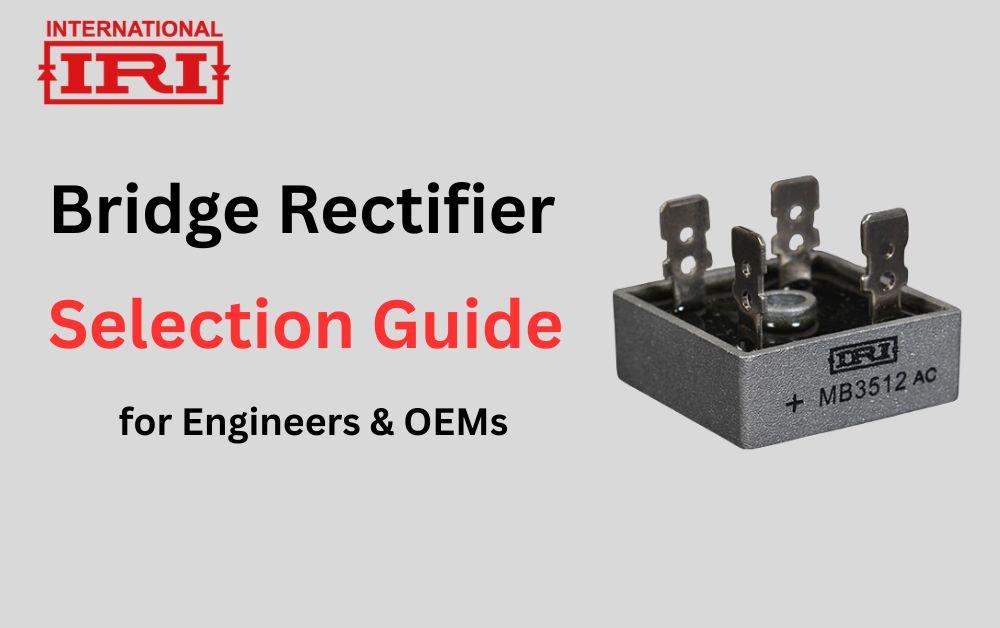
It may appear that it is not much of a problem to select the appropriate bridge rectifier, yet it is an established fact that everyone who designs or has to scale a power system is aware of how important such a choice can be. Not making a sound, in the center of your circuit is a rectifier that turns AC into DC, and when it does not match, the whole machine is affected. To engineers and OEMs, it is not only performance, reliability, and long-term stability of the solution, but also datasheets.
Understanding the Role of a Bridge Rectifier
The essence of a bridge rectifier is that it regulates the amount of power that is passed through a circuit. It establishes user stability, thermal cycling, and lifespan of the system. Certainly, regardless of the industrial power supplies, consumer electronics, or automotive applications, the choice of the rectifier has a direct effect on the quality of the product. This is what skilled engineers will do to go beyond the bare specifications and lay emphasis on the application specifications.
Full Wave vs Half Wave: Knowing What Fits
full-wave bridge rectifier is the preferred choice in most modern designs. It makes use of both half-cycles of the AC input cycle, making the DC output smoother, more efficient, and with less ripple. Full wave designs have obvious benefit in applications where steady voltage is required, and larger loads are to be handled. On the other hand, a half-wave bridge rectifier is simpler and cost-effective, but it uses only one half of the AC cycle. It results in increased ripple and reduced efficiency, thus only being applicable to the needs of low-power or non-critical applications. Being aware of where simplicity is effective, where it fails can save not only cost, but also performance-related problems in the future.
Key Parameters Engineers Should Never Ignore
Selection varies in addition to the type of waves, in terms of peak inverse voltage (PIV), forward current rating, thermal resistance, and package design. Compact assemblies often become the deciding factor in heat dissipation. This is where working with an experienced bridge rectifier manufacturer makes a real difference. Quality manufacturers produce reliability that is tested and supported by a design that extends well beyond the component itself.
Why Manufacturer Expertise Matters
Not every rectifier works so well in applications. Long-term reliability depends on the quality of materials, the integrity of the junction, and manufacturing precision. Insel Rectifier specializes in the manufacture of high-quality rectifier products suitable for harsh electrical conditions, which can consistently provide OEMs with consistent performance throughout the production cycle.
Investing with Certainty.
It is not merely that the right bridge rectifier can meet the needs of today--it can provide your design with longevity. The difference between matching the electrical characteristics to the application needs and using a manufacturer that can comprehend the engineering issues: The difference results in the systems running cooler, lasting longer, and performing better. When it needs to be reliable, efficient, and at scale, collaborating with a team such as Insel Rectifier will provide a solid base of power conversion.