

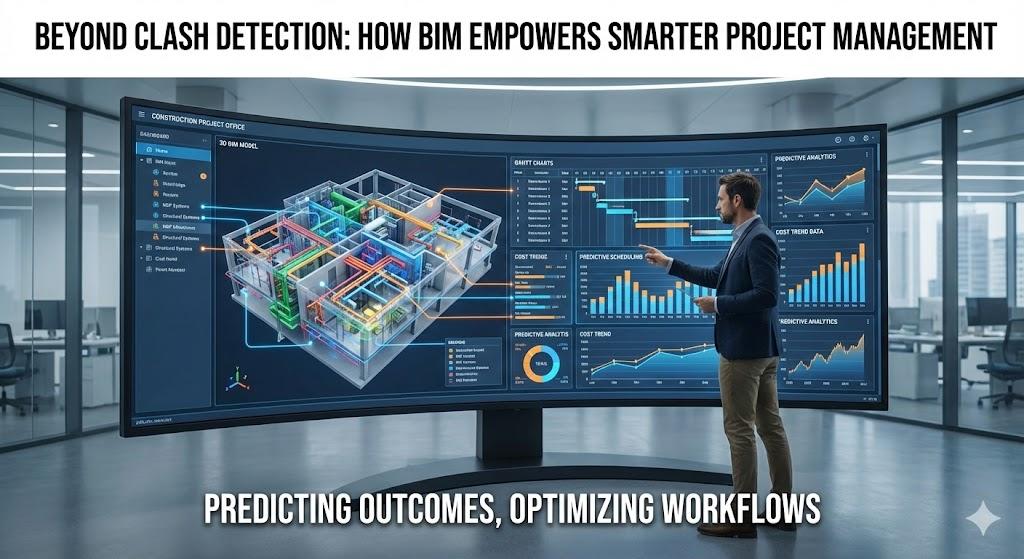
Let’s be honest: in most kick-off meetings, when someone mentions BIM, everyone immediately thinks of "clash detection." And fair enough—seeing a digital HVAC duct smash into a digital steel beam six months before it happens on site is incredibly valuable. It saves thousands of dollars and countless headaches.
But here is the thing: If you are only using BIM to spot collisions, you are using about 10% of its power. It’s like buying a smartphone just to make phone calls.
To truly unlock "smarter" project management, we need to stop viewing BIM as merely a 3D design tool and start treating it as what it actually is: a dynamic, data-rich database that just happens to have a visual interface.
Moving from Coordination to Management
Smarter project management isn't about reacting to problems faster; it's about predicting them. When you move beyond basic geometry and start leveraging the "I" (Information) in BIM, the game changes for the Project Manager.
Suddenly, the model isn't just showing you where things are; it's telling you when they need to be there (4D scheduling) and how much they cost (5D estimating). Instead of relying on disconnected spreadsheets and outdated 2D drawings, the PM has a single source of truth that connects design, timing, and budget.
Taming the Chaos
Nowhere is this empowered management more critical than with complex trades. Think about the usual chaos of coordinating mechanical, electrical, and plumbing systems. It’s often a major bottleneck. By utilizing specialized MEP BIM services facilitating project management, PMs can move from reactive firefighting to proactive sequencing. It allows them to visualize installation workflows and manage trade handoffs with precision rather than guesswork.
Final Thoughts
Clash detection is great for preventing rework. But comprehensive BIM is great for ensuring profitability and predictability across the entire project lifecycle. Don't just use the model to check the design; use it to manage the build.