

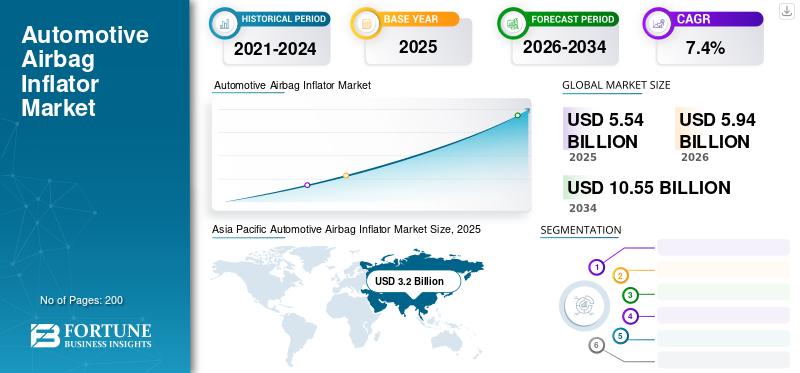
The global automotive airbag inflator market size 2026 was valued at USD 5.54 billion in 2025 and is projected to rise from USD 5.94 billion in 2026 to USD 10.55 billion by 2034, registering a compound annual growth rate (CAGR) of 7.4% over the forecast period (2026–2034). This robust growth reflects the automotive industry's increasing commitment to occupant safety, driven by tighter government regulations and rising consumer awareness worldwide.
Automotive airbag inflators are critical safety components that generate or store gas to rapidly inflate airbags during a collision — deploying in less than 0.02 seconds. These devices store either chemical propellant, compressed gas, or a hybrid combination, making them indispensable to modern passive safety systems.
Key Market Drivers
1. Stringent Safety Regulations Governments worldwide are mandating airbag installations across vehicle categories. In India, for instance, all new passenger cars produced from April 1, 2021, are required to include dual airbags as standard fittings. Similarly, frontal airbags have been standard equipment in all U.S. passenger cars since 1998. These regulatory frameworks compel manufacturers to continuously upgrade airbag inflator technologies.
2. Rising Vehicle Production and Sales With expanding middle-class populations, growing disposable incomes, and rapid urbanization — particularly in Asia Pacific — global vehicle sales are on an upward trajectory. As airbag systems are now standard in both luxury and mid-class vehicles, higher vehicle volumes directly translate into greater demand for inflators.
3. Consumer Awareness and Safety Consciousness Modern consumers are increasingly willing to pay a premium for advanced safety features. Automakers are responding by investing in innovative airbag technologies. A notable example is ZF's development of an external airbag in 2019, designed to reduce impact severity from oncoming collisions.
Get a Free Sample PDF - https://www.fortunebusinessinsights.com/enquiry/request-sample-pdf/automotive-airbag-inflator-market-105081
Market Segmentation
By Product Type
- Pyrotechnic Inflators dominate the global market due to their quick deployment capability and wide regulatory acceptance. Leading manufacturers such as Autoliv Inc. and Daicel Corporation are advancing this technology.
- Hybrid Inflators are gaining momentum, valued for improved performance tuning and lower exhaust gas temperatures.
- Stored Gas Inflators had a market value of USD 1.22 billion in 2025 and are projected to grow strongly due to faster inflation times using compressed cold gas.
By Component Type
The market is segmented into airbag inflator filters, airbag tubes, and other components. Airbag tubes and filters are witnessing rising demand driven by government mandates and growing airbag usage. However, increasing steel prices post-COVID-19 present a cost challenge, as steel is the primary manufacturing material.
By Vehicle Type
- Passenger Vehicles hold the largest share at 80.06% in 2025, supported by growing personal car sales in developing economies.
- Light Commercial Vehicles (LCVs) are also expected to show lucrative growth, supported by global government initiatives to improve commercial vehicle safety standards.
Regional Analysis
Asia Pacific is the clear market leader, contributing approximately USD 3.2 billion (57.81% share) in 2025. The region benefits from high vehicle production volumes, strong EV adoption, and government safety programs in China, India, Japan, and South Korea. China's market is forecast to grow at a CAGR of 8%, while Japan, China, and India are projected to reach USD 0.4 billion, USD 1.84 billion, and USD 0.35 billion respectively by 2026.
Europe held the second-largest share at 17.67% (USD 0.98 billion) in 2025, projected to grow at a CAGR of 3%, fueled by EV adoption, autonomous vehicle development, and shared mobility trends.
North America accounted for 7.47% of the market (USD 0.41 billion) in 2025, with growth driven by strict U.S. safety standards and high investment in product innovation.
Market Restraints
The industry faces significant challenges, most notably product recalls stemming from inflator defects. The widespread Takata airbag inflator recall affected millions of vehicles globally, resulting in massive financial losses, legal liabilities, and damaged consumer confidence. Such incidents underscore the need for rigorous quality control, improved testing protocols, and stronger supply chain oversight.
Additionally, high airbag system costs, the durability concerns of low-cost airbags, and limited spending power in underdeveloped economies continue to restrain broader market penetration.
Competitive Landscape
The market is relatively consolidated, with key players focusing on advanced inflator technologies. Major companies profiled include:
- Autoliv Inc. (Sweden) — market leader developing initiators, micro gas generators, and Bernoulli Principle-based airbag technology
- Joyson Safety Systems (U.K.)
- Daicel Corporation (Japan)
- Toyoda Gosei Co. Ltd. (Japan)
- Robert Bosch GmbH (Germany)
- ARC Automotive, Inc. (U.S.)
- Aptiv PLC (U.S.)
Recent developments include Honda's motorcycle airbag system (March 2024), Autoliv's partnership with NIO for EV safety products (May 2023), and Toyoda Gosei's expansion of its airbag development center in India (December 2023).
Conclusion
The automotive airbag inflator market is on a strong growth trajectory, underpinned by regulatory mandates, rising vehicle production, and increasing safety consciousness. Asia Pacific will continue to dominate, while advances in hybrid and stored-gas inflator technologies point toward a more diversified product landscape. Companies that invest in innovation, quality assurance, and regulatory compliance will be best positioned to capitalize on the market's expanding opportunities through 2034.