

The global aviation infrastructure and next-generation airspace management landscape is experiencing continuous upward momentum, fundamentally supported by an industry-wide transition toward modernized communication, navigation, and surveillance systems to safely accommodate rising global flight volumes.
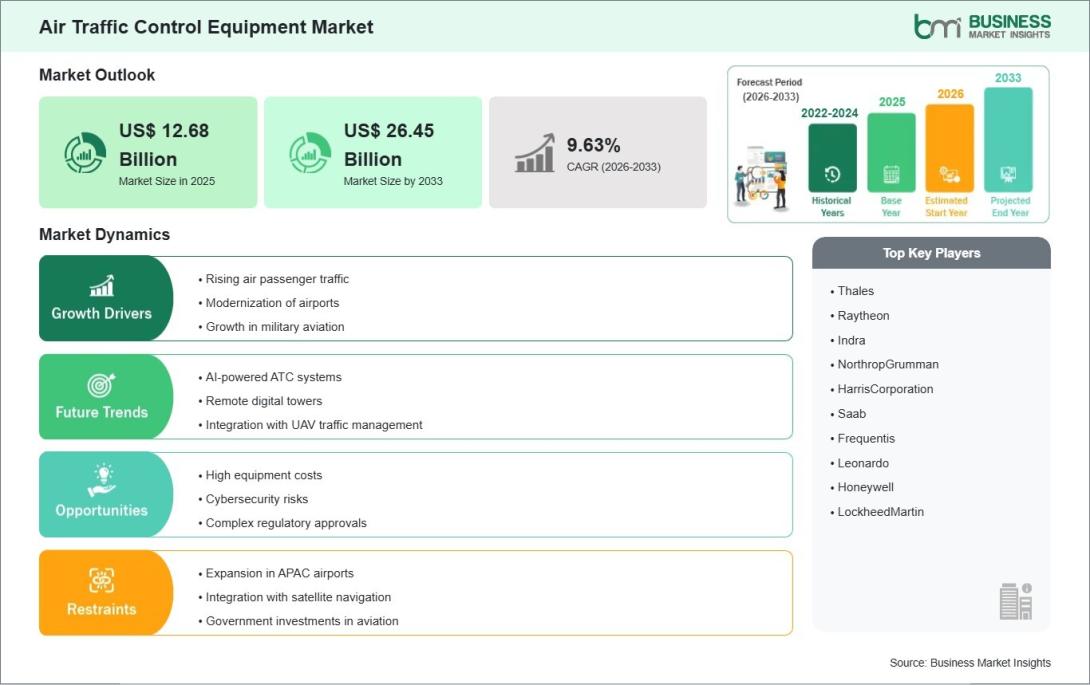
Business Market Insights forecasts that the global Air Traffic Control Equipment Market value will surge to US$ 26.45 Billion by 2033 from its 2025 baseline of US$ 12.68 Billion, progressing at a strong CAGR of 9.63% over the 2026–2033 forecast period.
Technological progress in radar systems, digital communication, satellite-based navigation, automated surveillance, cloud-based traffic management, and artificial intelligence is reshaping the Air Traffic Control Equipment Market. These innovations are helping aviation operators improve flight coordination, reduce congestion, strengthen airport efficiency, and support safer airspace operations. As aviation networks become more connected and more complex, demand for next-generation control systems continues to rise.
Download Sample Report: https://www.businessmarketinsights.com/sample/BMIPUB00035475
What Is Air Traffic Control Equipment?
Air traffic control equipment includes the systems and technologies used to monitor, manage, and coordinate aircraft movement in airspace and on airport runways. These tools help air traffic controllers and aviation authorities track flights, communicate with pilots, and maintain safe spacing between aircraft. The equipment is widely used to support aviation safety, improve operational efficiency, and manage the growing volume of global air traffic.
The category includes radar systems, communication tools, navigation equipment, and surveillance solutions. These systems are used by airports, airbases, and other aviation entities to strengthen flight coordination and improve the reliability of air traffic operations. As airports modernize and aviation traffic grows, the importance of advanced control equipment continues to increase.
Market Drivers
A major driver of the Air Traffic Control Equipment Market is the expansion of global air traffic and airport modernization projects. Rising passenger volumes and cargo movement are increasing pressure on existing aviation infrastructure, leading airports and regulators to invest in improved traffic control systems. These upgrades are helping reduce congestion, support safety, and improve overall flight scheduling efficiency.
Another important growth factor is the advancement of digital aviation technologies. Aviation authorities are increasingly adopting cloud-based traffic management, satellite navigation, automated surveillance, and data-driven coordination systems. These tools improve real-time monitoring and help aviation stakeholders respond more effectively to complex airspace demands.
The market is also benefiting from smart airport development and the growing need to integrate unmanned aerial systems into controlled airspace. As aviation becomes more digitally connected, the need for robust communication, navigation, and surveillance infrastructure is becoming more critical across both civil and military applications.
Market Segmentation
By Equipment Type
- Radar: Used for aircraft detection, tracking, and airspace monitoring.
- Communication: Supports real-time coordination between pilots, controllers, and airport authorities.
- Navigation: Helps ensure accurate aircraft positioning and route management.
- Surveillance: Provides enhanced monitoring and airspace visibility for safer operations.
By Application
- Civil: The leading segment, driven by passenger traffic growth and airport modernization.
- Military: Used for defense aviation, airbase coordination, and mission management.
By End-User
- Airports: The largest segment, supported by smart airport investment and air traffic management upgrades.
- Airbases: Use advanced systems for secure defense coordination and airspace control.
- Other End Users: Includes aviation training centers and government aviation agencies.
Radar systems account for a significant share of the market because of their essential role in aircraft tracking and operational safety. Civil aviation dominates the application segment because of strong passenger traffic and airport expansion programs. Airports lead the end-user segment due to ongoing investments in smart airport technologies and advanced traffic management systems.
Regional Insights
- North America holds a strong position due to advanced aviation infrastructure, high technology adoption, and continued airport and defense modernization.
- Asia-Pacific is growing significantly, supported by rapid airport expansion, rising passenger traffic, and major aviation infrastructure investments.
- Europe continues to advance through aviation modernization, digital airspace management, and strong regulatory frameworks.
- Middle East & Africa is seeing growing demand from airport expansion and aviation infrastructure development.
- South & Central America is gradually expanding as aviation connectivity and airport investments increase.
Top Players in the Air Traffic Control Equipment Market
The market is competitive, with leading companies focusing on radar innovation, digital aviation systems, surveillance upgrades, and integrated communication platforms to strengthen their positions.
- Thales
- Raytheon
- Indra
- Northrop Grumman
- Harris Corporation
- Saab
- Frequentis
- Leonardo
- Honeywell
- Lockheed Martin
These companies continue to invest in advanced traffic management, surveillance technologies, and digital communication solutions to support safer and more efficient aviation operations.
Technological Innovations
Technological innovation is transforming the Air Traffic Control Equipment Market through smarter radar, connected communication systems, and cloud-based air traffic management platforms. These innovations help aviation authorities improve situational awareness, process flight data more accurately, and reduce delays across busy airport environments.
Artificial intelligence and advanced analytics are also gaining importance. By supporting predictive traffic management and automated decision-making, these tools help controllers manage rising aircraft volumes more effectively while improving overall airport efficiency.
Satellite-based navigation and surveillance technologies are further expanding the market by improving tracking accuracy and supporting remote airspace management. As unmanned aerial vehicles and urban air mobility systems become more common, the need for advanced control equipment is expected to increase even further.
Future Market Outlook
The future outlook for the Air Traffic Control Equipment Market remains positive. Rising aviation activity, airport modernization, digital airspace management, and the integration of advanced surveillance systems are expected to support strong growth through 2033. As governments and aviation authorities continue to upgrade legacy systems, demand for modern control equipment will remain resilient.
Companies that focus on interoperability, cybersecurity, automation, and smart airport integration are likely to capture the strongest opportunities. With global aviation infrastructure becoming more connected and more technologically sophisticated, air traffic control equipment will remain a critical part of modern air transport systems.
Frequently Asked Questions (FAQs)
What is the projected size of the Air Traffic Control Equipment Market by 2033?
The market is projected to reach US$ 26.45 Billion by 2033, rising from US$ 12.68 Billion in 2025.
What is the CAGR for the Air Traffic Control Equipment Market?
The market is expected to grow at a CAGR of 9.63% from 2026 to 2033.
Which equipment type holds a significant share?
Radar systems account for a significant market share.
Which application segment dominates the market?
Civil aviation dominates the market.
Which end-user segment leads the market?
Airports represent the largest market share.
Browse More Reports:
https://www.businessmarketinsights.com/reports/middle-east-defibrillators-market
https://www.businessmarketinsights.com/reports/latin-america-implantable-defibrillators-market
About Us
Business Market Insights is a market research platform that provides subscription service for industry and company reports. Our research team has extensive professional expertise in domains such as Electronics & Semiconductor; Aerospace & Defense; Automotive & Transportation; Energy & Power; Healthcare; Manufacturing & Construction; Food & Beverages; Chemicals & Materials; and Technology, Media, & Telecommunications.
Contact Us
If you have any questions about this report or would like further information, please contact us:
Contact person: Ankit Mathur
Email: sales@businessmarketinsights.com
Phone: +16467917070