
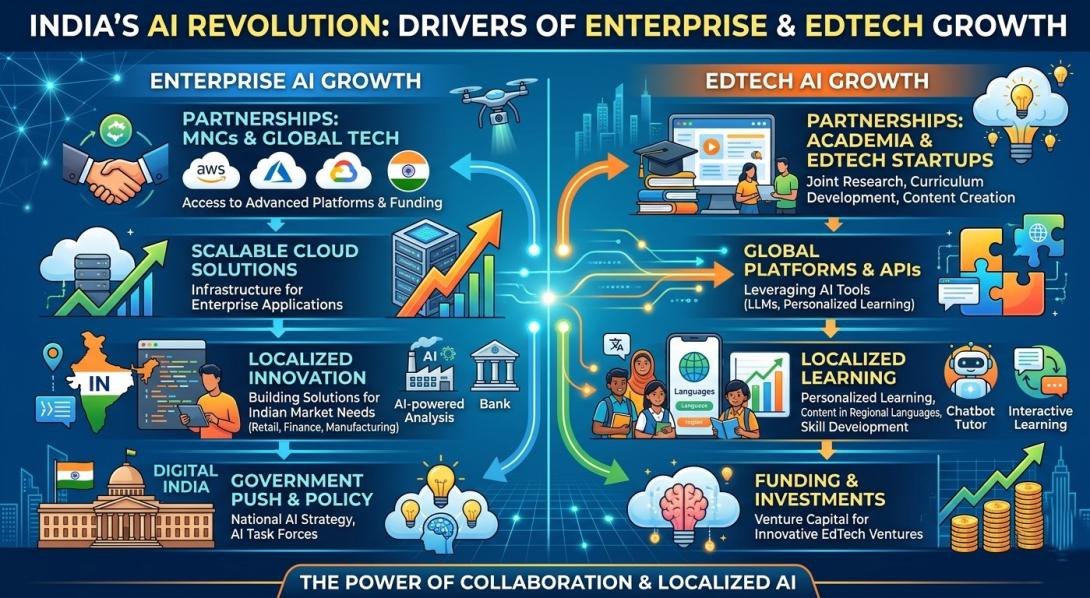
India's AI story over the last two years has shifted in a way most people outside the industry haven't caught up with yet. It's no longer just about Bengaluru startups raising funds or IT services adding "AI capabilities" to their pitch decks. The real movement is happening in classrooms, factory floors, hospital back-offices, and inside enterprise procurement teams who've finally stopped treating AI as a side project.
If you work in edtech or run learning programs for a corporate workforce, you've probably felt this shift already. Conversations have moved from "should we explore AI?" to "which partnership gets us there fastest?"
Why AI Innovation and Partnerships in India Are Moving So Quickly
A few things came together at roughly the same time. The IndiaAI Mission opened up serious compute and funding. Global cloud providers locked in deeper local tie-ups. And enterprises stopped waiting for perfect ROI math before signing pilots.
What's interesting is who's partnering with whom. We're seeing combinations that wouldn't have happened five years ago:
- Edtech platforms tying up with chipmakers and cloud labs to offer hands-on GPU access to learners
- Enterprises co-building proprietary models with academic research centres
- Skilling companies partnering directly with hiring teams to design curricula around real job descriptions, not theoretical syllabi
The last point matters more than people realise. A lot of AI training in India still teaches Python notebooks and calls it done. The partnerships actually working are the ones where the training output is judged by whether the learner can hold their own in a production environment on day one.
The Real Bottleneck: People Who Can Actually Ship
Here's the awkward truth most boardrooms now admit privately. The model isn't the bottleneck. The infrastructure isn't either, not really. What companies are struggling with is finding people who can take an AI use case from a slide deck to something running in their stack without breaking things.
This is where AI certification for job readiness has started carrying real weight, but only the kind that's tied to applied work. Certificates that just test theory have lost their shine. Hiring managers I've spoken with this year all say roughly the same thing: show me what you built, what dataset you used, and how you handled it when it broke.
A few signs a certification is actually worth the time:
- Project-based assessment, not just MCQs
- Mentorship from working practitioners, not full-time trainers
- Industry tie-ups that lead to interviews, not just badges on LinkedIn
- Updated content cycles, because something built around GPT-3.5 era thinking is already outdated
For edtech players, this is both the opportunity and the pressure. Learners and L&D buyers are getting sharper about what they're paying for.
What Enterprises Should Be Asking Right Now
If you're on the buying side, a quick gut check before any AI training or partnership deal:
Does the program produce people we'd actually hire?
Are the partners contributing tools and access, or just logos?
Is there a feedback loop between what learners build and what our teams actually need?
Most vendors will say yes to all three. The good ones can show you proof.
Where This Goes Next
India is in a strange and lucky position. The talent pool is enormous, the cost of experimentation is still reasonable, and the policy direction is mostly supportive. The next two years will probably separate the partnerships built for press releases from the ones built for outcomes.
Edtech companies that double down on practical, employer-aligned learning will keep winning. Enterprises that treat AI upskilling as a continuous capability instead of a one-time training spend will pull ahead of peers. The rest will keep running pilots that never quite go live.
FAQs
Q: Is an AI certification really worth it if I already have a tech background?
Yes, but only if it's applied. A good certification gives you portfolio work and exposure to current tools. If it's just a refresher of what you can read online, skip it.
Q: How are Indian enterprises typically structuring AI partnerships?
Most are moving toward a layered model: a cloud or compute partner, a model or tooling partner, and a talent or training partner. Single-vendor deals are becoming rarer for anything serious.
Q: What's the biggest mistake edtech companies make when designing AI courses?
Building the syllabus before talking to hiring managers. Curriculum should follow real job requirements, not the other way around.