

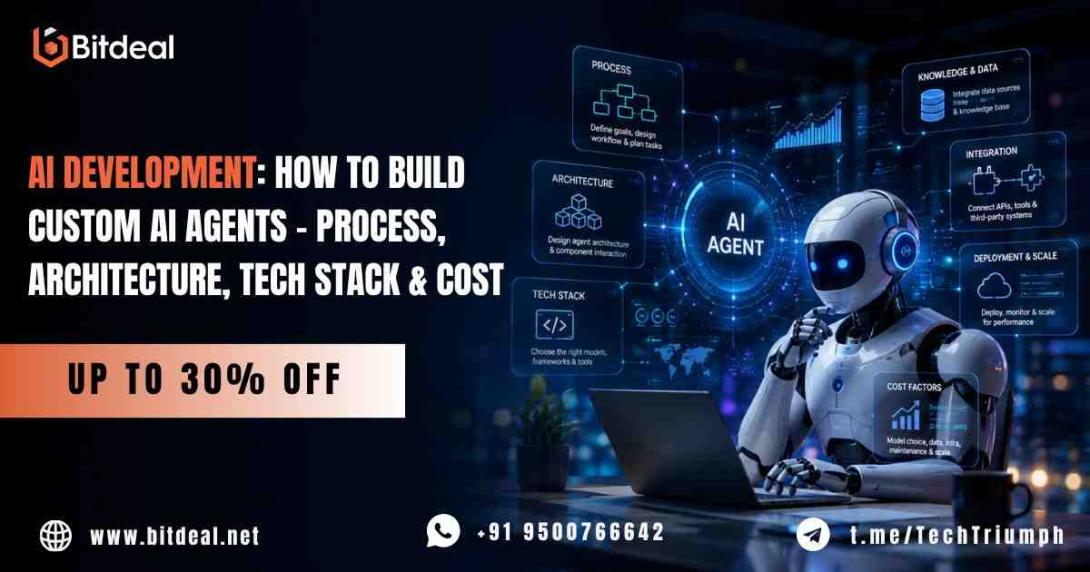
AI agents are changing how businesses automate decisions, not just tasks. Unlike simple chatbots, custom AI agents can reason, plan, and act across multiple systems with minimal human input. As enterprises scale operations, understanding the process becomes essential. This guide explains how businesses can approach custom AI agent development, covering the process, architecture, tech stack, and cost.
What Is Custom AI Agent Development?
Custom AI agent development is the process of designing intelligent systems customized to a specific business goal, rather than using generic, off-the-shelf tools. These agents combine large language models with memory, reasoning, and tool-use to complete multi-step tasks autonomously. A custom approach lets companies align agent behavior with their own workflows, data, and compliance needs.
How to Build Custom AI Agents
Building a custom AI agent through professional AI development typically follows these steps:
- Define the use case - Identify the exact problem the agent will solve.
- Select the right model - Choose an LLM that fits the task's complexity, accuracy, and performance requirements.
- Design agent logic - Map out how the agent reasons and plans.
- Integrate tools and APIs - Connect the agent to systems it must act on.
- Add memory and context handling - Let the agent retain relevant context.
- Test and refine - Validate outputs against real-world scenarios.
- Deploy and monitor - Launch with logging and performance tracking.
Each step requires close collaboration between AI engineers and business stakeholders.
AI Agent Architecture
A typical AI agent follows this flow:
User → AI Agent → LLM → Memory → Tools/APIs → Response
The LLM interprets the goal and plans actions. The memory module retains short- and long-term context. The tool/orchestration layer lets the agent call APIs, databases, or other agents. A feedback loop then evaluates outcomes to refine future responses. This architecture helps keep custom AI agents scalable, reliable, and easier to maintain.
Tech Stack for AI Agent Development
A modern AI development stack generally includes:
- LLMs for reasoning and language understanding
- Agent frameworks for orchestration and planning
- Vector databases for memory and retrieval
- Backend infrastructure for API integrations
- Cloud platforms for deployment and scaling
The right combination depends on the agent's complexity and the business use case.
How Much Does AI Agent Development Cost?
Custom AI agent development is estimated to cost USD 10,000–30,000 for a simple, single-purpose agent, while advanced multi-agent solutions with complex integrations can range from USD 50,000–150,000+. The final cost depends on factors such as agent complexity, integrations, data requirements, security, AI model selection, and deployment environment. These figures are estimates, not fixed pricing.
Why Choose Bitdeal as Your AI Development Company?
Choosing an experienced AI development company can reduce development risks and speed up time to market. The right team handles custom AI agent development end-to-end - mapping business-specific workflows, integrating APIs and internal systems, and building scalable, secure architecture through deployment and ongoing maintenance. Bitdeal brings this full-cycle expertise, helping businesses move from concept to a production-ready AI agent without the trial and error of building in-house.
Conclusion
Custom AI agents let businesses automate complex, multi-step processes with real intelligence. Getting there takes the right use case, architecture, and tech stack. Ready to build a custom AI agent? Choose Bitdeal for scalable AI development built around your business goals.