

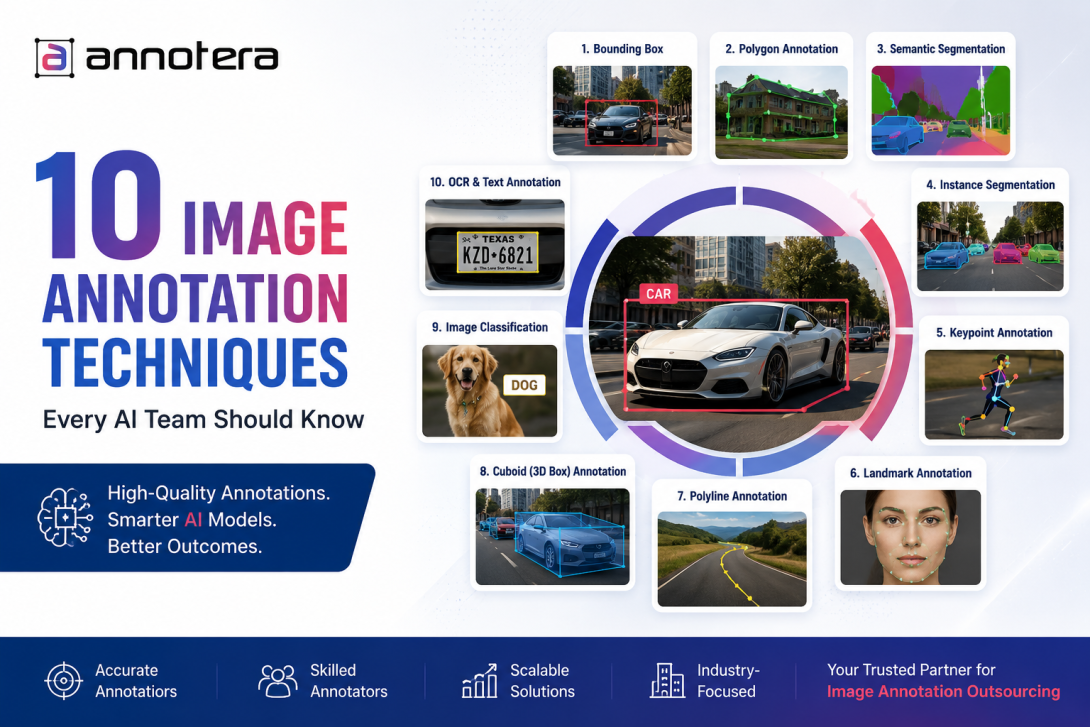
Artificial intelligence has transformed industries ranging from healthcare and retail to autonomous vehicles and manufacturing. However, the success of any computer vision model depends heavily on the quality of its training data. Even the most advanced AI algorithms cannot deliver reliable results if they are trained using poorly labeled images. This is where image annotation plays a critical role.
Image annotation is the process of labeling images so that AI models can recognize, classify, and interpret visual information accurately. Different AI applications require different annotation methods, and choosing the right technique significantly impacts model performance.
Whether you are building an object detection system, facial recognition software, or medical imaging solution, understanding the most common image annotation techniques is essential. In this guide, we'll explore ten image annotation techniques every AI team should know and explain how partnering with a professional image annotation company can accelerate AI development while maintaining high-quality datasets.
Why Image Annotation Matters
Computer vision models learn by analyzing thousands—or even millions—of labeled images. The annotation process teaches AI systems how to identify objects, boundaries, movements, and relationships within an image.
High-quality annotation helps AI models:
- Improve prediction accuracy
- Reduce false positives and false negatives
- Perform consistently across real-world scenarios
- Adapt to complex environments
- Accelerate machine learning development
Many organizations now choose image annotation outsourcing because managing large-scale labeling projects internally can be expensive, time-consuming, and difficult to scale.
1. Bounding Box Annotation
Bounding box annotation is one of the most widely used techniques in computer vision.
In this method, rectangular boxes are drawn around objects of interest so AI models can learn object detection and localization.
Common applications:
- Autonomous driving
- Retail shelf monitoring
- Traffic surveillance
- Wildlife monitoring
- Inventory management
Bounding boxes are relatively quick to create, making them ideal for large datasets where speed and scalability are important.
2. Polygon Annotation
Some objects have irregular shapes that cannot be accurately represented using rectangular boxes. Polygon annotation allows annotators to create precise outlines around an object's edges.
This technique improves annotation accuracy for complex objects such as:
- Buildings
- Road signs
- Trees
- Machinery
- Human bodies
Polygon annotation is commonly used when pixel-level precision directly impacts model performance.
3. Semantic Segmentation
Semantic segmentation labels every pixel in an image according to its class.
Instead of simply identifying an object, the model learns exactly which pixels belong to categories such as:
- Road
- Sky
- Pedestrian
- Vehicle
- Building
This detailed labeling is essential for applications requiring scene understanding.
Industries using semantic segmentation:
- Autonomous vehicles
- Agriculture
- Robotics
- Medical imaging
- Smart cities
4. Instance Segmentation
Although similar to semantic segmentation, instance segmentation separates individual objects belonging to the same category.
For example, if five people appear in one image, semantic segmentation labels them all as "person," whereas instance segmentation assigns each person a unique identity.
This technique is valuable for:
- Crowd analytics
- Warehouse automation
- Manufacturing inspection
- Retail analytics
5. Keypoint Annotation
Keypoint annotation identifies important landmarks on objects by placing labeled points at predefined locations.
For humans, keypoints often include:
- Eyes
- Nose
- Shoulders
- Elbows
- Knees
- Ankles
For vehicles, keypoints may represent headlights, mirrors, wheels, or license plates.
This annotation method supports:
- Human pose estimation
- Gesture recognition
- Sports analytics
- Fitness applications
- Augmented reality
6. Landmark Annotation
Landmark annotation is commonly used in facial recognition and biometric systems.
Rather than outlining entire objects, annotators mark critical facial features such as:
- Eyes
- Mouth
- Nose
- Jawline
- Eyebrows
These landmarks help AI models understand facial geometry, expressions, and identity.
Applications include:
- Face authentication
- Emotion recognition
- Driver monitoring systems
- Healthcare diagnostics
7. Polyline Annotation
Polyline annotation labels continuous linear structures by drawing connected line segments.
It is especially useful for objects that have long or curved shapes.
Examples include:
- Roads
- Railway tracks
- Pipelines
- Electrical wires
- River boundaries
GIS platforms, mapping solutions, and autonomous navigation systems frequently rely on polyline annotations.
8. Cuboid (3D Box) Annotation
Cuboid annotation extends traditional bounding boxes into three-dimensional space.
Instead of drawing a flat rectangle, annotators create a 3D box that represents an object's position, orientation, and depth.
Cuboid annotation is widely used in:
- Autonomous vehicles
- Robotics
- Warehouse automation
- Drone navigation
Because it captures depth information, AI models gain a better understanding of real-world environments.
9. Image Classification Annotation
Image classification is the simplest annotation technique.
Instead of labeling individual objects, the entire image receives one or multiple category labels.
Examples include:
- Cat
- Dog
- Damaged product
- Healthy plant
- Tumor detected
Classification is commonly used for:
- Medical diagnosis
- Product categorization
- Content moderation
- Document processing
Although straightforward, high-quality classification datasets remain essential for many AI systems.
10. OCR and Text Annotation
Many AI applications need to understand text within images.
OCR (Optical Character Recognition) annotation labels printed or handwritten text so AI can recognize and interpret written information.
Common use cases include:
- Identity document verification
- Invoice processing
- License plate recognition
- Postal automation
- Historical document digitization
Combining OCR with object detection often produces highly capable intelligent document processing systems.
Choosing the Right Annotation Technique
Selecting the appropriate annotation method depends on several factors:
- AI application requirements
- Desired prediction accuracy
- Dataset complexity
- Budget
- Project timeline
- Model architecture
Many AI projects actually combine multiple annotation techniques. For example, an autonomous driving dataset may include bounding boxes, semantic segmentation, cuboid annotation, and keypoint labeling within the same dataset.
Working with an experienced data annotation company ensures that each dataset is labeled using the most appropriate methodology while maintaining strict quality assurance standards.
Why Many Businesses Choose Image Annotation Outsourcing
As AI projects continue to grow, annotation requirements become increasingly complex. Managing thousands of annotators, maintaining consistency, and performing quality checks internally can significantly increase operational costs.
This is why many organizations prefer data annotation outsourcing to trusted service providers.
Professional annotation partners offer:
- Skilled annotation specialists
- Multi-stage quality assurance
- Scalable workforce
- Faster project turnaround
- Domain-specific expertise
- Secure data handling
- Support for multiple annotation formats
An experienced image annotation company can also customize annotation workflows based on industry requirements, whether for healthcare, automotive, retail, agriculture, or industrial AI.
How Annotera Delivers High-Quality Image Annotation
At Annotera, we understand that accurate training data is the foundation of successful computer vision models. Our team combines human expertise with rigorous quality assurance processes to deliver reliable image annotation at scale.
From bounding boxes and semantic segmentation to keypoint, polygon, cuboid, and OCR annotation, we support AI teams across diverse industries with customized workflows that meet project-specific requirements. Whether you're developing next-generation robotics, autonomous systems, medical AI, or retail analytics, our image annotation outsourcing services help reduce operational overhead while ensuring consistent, high-quality datasets.
Conclusion
Image annotation is far more than simply drawing boxes around objects—it is the process that enables AI systems to understand and interpret the visual world. Each annotation technique serves a unique purpose, from basic image classification to advanced instance segmentation and 3D cuboid labeling.
Selecting the right technique directly influences model accuracy, efficiency, and real-world performance. As AI projects become more sophisticated, partnering with a trusted data annotation company for data annotation outsourcing provides the scalability, expertise, and quality control needed to build dependable computer vision solutions. By leveraging the capabilities of a specialized image annotation company, organizations can accelerate AI development and deliver models that perform with confidence across real-world applications.