

Buy Now: https://www.eastwestoffroad.com/product/y-link-steering-for-gm-1-ton-tre
A Y link steering kit is a popular heavy-duty steering solution for custom 4x4s, solid-axle builds, rock crawlers, and off-road trucks where conventional crossover steering can be difficult to package. By combining the tie rod and drag-link functions in a Y-style arrangement and using larger GM 1 ton tie rod ends, this steering architecture can provide a practical option for builders working around leaf springs, limited steering-arm locations, Dana 44 or Dana 60 front axles, and other custom suspension constraints.
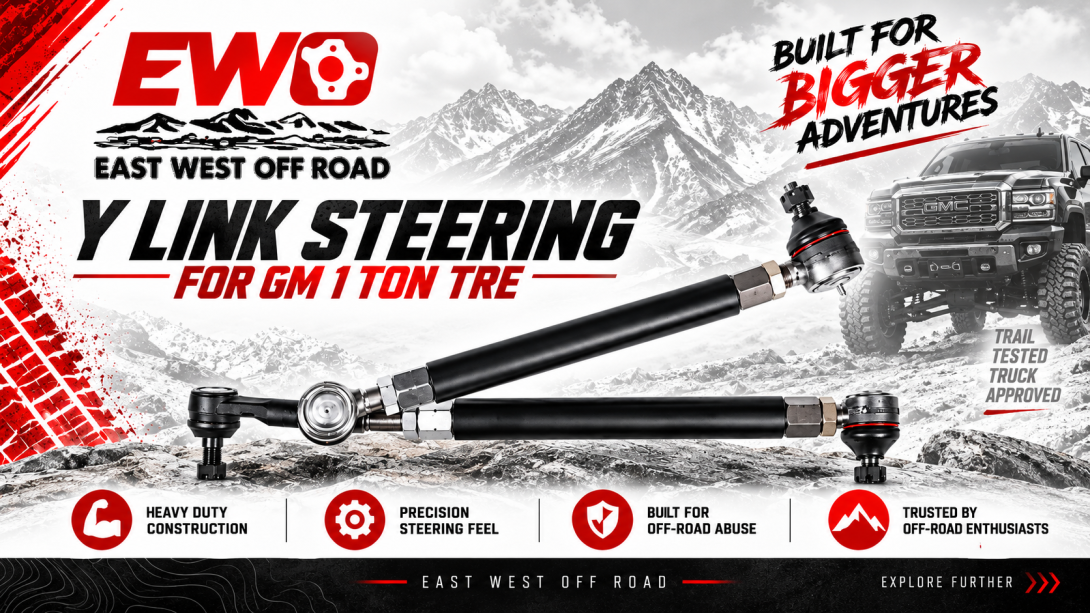
East West Off Road currently offers the E90065 Y LINK STEERING FOR GM 1 TON TRE, giving buyers a purpose-built starting point for a heavy-duty Y-link steering project based around GM 1-ton steering ends.
What Is a Y Link Steering Kit?
A Y link steering kit uses a steering layout where the drag link connects into the tie-rod assembly rather than operating as a completely separate crossover link running directly from the pitman arm to an independent steering arm.
Viewed from above, the steering links form a shape similar to the letter “Y.”
The layout generally consists of:
- A main tie rod connecting the steering knuckles
- A drag link extending from the pitman-arm side
- A Y-link connection between the drag link and tie-rod assembly
- Heavy-duty tie rod ends at the steering connections
- Adjustment points for steering alignment
The exact configuration varies by axle, knuckles, suspension design, and manufacturer.
Why Y-Link Steering Exists
Crossover steering works extremely well in many custom 4x4 applications, but there are builds where packaging a separate crossover drag link can become difficult.
Common obstacles include:
- Leaf springs
- Limited steering-arm locations
- Differential-cover clearance
- Suspension brackets
- Shock placement
- Track-bar placement
- Existing knuckle design
- Wheel and tire clearance
A Y-link arrangement can provide another way to route steering forces through the front axle when these components make a traditional crossover layout difficult to package.
Y-Link Steering vs. Crossover Steering
These terms are often used together, but they describe different steering layouts.
Y-Link Steering
In a Y-link system, the drag link joins into the tie-rod assembly.
Potential advantages include:
- Compact packaging
- Ability to work with limited knuckle mounting locations
- Compatibility with certain leaf-spring builds
- Heavy-duty GM 1-ton TRE options
- OTK or UTK configurations in suitable systems
Crossover Steering
A crossover system typically uses a separate drag link that runs from the pitman arm to a steering arm or knuckle on the opposite side.
It can offer favorable steering geometry when properly designed, but it may require additional steering-arm space or high-steer hardware.
Neither layout is universally better.
The correct choice depends on the axle, suspension, knuckles, lift height, packaging space, and intended use.
What Are GM 1 Ton Tie Rod Ends?
GM 1 ton tie rod ends are oversized steering joints commonly used in custom off-road steering systems.
They became popular because builders wanted:
- Larger steering joints
- Heavy-duty tapered studs
- Widely recognized replacement formats
- Stronger steering components than many factory light-duty systems
GM 1-ton TRE architecture is now common across custom Jeep, GM, Ford, Dodge, and fabricated axle applications.
The “1 ton” description refers to the heavy-duty truck-style steering component category rather than changing the vehicle's payload rating.
Why GM 1-Ton TREs Are Popular in Off-Road Steering
A larger steering system can be useful when a vehicle has:
- Oversized tires
- Heavy beadlock wheels
- Low-range gearing
- Increased front axle weight
- Rock-crawling use
- Custom suspension
- Frequent trail impacts
Large tires create additional steering leverage at the knuckles.
When a tire is loaded against an obstacle, those forces are transmitted through the tie rod, drag link, tie rod ends, pitman arm, and steering box.
GM 1 Ton TRE Steering Kit
A GM 1 ton TRE steering kit is especially attractive to builders who want a heavy-duty conventional tie-rod-end system rather than a heim-joint steering arrangement.
Important characteristics to compare include:
- Joint size
- Taper compatibility
- Thread direction
- Available articulation
- Replacement availability
- Steering-link dimensions
- OTK or UTK configuration
The complete steering package matters more than any one component.
1 Ton Tie Rod Steering Kit
A 1 ton tie rod steering kit generally refers to a steering system built around heavy-duty truck-style tie rod ends and substantially stronger linkage than many factory light-duty steering systems.
Applications can include:
- Solid-axle Jeeps
- Early Broncos
- GM trucks
- Custom rock crawlers
- Toyota axle swaps
- Fabricated buggies
- Dana 44 builds
- Dana 60 builds
Exact compatibility depends on the axle and steering-knuckle configuration.
1 Ton Tie Rod and Drag Link Kit
A 1 ton tie rod and drag link kit upgrades both major steering paths rather than replacing only a single tie rod.
This can make sense when:
- Both existing steering links are light duty
- Larger tires are installed
- The vehicle sees serious trail use
- The axle is being swapped
- Steering geometry is being redesigned
A matched system can also simplify future replacement-part planning.
What Makes Y-Link Steering Different From a Standard Tie Rod and Drag Link?
The primary difference is where the drag link connects.
In a conventional crossover layout, the drag link usually connects independently to the steering knuckle or a steering arm.
In a Y-link system, the drag-link connection is integrated into the tie-rod arrangement.
This changes:
- Steering-link routing
- Available clearance
- Link movement
- Packaging around suspension components
The layout should therefore be chosen according to the complete suspension and axle system.
Dana 44 Steering Kit Considerations
A Dana 44 steering kit is a common upgrade for older Jeeps, GM trucks, Broncos, Scouts, custom 4x4s, and axle-swap projects.
Dana 44 configurations vary significantly depending on:
- Manufacturer
- Model year
- Knuckles
- Flat-top or non-flat-top design
- Steering-arm configuration
- Wheel package
A Y-link system can be relevant when the chosen Dana 44 setup has limited room for a traditional crossover link.
Dana 44 Y Link Steering
Dana 44 Y link steering can be attractive for custom builders working with:
- Factory-style steering locations
- Leaf-spring suspensions
- Limited steering-arm space
- Heavy-duty GM 1-ton TREs
However, “Dana 44” alone does not establish fitment.
Ford, Jeep, GM, Dodge, International, and aftermarket Dana 44 assemblies may use different knuckles and steering geometry.
Dana 60 Steering Kit Considerations
A Dana 60 steering kit is commonly used in heavier builds involving:
- Large tires
- One-ton axles
- Rock crawling
- Custom trucks
- Buggies
- Heavy off-road vehicles
Dana 60 axles also exist in multiple versions.
Important differences can include:
- Kingpin vs. ball-joint design
- Ford vs. GM/Dodge knuckles
- Steering-arm provisions
- High-steer capability
- Leaf-spring clearance
The steering kit needs to match the actual axle rather than simply the Dana 60 name.
Dana 60 Y Link Steering
Dana 60 Y link steering can provide another packaging option where a traditional crossover arrangement is difficult because of suspension or steering-arm placement.
Current aftermarket Y-link systems are often marketed specifically toward situations where leaf springs or limited knuckle mounting points make crossover steering difficult.
For a custom Dana 60 build, the key question is not simply whether Y-link steering can be used, but whether the complete geometry works with the axle and suspension.
Y-Link Steering for Leaf-Spring Builds
Leaf springs can create significant steering-packaging challenges.
The spring may occupy space that would otherwise be used by:
- Drag link
- Tie rod
- High-steer arm
- Track bar
- Shock
This is one reason Y-link steering remains relevant in custom solid-axle builds.
The layout can sometimes use available steering locations more efficiently than a separate crossover system.
Over the Knuckle Steering Kit
An over the knuckle steering kit, often shortened to OTK, places the tie-rod connection above the steering knuckle in a compatible setup.
Potential reasons builders consider an OTK layout include:
- Increased steering-link height
- More trail clearance
- Different steering geometry
- Better packaging in certain lifted builds
However, moving a steering link higher can create new clearance issues elsewhere.
OTK Steering Kit
An OTK steering kit should be evaluated against:
- Wheel clearance
- Differential-cover clearance
- Suspension brackets
- Sway-bar links
- Track-bar placement
- Full steering travel
An OTK layout is not automatically superior to UTK.
It simply places the steering linkage in a different location.
Under the Knuckle Steering Kit
An under the knuckle steering kit keeps the tie rod below the steering knuckle.
This arrangement may provide:
- Simpler packaging
- More wheel clearance in some applications
- Compatibility with factory-style steering locations
- Easier integration into certain custom axle builds
The tradeoff is that the steering link may sit lower and therefore be more exposed to trail obstacles.
UTK Steering Kit
A UTK steering kit can be the better option when an OTK system would interfere with wheels, differential covers, suspension components, or other front-end hardware.
The correct choice depends on actual measured clearance throughout steering and suspension movement.
OTK vs. UTK Steering: Which Is Better?
Neither is universally better.
Consideration
OTK
UTK
Tie rod position
Higher
Lower
Trail clearance
Can improve
More exposed
Wheel clearance
Can become tighter
May be easier
Differential clearance
Must be verified
Must be verified
Packaging
Depends on suspension
Depends on suspension
Best choice
Vehicle-specific
Vehicle-specific
The correct layout is the one that provides safe, unrestricted steering and suspension travel on the actual vehicle.
Why Steering Geometry Matters More Than Component Size
Heavy-duty steering components cannot compensate for poor geometry.
A properly designed system needs to consider:
- Drag-link angle
- Tie-rod location
- Pitman-arm position
- Steering-arm position
- Suspension travel
- Track-bar geometry where applicable
- Ackermann geometry
- Steering range
A larger tie rod can increase component strength, but the vehicle still needs predictable steering behavior.
Track Bar and Drag Link Relationship
On vehicles using a track bar, the drag link and track bar need to be considered together.
Both move through arcs as the axle travels.
Large differences in their position or movement can contribute to unwanted steering input during suspension movement.
A Y-link or OTK steering conversion should therefore be evaluated as part of the entire front suspension.
Heavy Duty Off Road Steering Kit
A heavy duty off road steering kit is generally intended for vehicles that experience loads well beyond normal street driving.
Typical applications include:
- Rock crawlers
- Mud trucks
- Trail rigs
- Overlanding vehicles
- Solid-axle swaps
- Custom 4x4s
Off-road steering components may face both steering loads and direct physical impacts.
Why Larger Tires Increase Steering Load
A larger tire creates more leverage around the steering axis.
Other factors can increase load further:
- Greater tire weight
- Heavy wheels
- Low tire pressure
- Beadlocks
- High-traction surfaces
- Low-range gearing
The steering system should therefore be considered along with tire size and intended use.
Rock Crawling and GM 1-Ton Steering
Rock crawling creates extreme low-speed steering conditions.
A tire may be pressed against a rock while steering input is applied.
At the same time, the tie rod may be exposed to direct contact with trail obstacles.
This is one reason heavy-duty GM 1-ton steering components are popular in crawler builds.
Any steering system should still be inspected after a significant impact.
1 Ton TRE Kit vs. Heim Steering
A 1 ton TRE kit and a heim-joint steering system represent two different approaches.
GM 1-Ton TRE System
Potential advantages include:
- Conventional tapered steering joints
- Familiar service architecture
- Dust boots
- Common use in road/trail builds
Heim-Joint Steering
Potential advantages can include:
- High articulation
- Custom fabrication flexibility
- Multiple mounting possibilities
Which approach is appropriate depends on the vehicle, intended use, local requirements, and engineering of the complete system.
GM 1 Ton Tie Rod End Kit
A GM 1 ton tie rod end kit can be useful for builders fabricating or maintaining a custom steering system.
However, the joints should be selected as part of a complete matched design.
Important factors include:
- Correct taper
- Correct thread direction
- Correct articulation
- Compatible steering links
- Safe clearance
Mixing unrelated steering components without verifying compatibility can create unsafe steering behavior.
Y-Link Steering and Tie-Rod Roll
One characteristic buyers researching Y-link steering may encounter is tie-rod rotation or “roll.”
Because the drag link connects into the tie-rod assembly, steering input can sometimes try to rotate the main link depending on the joint arrangement and geometry.
The amount of movement depends on:
- Steering-joint design
- Link geometry
- Component condition
- System layout
A quality system should minimize unwanted movement while allowing the articulation required for steering and suspension travel.
Y-Link Steering and Bump Steer
Bump steer describes unwanted steering input as the suspension moves through its travel.
It is primarily a geometry issue rather than simply a component-strength issue.
Factors can include:
- Drag-link angle
- Track-bar relationship
- Steering-arm position
- Suspension travel
- Lift height
A 1 ton steering kit should not be advertised as a guaranteed fix for bump steer.
Correct geometry still needs to be established.
GM 1 Ton Steering Kit for Dana 44 Builds
A GM 1 ton steering kit can be a popular upgrade on Dana 44-based projects because heavy-duty GM-style tie rod ends are widely used in custom steering.
Before selecting a kit, verify:
- Knuckle design
- Existing steering taper
- Wheel clearance
- Differential-cover clearance
- Suspension design
Some custom steering conversions may require professional machining or fabrication.
GM 1 Ton Steering Kit for Dana 60 Builds
Dana 60 builds typically involve heavier axles and larger tires, making heavy-duty steering particularly important.
However, Dana 60 steering fitment can vary widely by manufacturer and generation.
A builder should verify:
- Knuckle style
- Steering-arm provisions
- Suspension type
- Wheel dimensions
- Tie-rod location
A “Dana 60” label alone is not enough to guarantee fitment.
Steering Clearance at Full Lock
A heavy-duty steering system should have sufficient clearance throughout its entire steering range.
Potential interference areas include:
- Differential cover
- Wheel
- Tire
- Leaf spring
- Shock
- Sway bar
- Track bar
- Suspension brackets
A steering system that looks clear with the wheels centered may still contact another component at full lock.
Suspension Travel Clearance
Clearance also needs to exist as the suspension compresses and extends.
This is especially important in off-road vehicles with significant articulation.
The steering links should not bind or contact suspension components throughout intended travel.
Wheel Backspacing and Steering Clearance
Wheel backspacing affects how close the inner wheel sits to steering components.
Large GM 1-ton tie rod ends may require more clearance than lighter factory steering ends.
Wheel fitment should therefore be verified before finalizing a steering configuration.
Differential Cover Clearance
Aftermarket differential covers can be larger than factory covers.
A heavy cast or fabricated cover may occupy space close to the tie rod.
This can be especially important when choosing between OTK and UTK positioning.
The steering and differential-cover combination should be checked together.
Why a Y-Link Kit Is Not “Universal”
Y-link steering is often used in custom fabrication, but that does not mean every kit fits every vehicle.
Compatibility can depend on:
- Axle
- Knuckles
- Pitman arm
- Suspension
- Wheel configuration
- Steering-link length
- Steering taper
- Available clearance
East West Off Road's current E90065 page identifies the product as Y LINK STEERING FOR GM 1 TON TRE, but buyers should confirm their specific axle and vehicle configuration before purchase.
East West Off Road Y-Link Steering
The current East West Off Road product is:
Y LINK STEERING FOR GM 1 TON TRE
Item Number: E90065
The product is positioned within EWO's steering-kit category and is currently listed as an in-stock GM 1-ton TRE Y-link steering option.
For a custom build, the 1 ton steering kit approach can provide a heavy-duty starting point while still requiring vehicle-specific fitment verification.
What to Check Before Buying a Y-Link Steering System
Check
Why It Matters
Front axle
Dana 44, Dana 60, or other axle affects fitment
Knuckle design
Determines available steering connections
Suspension type
Leaf springs and links affect routing
Existing taper
Must match steering-end architecture
OTK or UTK position
Changes link height and clearance
Wheel backspacing
Affects TRE clearance
Differential cover
Can interfere with tie rod
Pitman-arm location
Affects drag-link geometry
Track bar
Important on track-bar-equipped suspensions
Full steering travel
Ensures no binding
Suspension travel
Ensures links remain clear
Intended use
Determines appropriate steering architecture
Common Mistake: Buying by Axle Name Alone
Two Dana 44 axles can have different:
- Knuckles
- steering arms
- widths
- wheel patterns
- suspension configurations
The same is true for Dana 60 axles.
Always verify the actual axle hardware.
Common Mistake: Choosing OTK Only for More Clearance
OTK can raise the steering link, but it can also move it closer to:
- Wheels
- differential cover
- springs
- other suspension components
Higher is not automatically better.
Common Mistake: Assuming 1-Ton TREs Fix Steering Problems
Stronger tie rod ends do not automatically correct:
- Poor alignment
- Worn steering box
- Incorrect geometry
- Damaged knuckles
- Loose wheel bearings
A steering system should be diagnosed before parts are replaced.
Common Mistake: Ignoring Replacement Parts
Off-road steering components are wear items.
Before buying, consider how replacement joints and related service parts will be sourced later.
Long-term serviceability matters just as much as initial strength.
Is Y-Link Steering Good for Daily Driving?
A properly engineered Y-link system may be used on vehicles that see road use, depending on the complete vehicle configuration and local requirements.
Road-driven vehicles should prioritize:
- Predictable steering
- Correct alignment
- Minimal unwanted link movement
- Adequate clearance
- Secure joints
- Proper suspension geometry
Professional inspection is particularly important for any custom steering system used at road speeds.
Is Y-Link Steering Good for Rock Crawling?
It can be a strong option when the layout solves packaging problems and works correctly with the axle and suspension.
Rock-crawling builds often value:
- Heavy-duty TREs
- Strong linkage
- Compact packaging
- Serviceable steering components
The complete design remains more important than the steering-layout name.
Frequently Asked Questions (FAQs)
What is a Y link steering kit?
A Y-link steering kit is a steering system where the drag link joins the tie-rod assembly, creating a Y-shaped steering layout rather than a fully independent crossover drag link.
What is EWO E90065?
E90065 is East West Off Road's current Y LINK STEERING FOR GM 1 TON TRE product.
What are GM 1 ton tie rod ends?
They are heavy-duty truck-style steering joints commonly used in custom off-road steering systems.
Does “1 ton” increase my vehicle's weight rating?
No. The term refers to the heavy-duty steering component category, not the vehicle's payload or GVWR.
Why choose Y-link steering?
Y-link steering can help solve packaging challenges where leaf springs, limited knuckle mounting points, or other components make conventional crossover steering difficult.
Is Y-link steering the same as crossover steering?
No. In Y-link steering, the drag link connects into the tie-rod assembly. In a conventional crossover layout, the drag link generally connects independently to the opposite knuckle or steering arm.
Is Y-link steering good for a Dana 44?
It can be appropriate for some Dana 44 builds, but exact fitment depends on the knuckles, suspension, wheels, and steering geometry.
Is Y-link steering good for a Dana 60?
It can be used in some Dana 60 applications, especially where packaging conventional crossover steering is difficult. Exact axle configuration must be verified.
Will a Dana 44 Y-link kit automatically fit every Dana 44?
No. Dana 44 axles vary by manufacturer, year, knuckle type, and vehicle application.
Will a Dana 60 Y-link kit fit every Dana 60?
No. Dana 60 axles vary substantially in knuckle, steering-arm, and suspension configurations.
What is OTK steering?
OTK means Over the Knuckle, where the steering link mounts above the steering knuckle in a compatible configuration.
What is UTK steering?
UTK means Under the Knuckle, where the steering link mounts below the steering knuckle.
Is OTK steering better than UTK?
Not universally. OTK can increase link height but may create wheel or component-clearance issues. The correct option depends on the vehicle.
Does OTK steering provide more ground clearance?
It can position the steering link higher, which may improve clearance, but complete suspension and wheel fitment still need to be checked.
Are GM 1-ton TREs stronger than factory steering ends?
They are larger heavy-duty steering joints commonly used as an upgrade in custom builds, but actual strength depends on the complete component design and application.
Is a GM 1-ton TRE steering system good for large tires?
It can be appropriate for large-tire off-road builds when the entire steering and axle system is properly engineered.
Is Y-link steering good with leaf springs?
Y-link layouts are often considered when leaf springs make conventional crossover-steering packaging difficult.
Does a Y-link steering kit fix bump steer?
Not automatically. Bump steer is strongly influenced by steering and suspension geometry.
Can Y-link steering have tie-rod roll?
Some Y-link layouts can experience rotational movement in the tie rod depending on joint design and geometry. The complete system needs to be properly engineered.
Can I use a GM 1-ton TRE kit with a track bar?
Potentially, but drag-link and track-bar geometry need to be considered together.
Does wheel backspacing matter?
Yes. Larger steering ends may require additional inner-wheel clearance.
Does differential-cover size matter?
Yes. Large aftermarket differential covers can reduce tie-rod clearance.
Can I use an aftermarket differential cover with Y-link steering?
Possibly, but actual tie-rod clearance should be checked through the steering range.
Is a Y-link system good for a rock crawler?
It can be a practical heavy-duty solution when its packaging and geometry suit the axle and suspension.
Is a Y-link system good for an axle swap?
It can be useful in custom axle-swap builds, but steering geometry, link length, suspension layout, and joint compatibility all need to be verified.
Is EWO's Y-link kit confirmed for every Dana 44 and Dana 60?
The current EWO product page identifies E90065 as Y LINK STEERING FOR GM 1 TON TRE, but it does not publish universal Dana 44/Dana 60 fitment in the product text reviewed here. Specific axle compatibility should be confirmed before ordering.
Should custom steering be professionally installed?
Professional fabrication, installation, alignment, or final inspection is recommended because the tie rod, drag link, steering ends, and related components directly affect vehicle control.