

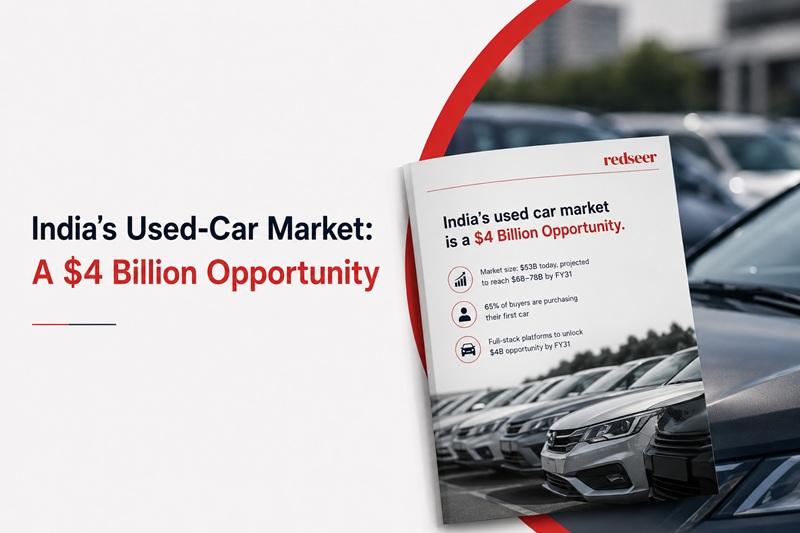
India's used car market has stopped being a side story in the country's automotive world. A recent report from Redseer Strategy Consultants puts the industry's current value at around $53 billion, with room to grow to $68 to $78 billion by FY31. If that holds, India becomes the third largest used car market in the world, behind only the US and China. Numbers like that don't just describe a market. They describe a turning point, and turning points are exactly where automotive strategy consulting in India starts to matter.
A Market Still Running on Trust Deficits
Nearly four out of five used car transactions in India still happen through unorganized channels. Individual sellers, local brokers, small lots on the side of the road. Independent research firms mostly agree with this picture too. Several place unorganized dealer share somewhere between 60 and 71 percent of the market, even with organized players gaining ground. Redseer's own satisfaction numbers make the cost of this fragmentation pretty clear. The channels that dominate by volume are also, almost every time, the ones giving buyers the worst experience.
This isn't really a demand problem. It's a design problem. Buyers are already showing up. Redseer's research found that 65 percent of used car purchases are made by first time buyers, which means the market is absorbing a wave of people with no prior used car experience to draw on and very little patience for confusion. Put that together with unorganized supply and high emotional and financial stakes, and you get exactly the kind of gap that mobility consulting in India is built to close. It's less about fine tuning an existing playbook and more about writing one for a market that never really had organized rules to begin with.
Financing Was the Missing Piece. Now It Isn't.
For years, the single biggest constraint on India's used car growth wasn't demand or even supply. It was financing. Buyers wanted cars, but lenders were cautious about backing them. That's shifting quickly now. NBFC loan sanctions for used vehicles grew substantially between FY22 and FY24, and financing penetration is expected to climb from roughly 20 to 30 percent today toward 30 to 40 percent by FY27, according to Redseer's projections. Digital KYC and real time vehicle evaluation are removing a lot of the friction that used to make used car loans slow and risky to underwrite.
This matters a lot for anyone working in financial services consulting in India, because used car financing isn't a niche product line anymore. It's becoming a real profit engine on its own. Platforms that can bundle financing, warranty, and resale into one transaction aren't just making things easier for the customer. They're building a second revenue stream. That's a very different conversation than the one financing teams were having even a few years ago, which is part of why used car financing in India has quietly turned into one of the more consulting heavy corners of the sector.
The Full Stack Model Is a Consulting Problem Before It's an Operating One
Redseer's report makes its strongest point here. Full stack operators, the ones controlling sourcing, refurbishment, financing, and sales all under one roof, are the companies actually turning trust into growth. Their reported NPS scores sit above 75 percent, well ahead of both OEM channels and classifieds. But the report is just as clear that building this model is hard. Refurbishment infrastructure takes years to get right. Pricing and inspection technology can't just be bought off a shelf. Working capital needs alone keep most casual entrants out of the game.
That mix of high payoff and high difficulty is exactly the territory where automotive retail consulting in India adds real value. Not by telling a company to simply "go full stack," but by helping sequence how sourcing, refurbishment, and financing get built without burning through capital before scale actually arrives. It's also why full stack used car platforms are increasingly treated as their own strategic category, rather than a variation of a classifieds site or a dealership chain. The economics, the org design, and the capital requirements are just different animals.
What This Means for the India Growth Strategy Conversation
Put it all together and the signals line up. Replacement cycles are getting shorter. The used to new car ratio is rising as vehicle ownership matures. Financing access is improving. Regulatory tailwinds from the vehicle scrappage policy and VAHAN digitization are pushing things along too. No single one of these would justify a wave of specialized advisory work on its own. Together, they explain why growth strategy consulting projects in India, particularly in automotive and nearby consumer sectors, have picked up noticeably. Investors and operators are trying to time their entry into a market that is formalizing in real time, not one that has already settled.
It's worth pointing out how closely this mirrors patterns seen across consumer internet consulting in India more broadly. A large, historically informal market getting reshaped by digital infrastructure, trust mechanisms, and embedded financial services, all happening at once. The used car sector isn't really a special case here. It's a fairly clean example of a pattern that keeps showing up across India's consumer economy.
The Real Opportunity Isn't the Market Size. It's the Timing.
Redseer frames full stack players as controlling roughly 2 percent of the used car market today, with room to reach 5 to 6 percent nationally, and 14 to 16 percent in India's top eight cities, by FY31. That would unlock close to $4 billion in addressable GMV. Whether the number lands exactly on target matters less than the direction it's pointing in. Toward a market where the operators, and the automotive consulting firms in India advising them, who move deliberately now will be the ones setting the terms of competition later.
The shift from unorganized to organized in India's used car market isn't going to complete itself. It's being built one financing product, one refurbishment center, and one trust signal at a time. That's a strategy problem just as much as it's a market one.