

Industrial enterprises are under increasing pressure to improve asset reliability, reduce unplanned downtime, control maintenance costs, and maximize the value of critical infrastructure. As physical assets become more connected and operational environments become more complex, traditional maintenance approaches are no longer sufficient. This is driving organizations toward Asset Performance Management (APM) platforms that combine asset data, analytics, automation, and advanced technologies to improve operational decision-making.
The growing adoption of connected sensors, industrial IoT, artificial intelligence, and advanced analytics is transforming how enterprises monitor and manage asset performance. Technologies such as digital twin and predictive maintenance are becoming increasingly important within modern APM strategies, helping organizations move from reactive maintenance toward proactive and data-driven asset management.
Click Here For More Information: https://qksgroup.com/market-research/spark-matrix-asset-performance-management-q3-2025-8983
Why Is Asset Performance Management Becoming a Strategic Priority?
Asset-intensive organizations operate complex equipment and infrastructure where failures can result in significant operational, financial, and safety consequences. Unexpected equipment downtime can disrupt production schedules, increase maintenance expenses, affect customer commitments, and reduce overall asset utilization.
APM platforms provide a centralized framework for monitoring asset health, assessing operational risks, and optimizing maintenance strategies. These platforms aggregate information from sensors, control systems, enterprise applications, and other operational technologies to provide a unified view of asset performance.
The shift from reactive to proactive asset management is one of the most important changes taking place in industrial operations. Instead of waiting for equipment to fail, organizations can continuously assess asset conditions, identify emerging issues, prioritize maintenance activities, and make more informed lifecycle decisions.
This enables enterprises to improve reliability while aligning maintenance strategies with business and operational objectives.
How Digital Twin Technology Is Strengthening APM
A digital twin creates a virtual representation of a physical asset, system, or process and uses operational data to reflect its real-world condition and behavior. Within APM environments, digital twin capabilities can help organizations understand how assets perform under different operating conditions.
By integrating real-time and historical data, digital twin models can support asset simulations, performance analysis, scenario planning, and risk assessment. Organizations can use these insights to evaluate potential operational changes before implementing them on physical equipment.
Digital twin technology is helping APM platforms evolve from monitoring systems into intelligent decision-support environments. It can provide deeper visibility into asset behavior and help engineering and maintenance teams understand the potential impact of changing operating conditions.
For complex industrial environments, this capability can support lifecycle planning, asset optimization, and reliability improvement while reducing the need for unnecessary physical intervention.
Check SPARK Plus Study Here: https://qksgroup.com/sparkplus?market-id=93&market-name=asset-performance-management
Predictive Maintenance Is Changing Maintenance Strategies
Traditional preventive maintenance typically relies on predefined schedules. While this approach can reduce certain failure risks, it may also result in unnecessary maintenance when equipment remains in good condition.
Predictive maintenance uses asset data and analytics to identify potential failures before they occur. By analyzing equipment conditions, historical performance, sensor readings, and operational patterns, organizations can identify anomalies and prioritize maintenance activities based on actual asset health.
When integrated into APM platforms, predictive maintenance can help maintenance teams determine which assets require immediate attention and which can continue operating safely.
This approach can improve maintenance planning, reduce unnecessary interventions, and support better allocation of maintenance resources. It can also help organizations transition toward condition-based maintenance strategies that are more closely aligned with real asset conditions.
Key Capabilities Driving Modern APM Platforms
Modern APM platforms are increasingly combining multiple capabilities into integrated environments. These capabilities include:
- Real-time condition monitoring for continuous visibility into asset health.
- Predictive and prescriptive analytics to identify risks and recommend appropriate actions.
- Reliability-centered maintenance (RCM) to align maintenance strategies with asset criticality and operational requirements.
- Risk analytics to identify potential operational and business impacts associated with asset failures.
- Digital twin simulation to model asset behavior and evaluate operational scenarios.
- Lifecycle strategy planning to support long-term asset investment and replacement decisions.
- Data integration to connect information from industrial systems, sensors, enterprise applications, and operational technologies.
The combination of these capabilities allows organizations to establish a more comprehensive approach to asset performance and reliability management.
What Business Benefits Can Organizations Expect?
The business value of APM extends beyond maintenance departments. Improved asset visibility and reliability can influence production efficiency, operational resilience, workforce productivity, and capital investment decisions.
Reducing unplanned downtime remains one of the most important objectives for enterprises adopting APM platforms. By identifying early indicators of asset degradation, organizations can intervene before failures disrupt operations.
APM can also support better maintenance prioritization. Instead of treating every maintenance requirement equally, teams can focus resources on assets that present the highest operational or financial risk.
Other potential benefits include improved asset utilization, optimized maintenance expenditure, stronger regulatory compliance, enhanced workforce productivity, and improved return on asset investment.
Competitive Landscape: Which Vendors Are Shaping the APM Market?
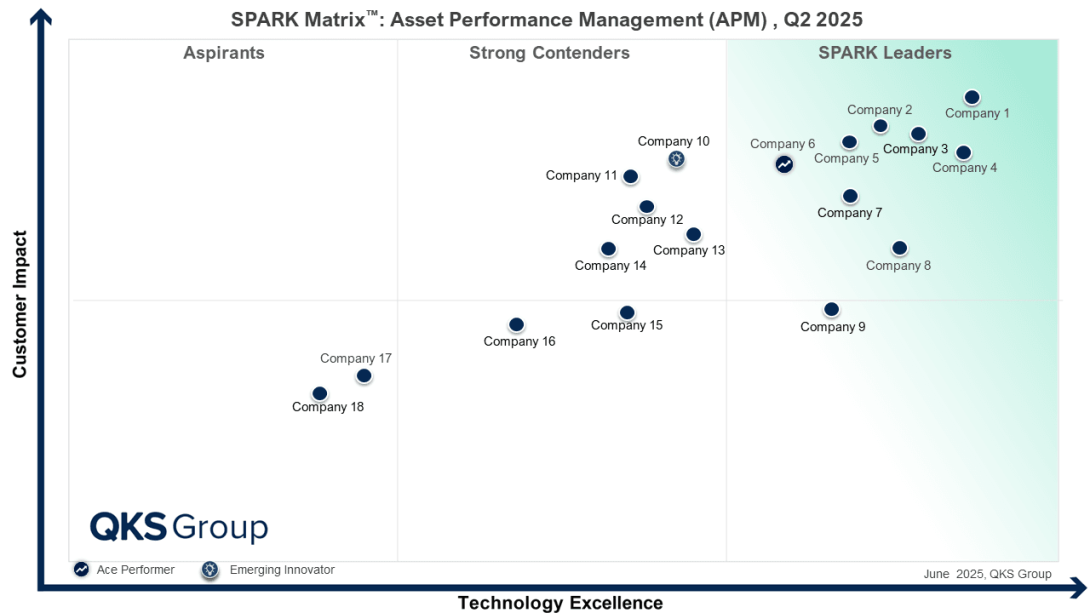
The Asset Performance Management market includes established industrial technology providers, enterprise software companies, and emerging technology vendors. QKS Group's research evaluates leading vendors based on their capabilities, competitive differentiation, and market positioning through its proprietary SPARK Matrix analysis.
The SPARK Matrix includes vendors such as ABB, AspenTech, AVEVA, Baker Hughes, Bentley Systems, Emerson, GE Vernova, Hexagon AB, Hitachi Energy, Honeywell, IBM, IPS Energy, Rockwell Automation, SAP, SymphonyAI Industrial, Upkeep, Xempla, and Yokogawa.
These vendors are strengthening their APM portfolios through capabilities spanning industrial analytics, reliability management, AI-enabled insights, condition monitoring, digital twins, predictive maintenance, and asset lifecycle optimization.
How Should Enterprises Evaluate an APM Platform?
Organizations considering APM adoption should evaluate platforms based on both technology capabilities and business requirements. Key evaluation criteria include:
- Integration with existing OT, IoT, ERP, EAM, and maintenance systems.
- Strength of predictive and prescriptive analytics.
- Digital twin and simulation capabilities.
- Asset health and condition monitoring functionality.
- Scalability across sites and asset classes.
- AI and machine learning capabilities.
- Risk and reliability management features.
- Ease of deployment and usability.
- Vendor ecosystem and implementation support.
- Ability to demonstrate measurable business value.
Selecting the right APM platform requires more than comparing individual features. Enterprises should assess how effectively a platform can integrate asset data, translate information into actionable intelligence, and support long-term reliability and lifecycle strategies.
Download Sample Report Here: https://qksgroup.com/download-sample-form/spark-matrix-asset-performance-management-q3-2025-8983
Conclusion
Asset Performance Management is becoming a critical component of modern industrial operations as enterprises seek greater reliability, efficiency, and resilience. The integration of digital twin technology, predictive maintenance, AI, analytics, and real-time monitoring is enabling organizations to move beyond traditional maintenance models and adopt more intelligent approaches to asset management.
QKS Group's Asset Performance Management research provides a comprehensive view of emerging technology trends, market dynamics, competitive positioning, and future market outlook. Through the proprietary SPARK Matrix analysis, technology users can assess vendor capabilities and competitive differentiation, while technology providers can better understand the evolving market landscape.
The future of asset management will increasingly depend on the ability to transform operational data into timely decisions. APM platforms that combine intelligent analytics, digital twins, predictive maintenance, and lifecycle optimization can help enterprises build more reliable assets and more resilient operations.