

DEEP BORING GUIDE • SUBMERSIBLE PUMP SELECTION
Which Submersible Pump is Best for Deep Boring in Pakistan?
A practical guide to matching pump size, HP, and phase to your boring depth — so you stop guessing and start getting water.
By Hikmat Pump Pvt Ltd • Islamabad, Pakistan • www.hikmatpump.com
You spent money on a boring, bought a pump, installed it — and a few months later, it burned out. Or worse, it’s running but barely delivering enough water to fill a bucket.
This is Pakistan’s most common pump problem. And almost every time, the culprit is not the brand, not the voltage, not even the motor quality. It’s a mismatch — the wrong submersible pump installed in the wrong boring depth.
Picking a submersible pump for deep boring is not the same as picking one for a shallow domestic boring. The depth changes everything: the horsepower you need, the pipe size, the phase of electricity, and even whether the pump will physically fit inside your borehole. Get any one of these wrong, and you’ve wasted both the pump and the boring.
This guide breaks it down clearly and practically. By the end, you’ll know exactly what to look for, and what to avoid.
What is a Submersible Pump and Why Does it Work for Deep Borings?
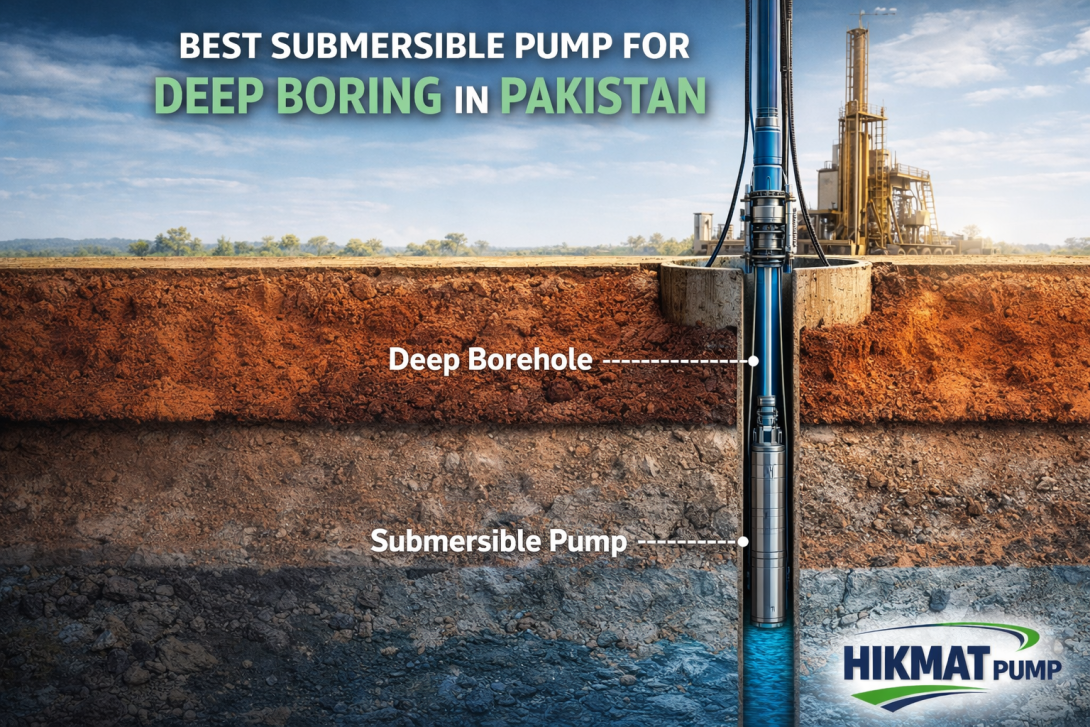
A submersible pump — also called a bore pump, deep well pump, or submersible motor pump — is exactly what the name says: it goes inside the borehole, submerged in water, and pushes water up to the surface from below.
This is fundamentally different from a surface pump or jet pump, which sits above ground and tries to suck water up. Suction has physical limits. Physics caps a surface pump’s practical pull at around 25–30 feet. Beyond that, it loses battle.
A submersible pump does not suck — it pushes. Since it operates from inside the water column itself, it can deliver water from depths of 100 feet, 200 feet, 300 feet, or even deeper, without losing prime or fighting atmospheric pressure.
For deep boring in Pakistan — whether for home water supply in Islamabad or Rawalpindi, or for agriculture and farm irrigation in Punjab and beyond — a submersible pump is not just the better choice. It is the only practical choice.
What Counts as “Deep Boring” in Pakistan?
Before you pick a pump, you need to know your depth category. In Pakistan, borings are generally classified like this
Boring Category Depth Range Common Use
Shallow Boring Up to 50 ft Small homes, gardens
Medium Boring 50 ft – 150 ft Houses, small farms
Deep Boring 150 ft – 300 ft Agricultural, residential in low water-table areas
Very Deep Boring 300 ft and above Industrial, commercial, agricultural tube wells
Why does this matter? Because Pakistan’s water table is not uniform. In Islamabad and Rawalpindi, you might hit water at 80–120 feet. In parts of central Punjab or arid zones, the same water-bearing layer can sit at 250–350 feet underground.
If you’re buying a pump rated for 100 feet and your boring is at 220 feet, the pump will run, overheat, and fail — often within the warranty period. Depth is not just a number to fill on a purchase form. It is the foundation of every decision that follows.
5 Key Factors That Determine the Right Submersible Pump for Your Boring
Every boring is different. But the selection always comes down to the same five factors. Nail these, and you’ll get a pump that runs strong for years. Skip even one, and you’re rolling the dice.
1. Boring Depth and Total Dynamic Head (TDH)
Most people only think about how deep their boring is but no one think about the Total Dynamic Head (TDH) — and there’s a critical difference.
TDH is not just the depth of your boring. It accounts for:
- The static water level (how deep the water sits inside the bore)
- The vertical lift to your tank or destination point
- Friction losses inside the delivery pipe
As a practical rule: always add 20–30% on top of your boring depth when calculating TDH. A boring that is 200 feet deep may effectively require a pump rated for 250+ feet of head. If your pump’s specifications say “max head 180 ft,” it will not perform reliably in a 200-foot boring, let alone sustain it long-term.
Rule of thumb: Never buy a pump that is “just enough” for your depth. Always buy one rated comfortably above your actual TDH. This single habit prevents most pump failures in Pakistan.
2. Horsepower (HP) — The Most Misunderstood Spec
HP is the engine of your pump. More depth demands more HP. But too much HP in a shallow boring wastes electricity and can damage your system. Here is the practical reference guide:
Boring Depth Recommended HP Typical Use Case
Up to 100 ft 0.5 – 1 HP Home boring, domestic water supply
100 ft – 200 ft 1 – 2 HP Residential, small agriculture
200 ft – 300 ft 2 – 3 HP Agricultural, deep home supply, tube wells
300 ft and above 3 – 5 HP Commercial, industrial, heavy farm irrigation
These are starting points, not absolute rules. Your actual flow rate requirement, pipe diameter, and delivery height will fine-tune the number. But this table alone can save you from the most common mistake in pump buying: under-powering a deep installation.
3. Single Phase vs. Three Phase — Match Your Electricity Supply
This is where a lot of buyers in Pakistan go wrong, especially in domestic settings.
Single phase (220V) power is what most homes are connected to. It works well for pumps up to 2 HP, which covers most residential deep borings up to 200 feet. Three phase (380–440V) is typically found in agricultural areas, industrial zones, and commercial connections. It handles higher HP motors more efficiently and is the right choice for larger agricultural submersible pumps.
Power Supply Suitable HP Range Best For
Single Phase (220V) 0.5 HP – 2 HP Home, domestic use, small borings
Three Phase (380–440V) 1.5 HP – 10+ HP Agriculture, industrial, deep tube wells
Installing a three-phase motor on a single-phase connection — or the reverse — will damage the motor. Always confirm your electricity connection type before purchasing. If you are in an area with frequent load shedding, also check whether the pump includes thermal overload protection or a built-in control panel, both of which protect the motor during voltage fluctuations.
4. Borehole Casing Diameter — Will the Pump Fit?
A borehole is drilled to a specific diameter, typically 3 inch, 4 inch, or 6 inch in Pakistan. Your submersible pump must fit inside it. This sounds obvious, but mismatches happen constantly.
Borehole Casing Size Compatible Pump Size Notes
3 inch 2.5 or 3 inch pump body Limited to lower HP, domestic only
4 inch 3 or 4 inch pump body Most common residential and light agri pumps
6 inch 4 or 6 inch pump body Agriculture, industrial, high-flow tube wells
A 4-inch submersible pump will physically not go into a 3-inch casing. Always know your borehole diameter before buying. If you’re drilling a new boring, discuss the pump size with your driller upfront so they drill the right diameter from the start.
5. Flow Rate — How Much Water Do You Actually Need?
Flow rate (measured in gallons per hour or litres per minute) answers the question: how fast can this pump deliver water?
This depends on your use case:
- A home in Islamabad or Rawalpindi typically needs 200–500 litres per hour for reliable daily supply.
- A 2–3 acre farm under irrigation will require significantly higher flow — often 1,000–3,000 LPH or more.
- High-rise buildings or multi-floor homes require pumps with high pressure ratings, not just high flow.
Match the flow rate to your actual demand. An oversized pump in a low-demand system cycles on and off too frequently, wearing out the motor faster than expected.
Quick Reference: Pump Selection by Depth, HP, Phase and Casing
Use this table as your go-to reference when comparing submersible pump options for deep boring in Pakistan. It summarizes all five factors in one view.
Depth Range HP Required Phase Casing Size Best For
Up to 100 ft 0.5–1 HP Single 3" or 4" Domestic home supply, garden boring
100–200 ft 1–2 HP Single 4" Residential, light agriculture
200–300 ft 2–3 HP Single/3-Ph 4" or 6" Deep home supply, farm irrigation
300 ft+ 3–5+ HP Three Phase 6" Agricultural tube wells, commercial
Note: These figures are reference ranges based on standard submersible pump specifications widely used in Pakistan. Site-specific conditions — such as water table fluctuation, pipe run distance, and local voltage stability — should always be evaluated by a qualified technician.
5 Smart Things to Do When Buying a Submersible Pump in Pakistan
The market is full of options. Some are excellent. Some will disappoint you within a season. These five practices will help you buy smart, not just buy cheap.
- Confirm your exact boring depth before you shop. Not an estimate — the actual drilled depth and the static water level inside it. This single number drives every other decision on this list.
- Check your electricity supply type. Single phase or three phase. Do not assume. Wrong phase = dead motor. If your area has severe load shedding, specifically ask for a pump with thermal overload protection.
- Match pump body size to borehole casing. Know whether your boring is 3-inch, 4-inch, or 6-inch before you step into any pump shop. A pump that does not fit is a pump you cannot use.
- Do not judge HP by price alone. A cheaper pump with lower HP for a deep boring will run at maximum stress permanently. It will fail faster and cost you more in the long run than a correctly-sized pump bought once.
- Ask about motor re-windability and spare part availability. In Pakistan, a rewindable motor is a practical advantage. When a motor winding eventually fails — and in deep borings, it can — you want a motor that a local electrician can rewind, not one you have to replace entirely.
Frequently Asked Questions
These are real questions that come up constantly from pump users across Pakistan.
Can a submersible pump get stuck underground — and can it be retrieved?
Yes, it can happen — typically due to bore collapse, mineral buildup on the pump body, or the pipe being too loose. And yes, in most cases it can be retrieved, but it requires proper tools and an experienced pump technician. This is why using the correct pump diameter for your casing size matters from the start. A pump body that fits with appropriate clearance is far less likely to get stuck than one that is a tight fit.
Will a submersible pump work at 160 ft water level with only 200 Volts?
Low voltage is a serious concern in Pakistan, especially in rural areas and during peak summer load shedding. Most single-phase submersible motors are rated for 220V and can tolerate a range of approximately 180–240V. Running continuously at 200V is borderline — it may work, but it will cause the motor to draw higher current, generating more heat and shortening its lifespan. If your area consistently delivers below 210V, a voltage stabiliser is not optional. It is essential.
How many units of electricity does a 4-inch pump consume per hour?
Electricity consumption depends on the motor’s HP rating. As a practical reference:
Motor HP - Approximate Units per Hour (kWh)
1 HP - 0.75 – 0.85 kWh
2 HP - 1.5 – 1.7 kWh
3 HP - 2.2 – 2.5 kWh
5 HP - 3.7 – 4.2 kWh
Note: These are approximate values for standard efficiency motors under normal operating conditions. High-efficiency motors will consume less. If energy costs are a priority, look for pumps marketed as high-efficiency or energy-saving submersible pumps — they carry a higher upfront cost but reduce your electricity bill meaningfully over time.
What pump inch size is right for a 3-kanal farm or multi-story home?
For a 3-kanal or 2-acre farm under irrigation, you typically need a 4-inch or 6-inch pump with 2–3 HP, capable of delivering 1,000–2,000 LPH depending on crop type and irrigation method. For a three-story home, the concern shifts from flow rate to pressure. You need a pump with sufficient head rating to push water up to the top floor — add approximately 10 feet of head for each floor above ground level when calculating your required TDH.
Conclusion
Choosing the best submersible pump for deep boring in Pakistan is not about picking the most expensive brand or the highest HP you can afford. It is about alignment — matching the pump’s specifications to your specific boring depth, your electricity supply, your borehole diameter, and your actual water demand.
Get that alignment right, and a good submersible pump will run quietly and reliably for years — delivering strong water flow whether you’re filling a rooftop tank in Islamabad, irrigating a farm in Punjab, or running a commercial supply in Rawalpindi.
Get it wrong, and no brand name in the world will save the motor.
Depth → HP → Phase → Casing Diameter. In that order. Every time.
At Hikmat Pump, we have been working with boring contractors, farmers, and homeowners across Pakistan long enough to know that the right guidance before the purchase is worth more than any warranty after it. If you’re unsure about your boring specs or need help matching a pump to your site, reach out to our team. We’ll give you a tailored answer based on your actual depth and water requirements.