
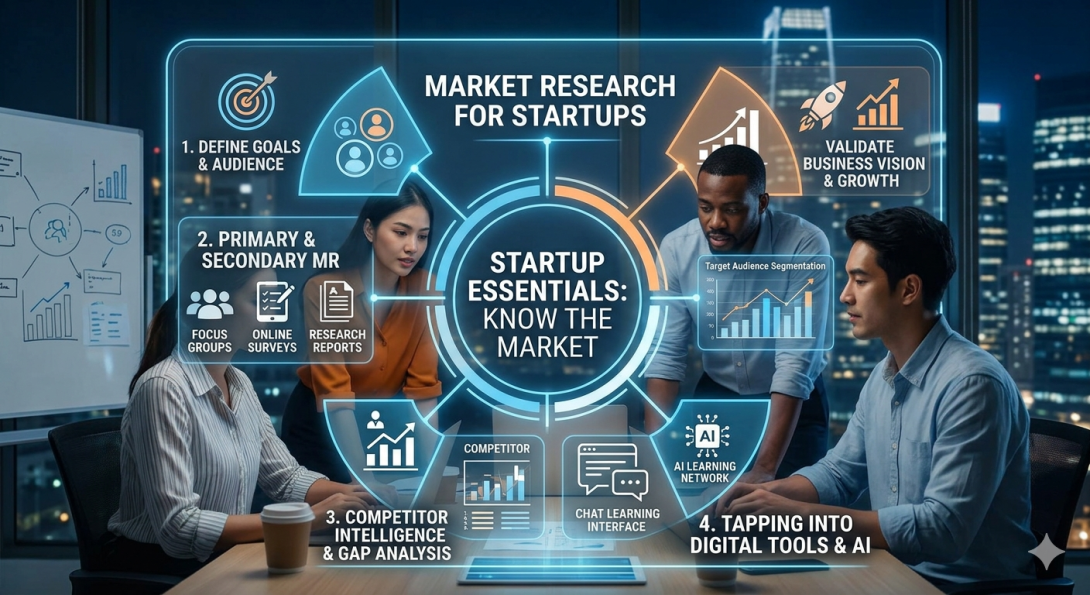
Startups must perform reliable market research (MR) if they want to thrive as successful businesses and compete with established brands in the target industry. It delivers insights into engaged audiences, top rivals, persisting industry trends, and possible challenges. This post will clarify the market research essentials for startups.
Adequate market research assists startups in validating their business vision. Entrepreneurs can also recognize innovation prospects and develop data-backed development strategies. However, constraints concerning resource availability and time management hurt startups’ journey. In other words, startups must comprehend the exemplary methods to gather required market insights.
How Startups Can Master Market Research: Key Steps
1. Know the Goal
Well-defined objectives must inform startup founders’ selection of data processing procedures. The type of market research and direct data needs can influence how startups tap into market research consulting. Still, there is a chance that short-term objectives might derail the improvement toward the long-term vision. Thus, entrepreneurs must specify which insights they want to prioritize.
2. Specify Your Target Audience
Knowing your target audience’s classifications helps sort data insights and streamline reporting for customer cohort creation. A group or cohort allows you to filter data. This technique of segmentation is fundamental to harnessing consequential data.
Startups must sufficiently employ the tools and methods to identify the primary demographic, geographic, and psychographic characteristics of likely customers.
Effectively segmenting the audience makes it feasible to conduct more tailored research. So, startups can serve different customer groups based on well-optimized engagement and retention processes. Automating profile classification via social listening, focus groups, online surveys, and industry reports is advantageous.
3. Combine Primary and Secondary Market Research
Startups must not prioritize only one technique for conducting market research. Remember, both primary and secondary research techniques will be vital to capturing exhaustive insights. Primary research collects information via consumer surveys and interviews. Likewise, focus groups let startups sample ideas for product improvements and marketing media.
In addition to direct feedback from the potential customers, secondary research sources data from existing information. They also enhance your understanding of competitors’ progress and market entry limitations.
4. Assess Where You Can Surpass Competitors
Understanding the competitiveness requirement demands qualitative data on the startup’s rivals. All businesses, whether traditional or newly incorporated, have unique strengths and weaknesses. Competitive market intelligence services let entrepreneurs or startup founders explore how to compete with established brands and surpass other startups in the same space.
You want to research your competitors’ strengths, weaknesses, pricing strategies, and customer feedback. Such market research best practices help identify gaps and potential areas for differentiation.
5. Tap into New Digital Tools and AI Platforms
Digitalization aids in saving time and getting accurate findings for market research. Moreover, artificial intelligence, cloud computing, and chatbots can streamline how you encourage stakeholders to participate in consumer surveys.
For illustration, generative AI integrations let you offer stakeholders choices to adjust survey length based on how much time stakeholders are willing to give. Natural language processing allows for the ease of unstructured data processing with context determination.
Conclusion
The market research best practices provide startups with noteworthy strategic advantages. The extracted insights into consumers, customers, and industry norms will help startup founders make the most critical decisions in their journey.
Professional market researchers can empower them to adjust growth strategies and pricing methods to respond to changes in market demands. Nevertheless, clarity of why market insights must be discovered is crucial. Startups must find efficient techniques to study the pain points and aspirations that impact consumer behaviors without going over budget.
-