
Introduction
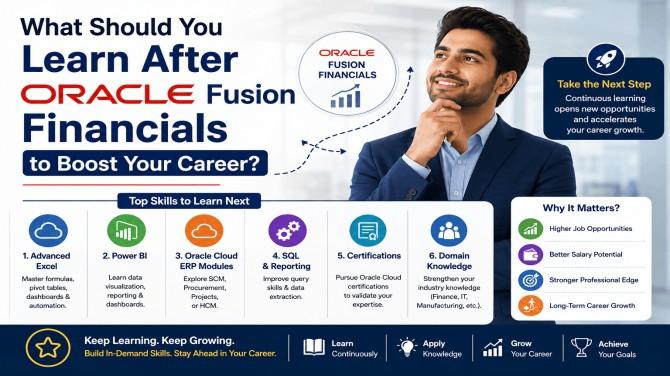
Finishing your Oracle Fusion Financials certification is a real accomplishment, but a lot of people hit a quiet pause right afterward, unsure exactly where to point their learning next. Tech Leads IT gets this question constantly from graduates who've already nailed the fundamentals and now want a clear sense of direction for their next stretch of study. This article covers the skills and neighboring areas genuinely worth pursuing after Oracle Fusion Financials Training, so whatever comes next actually builds on what you've already put in, rather than starting over in some disconnected direction.
Here's the good news: Financials naturally ties into several other high-value areas, so your next step doesn't have to feel like a total reinvention of your career. It can simply be a focused expansion that makes you noticeably more valuable in the roles you're already suited for.
Picking Up Adjacent Financial Modules
Once your core Financials fundamentals are solid, moving into neighboring modules within the same broader platform is often the most sensible next move. Areas like Project Portfolio Management, Procurement, or Revenue Management connect directly to the financial data you already know well, letting you build outward instead of starting completely fresh somewhere unrelated.
Plenty of professionals who went through solid Oracle Fusion Financials Training find that adding just one adjacent module noticeably broadens the projects they qualify for. Employers increasingly want consultants who can move comfortably across connected areas instead of staying boxed into one narrow lane, so this kind of expansion tends to open doors fairly quickly.
Getting Sharper With Data Analytics and Reporting
As Oracle Fusion keeps building out its embedded analytics tools, professionals who can genuinely read and present financial data well are pulling ahead of those who only know how to pull a standard report. Learning to build custom dashboards, work with Oracle Analytics tools, and turn raw numbers into clear business insight adds a distinct, marketable skill layered on top of your Financials background.
This is exactly why many refreshed Oracle Fusion Financials Course programs now spend real time specifically on reporting and analytics, recognizing that this combination makes graduates noticeably more competitive in interviews and genuinely more useful once they're actually working.
Understanding the Basics of Project Management
Consultants comfortable with basic project management ideas tend to move into senior roles faster than those who stick purely to technical configuration work. Knowing how implementation timelines get built, how stakeholder communication actually works day to day, and how project milestones get tracked gives Financials professionals a real advantage whenever leadership or coordination opportunities come up.
While most Oracle Fusion Financials Training programs don't cover this directly, picking up even a lightweight project management certification alongside your technical skills can meaningfully speed up career progression, particularly for anyone eyeing senior consulting or team lead roles later on.
Actually Understanding AI and Automation Tools
Oracle keeps embedding AI-driven features directly into Fusion Financials, covering things like automated reconciliation, anomaly detection, and predictive forecasting. Professionals who genuinely know how to configure and troubleshoot these tools are becoming increasingly valuable to employers trying to get real value out of their platform.
Forward-thinking Oracle Fusion Financials Course programs have started building dedicated coverage of these AI-assisted features right into the material, recognizing this is quickly becoming just as essential as basic journal entry knowledge once was for earlier generations of Fusion professionals.
Building Real Industry-Specific Knowledge
Developing deeper familiarity with a particular industry manufacturing, healthcare, retail, or financial services, for example, can genuinely set you apart from other Oracle Fusion Financials professionals with similar technical backgrounds. Employers in specialized industries frequently prefer consultants who understand both the platform and the specific regulatory or operational quirks of their sector.
Combining solid Oracle Fusion Financials Training with real industry knowledge, whether gained through actual work experience or focused study, positions professionals for roles that pay a premium for that combined expertise rather than technical skill by itself.
Getting Better at Communication and Stakeholder Work
Technical skill alone rarely decides who ends up in leadership roles on implementation teams. Professionals who can clearly explain system changes to non-technical people, manage user adoption struggles, and bridge the gap between finance and IT teams become disproportionately valuable on bigger, more complicated projects.
While this soft skill isn't something a typical Oracle Fusion Financials Course teaches outright, actively looking for chances to practice explaining technical ideas to non-technical people pays off over time, often deciding who gets pulled into leadership roles versus who stays stuck doing purely technical work.
Keeping Up as the Platform Keeps Changing
Oracle pushes updates to Fusion Financials several times a year, and professionals who make a real habit of reviewing these updates stay noticeably more current than those who only pay attention once something breaks. Treating ongoing learning as an actual habit, rather than something tied to a single certification moment, is arguably the single biggest thing you can do to protect your long-term value in this space.
Final Thoughts
The most useful next steps after Oracle Fusion Financials build directly on what you already have, rather than heading off in some unrelated direction. Adjacent modules, sharper data analytics ability, project management basics, real AI literacy, industry-specific knowledge, and stronger communication skills all stack together over time to make you considerably more valuable.
For anyone figuring out their next move, revisiting your original Oracle Fusion Financials Training with these adjacent skills in mind, or enrolling in a more advanced Oracle Fusion Financials Course that covers this ground directly, remains one of the smarter ways to keep real career momentum going.