

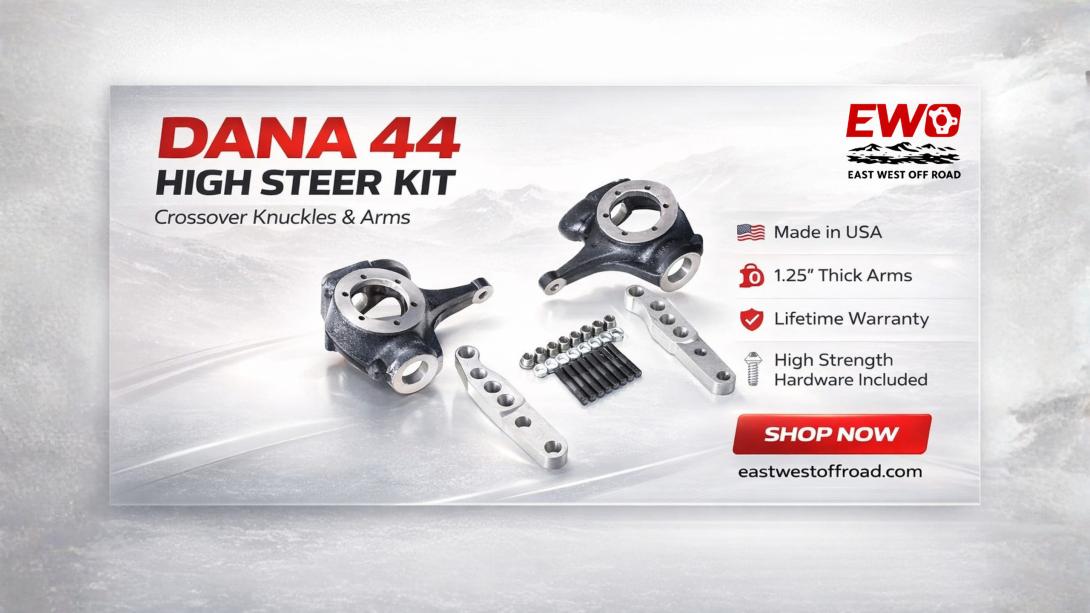
Buy Now: https://www.eastwestoffroad.com/product/dana-44-high-steer-crossover-knuckles-and-arms-kit
What a 1 ton steering upgrade for Dana 44 includes depends on the seller and the specific product. In the aftermarket, “1-ton steering” is often shorthand for a heavy-duty linkage concept or tie-rod-end style; it is not a universal bill of materials. A buyer must read the exact inventory instead of assuming that knuckles, arms, tie rod, drag link, ends, pitman arm, and every fastener are packaged together.
EWO E90178 is not listed as a complete one-ton linkage. It supplies two flat-top knuckles, two 1.25-inch four-hole billet high-steer arms, eight 9/16-18 studs, eight conical washers, and eight lock nuts. The design is intended for 7/8-inch Chevy 3/4-ton tie-rod ends, while the tie-rod ends, tie rod, drag link, pitman arm, steering box, and other linkage parts must be confirmed separately.
Treat “1 Ton” as a Category Label
No universal definition
Different sellers may use “1 ton” for joint size, linkage style, tube package, or a broader steering upgrade. Before parts are committed, compare exact part numbers, dimensions, tapers, and included quantities. A category label cannot safely replace a component list.
Vehicle rating versus part shorthand
Aftermarket terminology does not necessarily mean the axle or vehicle becomes a one-ton-rated system. Avoid load-rating or performance claims unless supported by verified engineering and vehicle data. Steering capacity depends on the complete design, not a label.
Read the Exact EWO Package Scope
Knuckles and arms
E90178 provides the axle-side flat-top knuckle pair and raised billet arm pair. For a useful inspection, verify axle fitment, sides, bottom-down taper, arm holes, and wheel/brake/suspension clearance. These components create attachment options but do not steer the vehicle without linkage.
Mounting set
The listed eight 9/16-18 studs, conical washers, and lock nuts mount the arms according to the package design. In practical terms, count and inspect the hardware, then use current manufacturer procedures. Mounting hardware does not include the separate joints and tubes needed for the tie rod and drag link.
Define the Complete System Yourself
7/8-inch Chevy 3/4-ton ends
The specified intended ends are described by their thread/application convention even when the broader build is marketed with “1-ton” language. During planning, use exact joint specifications and taper match rather than trying to reconcile labels. The part number and interface are what matter.
Complete linkage definition
A working system needs verified tie rod, drag link, ends, adjustment method, pitman-arm connection, steering box, and lengths. For the finished system, create a project-specific bill of materials and geometry drawing. Anything not explicitly listed remains an open sourcing and compatibility task.
Terminology Translation Sheet
For every product using “1 ton,” translate marketing language into these exact fields.
• Knuckle quantity, side, axle application, taper direction, and outer compatibility.
• Steering-arm quantity, thickness, hole design, mounting pattern, and warranty scope.
• Tie-rod-end part numbers, thread size, taper, shank direction, and articulation.
• Tie-rod and drag-link tube material, length, wall, threads, and adjusters—if included.
• Pitman-arm and steering-box interface—if included or explicitly compatible.
• Mounting studs, conical washers, lock nuts, jam nuts, and related hardware.
• Fabrication, machining, welding, alignment, and professional inspection requirements.
• Claims that are verified versus labels that still need definition.
Why the 3/4-Ton Tie-Rod-End Name Is Not a Contradiction
A shopper may see “1-ton steering upgrade” in a search result and wonder why EWO specifies 7/8-inch Chevy 3/4-ton tie-rod ends. The answer is that aftermarket category language and component application naming are not a standardized rating system. Use the actual 7/8-inch thread and taper requirements for fitment, and do not infer that a name changes the vehicle’s capacity. Exact interfaces are more reliable than broad labels.
Fitment Boundary for This Decision
Important: The EWO package is intended for compatible Chevy Dana 44 and Chevy/GM Corporate 10 Bolt front axles within its stated applications. Verify the axle and knuckles, bottom-down taper, intended 7/8-inch Chevy 3/4-ton ends, linkage lengths, pitman-arm configuration, suspension height, wheel and brake clearance, and alignment needs. A “1-ton” search phrase does not expand fitment.
Installation and Safety Boundary
Important: Do not select or install joints based only on a “1-ton” label. Use exact current product specifications and instructions, with no invented torque values. After assembly, verify taper and hardware seating, joint articulation, steering stops, full travel, wheel/brake/suspension clearance, toe, and alignment. Use professional fabrication and inspection when the complete linkage is custom.
Where EWO E90178 Fits
E90178 is appropriate to evaluate as the knuckle-and-arm foundation within a broader heavy-duty linkage plan, provided its exact interfaces match. It should not be sold or described as the complete one-ton linkage. Its billet-arm lifetime warranty is a component fact; the rest of the system needs its own documented specifications and support.
Evidence That Makes the Decision Defensible
Turn the article’s terminology translation sheet into a dated project record. For “Knuckle quantity, side, axle application, taper direction, and outer compatibility.” retain a clear photograph, measurement, part number, or written manufacturer confirmation. Do the same for “Steering-arm quantity, thickness, hole design, mounting pattern, and warranty scope.” and “Tie-rod-end part numbers, thread size, taper, shank direction, and articulation..” Mark every unresolved item as open rather than filling it with a likely answer. This record helps the buyer, installer, alignment technician, and future owner understand why the selected parts were considered compatible, and it creates a baseline for investigating any later contact, play, alignment change, or steering behavior.
Before the vehicle returns to service, compare the completed assembly with the original goal: the reader assumes “1 ton steering” has a universal parts definition and may mistake a knuckles-and-arms package for complete linkage. Confirm that the solution addresses that specific problem without creating a new clearance, articulation, taper, or serviceability issue. A short written acceptance note should identify who inspected the system, which conditions were checked, the alignment result, and when the first reinspection is due. The note is not a substitute for manufacturer instructions; it is a durable record that the project’s own acceptance criteria were reviewed.
For builders researching “1-ton steering” parts for a dana 44, the final review should stay centered on this article’s distinct angle: translate a broad aftermarket phrase into exact ends, tapers, tubes, arms, and hardware. Use photographs taken from consistent positions, measurements between joint centers, exact part numbers, and written fitment responses so another competent person can reproduce the decision. If a later change is made to tire size, wheel backspacing, suspension height, pitman arm, steering box, brakes, or axle position, reopen the same review rather than assuming the earlier clearance and geometry conclusions still apply.
Your Next Useful Step
Replace every use of “1 ton” on the project sheet with exact part numbers, dimensions, tapers, and quantities. Then confirm E90178’s defined scope at https://www.eastwestoffroad.com/product/dana-44-high-steer-crossover-kn…