
Introduction
Ask any beginner three weeks into self-teaching Oracle Fusion Financials how it's going, and you'll usually hear some version of "I'm not sure any of this is actually connecting." Tech Leads IT hears this constantly, and after watching a lot of learners go through this exact frustration, the pattern is clear the platform isn't what's causing the confusion. The sequence someone follows while learning it is almost always the real issue. Here's what a genuinely effective learning path actually looks like.
Start With the "Why," Not the "Where"
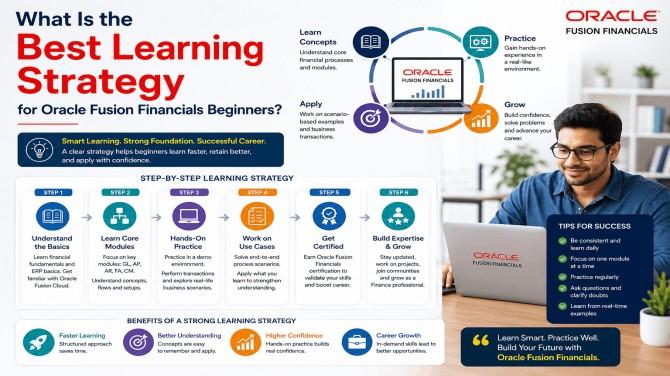
Before ever opening the software, beginners need real comfort with the accounting logic sitting underneath it what a chart of accounts actually represents, how journal entries function, what accrual accounting means in practice, and how a typical transaction moves through a business from start to finish. Skipping straight to "where do I click" without understanding "why does this exist" is exactly why so many beginners feel lost early on, even when the software itself isn't objectively difficult.
A well-designed Oracle Fusion Financials Course recognizes this and deliberately opens with this conceptual groundwork rather than diving into configuration screens on day one, precisely because this is where confusion tends to quietly take root.
Build Depth in One Module Before Spreading Thin Across Five
It's tempting for beginners to try absorbing every core module at once, assuming broad early exposure will pay off down the line. In practice, this produces shallow familiarity everywhere and genuine competence nowhere. General Ledger deserves full attention first, since nearly every other module payables, receivables, fixed assets eventually reports back into it. Understanding GL in real depth first makes everything studied afterward click far more easily.
This is exactly why properly structured Oracle Fusion Financials Training insists on starting with GL rather than letting learners jump straight to whichever module happens to look most interesting at first glance. Trying to make sense of payables before understanding the ledger is a bit like walking into the middle of a conversation and trying to catch up as you go.
Pair Payables and Receivables Instead of Separating Them
Once GL feels solid, Accounts Payable and Accounts Receivable are best learned together rather than fully finishing one before touching the other. These modules genuinely mirror each other one tracks money owed to suppliers, the other tracks money owed by customers and studying them side by side makes that relationship obvious far faster than learning them in isolation.
Beginners who spend disproportionate time on one while neglecting the other often struggle later to piece together how cash actually flows through a business as a whole. A thoughtfully built Oracle Fusion Financials Course deliberately pairs these two modules for exactly this reason.
Stop Reading and Start Doing
There's a real ceiling on how much understanding comes from reading about invoice processing or journal entries. Genuine skill comes from actually working inside the platform entering real transactions, generating reports, watching how a single change ripples across connected modules elsewhere. Without this kind of hands-on practice, even solid theoretical knowledge tends to fall apart the first time a messy, real-world situation shows up.
This is exactly where quality Oracle Fusion Financials Training separates itself from free video content or scattered PDF guides. Programs offering genuine access to a live Fusion Cloud environment let beginners experiment safely, learn directly from their own mistakes, and build real familiarity that passive reading simply can't replicate.
Save Fixed Assets and Cash Management for Later
Once GL, AP, and AR start feeling comfortable, it's time to bring in Fixed Assets and Cash Management not before. Both modules depend heavily on concepts introduced earlier, and tackling them too soon usually creates confusion that better pacing would have avoided entirely. Fixed Assets introduces depreciation schedules and asset lifecycle tracking, while Cash Management ties bank reconciliation and cash forecasting back into everything already covered.
A properly sequenced Oracle Fusion Financials Course paces this deliberately, building genuine depth one stage at a time rather than rushing toward broad, shallow coverage across everything at once.
Practice Scenarios That Actually Resemble the Job
Neither theory nor basic navigation alone prepares someone for what real work actually demands. Beginners get real value from practicing situations that mirror genuine job responsibilities: running a full month-end close, processing a batch of vendor payments, reconciling a bank statement against system records. These exercises resemble what consultants and analysts handle regularly, and they tend to expose gaps that pure theoretical study conveniently hides.
Strong Oracle Fusion Financials Training builds these scenarios directly into its structure, rather than leaving learners to figure out practical application entirely on their own once the course technically wraps up.
Don't Stop Learning the Moment You're Certified
One habit that quietly damages long-term readiness is treating certification as the finish line rather than a checkpoint along the way. Oracle rolls out updates to the platform multiple times a year, and professionals who stop learning right after certification often find their knowledge outdated within a year or two. Staying current with these ongoing changes is exactly what keeps someone's expertise genuinely valuable well past that first credential.
Final Thoughts
The most effective way for beginners to learn Oracle Fusion Financials isn't about studying harder, it's about following a properly paced, logical sequence instead of bouncing between disconnected topics. Start with fundamentals, prioritize GL, pair AP and AR, get real hands-on practice, pace Fixed Assets and Cash Management appropriately, and keep learning well past the first certificate.
For anyone genuinely committed to mastering this platform, enrolling in a structured Oracle Fusion Financials Course, supported by comprehensive Oracle Fusion Financials Training, remains one of the most reliable ways to build real, lasting competence without falling into the same traps that hold so many beginners back.