
The global Threat Intelligence Security Market is experiencing significant growth as organizations strengthen their cybersecurity systems to protect sensitive information, business operations, and digital infrastructure. The increasing frequency of cyberattacks, including ransomware, phishing, malware, and data breaches, has encouraged businesses to adopt proactive security solutions. Threat intelligence security tools help organizations identify potential risks, analyze suspicious activities, and improve their ability to detect and respond to cyber threats.
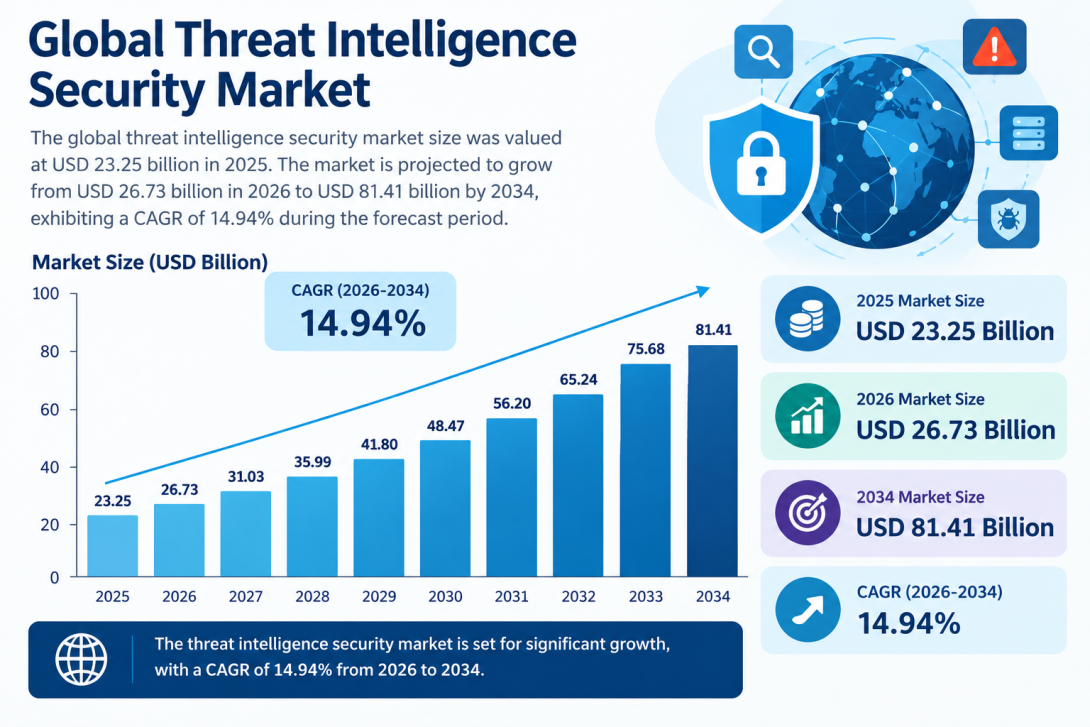
According to Fortune Business Insights, the global Threat Intelligence Security Market was valued at USD 23.25 billion in 2025. The market is projected to grow from USD 26.73 billion in 2026 to USD 81.41 billion by 2034, exhibiting a compound annual growth rate (CAGR) of 14.94% during the forecast period. Increasing cloud adoption, digital transformation, and demand for advanced threat detection technologies are expected to support market expansion.
Rising Cybersecurity Threats Driving Market Growth
The growing number of sophisticated cyberattacks is a major factor driving the Threat Intelligence Security Market. Organizations across banking, healthcare, retail, manufacturing, and information technology face increasing risks from cybercriminals seeking financial information, confidential records, and business data.
Traditional security systems may struggle to identify complex threats that evolve rapidly. Threat intelligence solutions help security teams understand attacker behavior, recognize emerging vulnerabilities, and prioritize potential risks. By combining information from multiple sources, these solutions support more informed security decisions and improve incident response capabilities.
As businesses become increasingly dependent on digital platforms, demand for proactive cybersecurity strategies is expected to increase throughout the forecast period.
Growing Adoption of Artificial Intelligence and Automation
Artificial intelligence (AI) and machine learning are becoming important technologies in the Threat Intelligence Security Market. These technologies help security systems analyze large volumes of data, identify unusual patterns, and detect potential threats more efficiently.
Automated threat analysis can reduce the time required to investigate suspicious activities and help security teams respond to incidents faster. AI-powered platforms can also support threat prioritization by identifying patterns associated with known attack methods.
However, organizations must address challenges related to data quality, false positives, system integration, and the reliability of automated decisions. Continued technological development is expected to improve the effectiveness of threat intelligence solutions.
For detailed market insights : https://www.fortunebusinessinsights.com/threat-intelligence-security-market-116655
Solution and Service Analysis
The Threat Intelligence Security Market includes threat intelligence platforms, security information and event management (SIEM) integration, threat hunting, risk assessment, and managed detection services.
Threat intelligence platforms collect and analyze information about potential cyber threats, helping organizations gain a clearer understanding of their security environment. SIEM integration enables businesses to combine intelligence with security event data, improving threat identification and investigation.
Services such as threat hunting and risk assessment help organizations identify weaknesses and investigate suspicious behavior. Managed detection and response (MDR) services provide monitoring, threat investigation, and response support, making them particularly relevant for businesses with limited internal cybersecurity resources.
The combination of advanced platforms and specialized services is expected to support market development.
Application Analysis
Incident response is an important application of threat intelligence security solutions. Organizations use intelligence data to investigate security incidents, understand attack methods, and limit potential damage.
Fraud detection is another significant application, particularly in financial services and digital commerce. Threat intelligence can help identify suspicious activities, malicious infrastructure, and indicators associated with fraudulent operations.
Other applications include malware analysis, vulnerability management, threat hunting, and security monitoring. These capabilities help organizations strengthen their cybersecurity strategies and protect critical business systems.
Regional Analysis
North America
North America represents an important regional market because of its established cybersecurity infrastructure, high technology adoption, and substantial investment in enterprise security. Government agencies and private organizations continue to strengthen their defenses against sophisticated cyber threats.
Europe
Europe is supported by growing cybersecurity awareness, data protection requirements, and increasing investment in digital infrastructure. Organizations are adopting threat intelligence tools to improve risk management and protect sensitive information.
Asia Pacific
Asia Pacific is expected to offer growth opportunities as businesses accelerate digital transformation and expand cloud-based operations. Increasing internet usage, e-commerce activity, and cybersecurity awareness are encouraging organizations to invest in advanced threat detection solutions.
South America
South America presents opportunities as businesses modernize IT infrastructure and respond to increasing cybersecurity risks. Greater awareness of digital fraud and data protection is expected to support demand.
Middle East & Africa
The Middle East & Africa market may benefit from investments in digital services, financial technology, telecommunications, and critical infrastructure protection. Organizations are increasingly recognizing the importance of proactive cybersecurity measures.
Competitive Landscape
The Threat Intelligence Security Market includes cybersecurity providers that compete through technology development, platform integration, service capabilities, and threat detection performance. Companies focus on improving analytics, automating investigations, and expanding security monitoring capabilities.
Competition is also influenced by demand for cloud-compatible platforms, managed security services, and solutions that integrate with existing enterprise security systems. Providers that offer scalable technologies and actionable intelligence may be better positioned to address evolving customer requirements.
Recent Industry Developments
Industry developments are increasingly focused on AI-powered threat analysis, automated security operations, cloud-native cybersecurity, and improved intelligence sharing. Security providers are working to connect threat intelligence platforms with endpoint protection, network monitoring, and incident response systems.
Another important trend is the growing adoption of managed cybersecurity services. These services help organizations access specialist expertise and continuous monitoring without building every security capability internally. Integration and automation are expected to remain important areas of development as cyber threats become more complex.
Get Free Sample PDF: https://www.fortunebusinessinsights.com/enquiry/request-sample-pdf/threat-intelligence-security-market-116655
Future Outlook
The global Threat Intelligence Security Market is expected to expand considerably through 2034 as organizations prioritize proactive cybersecurity and invest in advanced threat detection capabilities. According to Fortune Business Insights, the market is projected to reach USD 81.41 billion by 2034, growing at a CAGR of 14.94% from 2026 to 2034.
Future growth will depend on the evolution of cyber threats, increasing adoption of AI and automation, cloud security requirements, and demand for managed detection services. Organizations will continue seeking solutions that improve visibility, accelerate incident response, and reduce exposure to cyber risks.
As digital infrastructure becomes more interconnected, threat intelligence security is likely to remain an important component of enterprise cybersecurity strategies across industries and regions.
Related Reports
Uncover Japan’s Market Trends - Explore the Latest - Threat Intelligence Security Market - Insights