
The global Testosterone Test Kits Market is gaining momentum as awareness of hormonal health, reproductive health, and age-related hormonal changes continues to increase. Testosterone testing is used to assess hormone levels and can support healthcare professionals in evaluating conditions associated with abnormal testosterone levels. The growing emphasis on preventive healthcare and accessible diagnostic testing is creating new opportunities for testosterone test kit manufacturers.
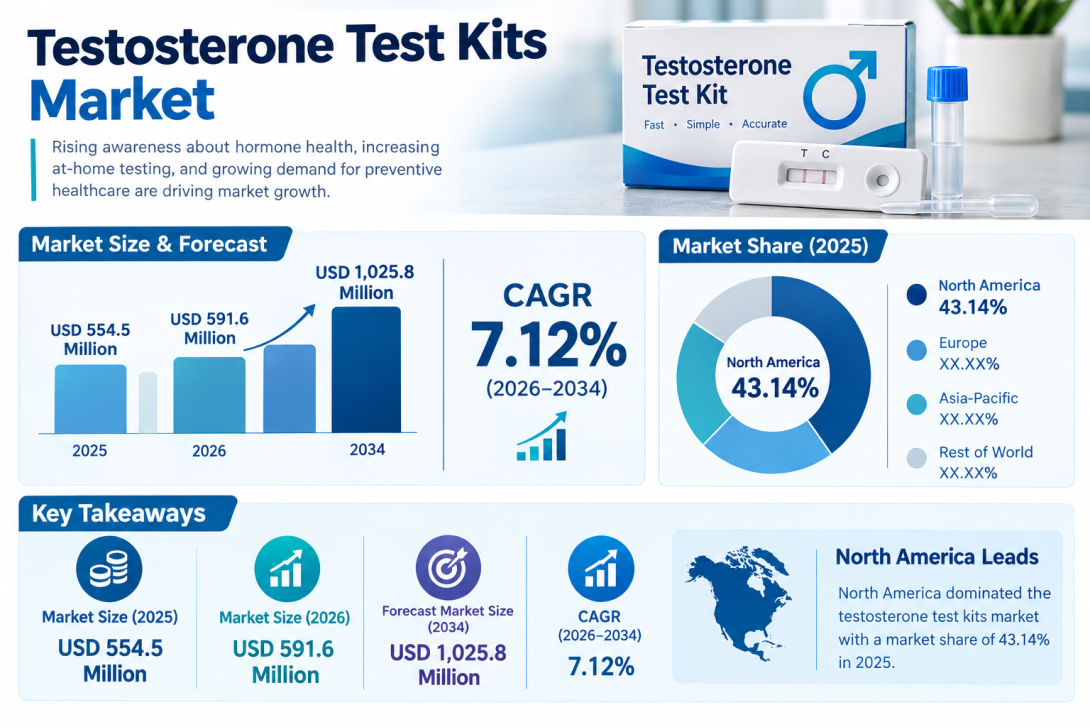
According to Fortune Business Insights, the global testosterone test kits market size was valued at USD 554.5 million in 2025. The market is projected to grow from USD 591.6 million in 2026 to USD 1,025.8 million by 2034, exhibiting a CAGR of 7.12% during the forecast period. North America dominated the testosterone test kits market with a market share of 43.14% in 2025.
Increasing Awareness of Hormonal Health
Growing awareness of hormonal health is one of the key factors supporting the expansion of the Testosterone Test Kits Market. Consumers and healthcare professionals are paying greater attention to hormone levels as part of broader health assessments, particularly among aging populations.
Testosterone levels can vary based on age, health conditions, medications, and other factors. Increased awareness of these variations is encouraging demand for convenient testing options that can help identify whether additional clinical evaluation may be appropriate.
Rising Demand for Convenient Diagnostic Testing
The healthcare industry is increasingly moving toward convenient and accessible diagnostic solutions. Testosterone test kits can offer consumers and healthcare providers an alternative to conventional testing processes, depending on the type of test and applicable regulatory requirements.
At-home and decentralized testing options are gaining attention because they can improve convenience and potentially reduce barriers associated with visiting healthcare facilities. The expansion of digital health services and telemedicine is also creating opportunities for diagnostic kits that can complement remote healthcare workflows.
For detailed market insights : https://www.fortunebusinessinsights.com/industry-reports/testosterone-test-kits-market-100416
Test Type Analysis
The Testosterone Test Kits Market can be segmented based on test type into blood tests, saliva tests, urine tests, and other testing methods.
Blood-based testing remains an important method for testosterone assessment because it can provide quantitative measurements used in clinical evaluation. Saliva-based and other testing formats are also attracting attention because of their potential convenience and less invasive sample collection.
Advancements in testing technology are expected to focus on improving accuracy, ease of use, sample handling, and result interpretation. These improvements can support broader adoption across healthcare and consumer testing environments.
Application Analysis
Based on application, testosterone test kits are used for hormonal disorder diagnosis, reproductive health assessment, monitoring of hormone-related conditions, and other applications.
Hormonal disorder diagnosis represents an important area of demand because abnormal testosterone levels may be associated with various health conditions. Testosterone testing can form part of a broader diagnostic assessment conducted by healthcare professionals.
Reproductive health is another relevant application area, as hormonal levels can play a role in fertility evaluation and related healthcare assessments. Increasing awareness of reproductive and hormonal health is expected to support demand for testing solutions.
End-User Analysis
The market can also be analyzed based on end users, including hospitals and clinics, diagnostic laboratories, home healthcare settings, and other healthcare facilities.
Hospitals and clinics remain important users of testosterone testing products because hormone assessments are frequently incorporated into broader diagnostic procedures. Diagnostic laboratories also play a significant role by providing specialized testing services and processing samples from healthcare providers.
Home healthcare represents an emerging area as consumers increasingly seek convenient health-monitoring solutions. The continued development of reliable and easy-to-use testing products could support this segment during the forecast period.
Technological Advancements Supporting Market Growth
Technological innovation is contributing to the development of more convenient and efficient testosterone testing solutions. Manufacturers are focusing on improvements in sample collection, testing procedures, portability, and digital integration.
The combination of diagnostic testing with digital health platforms may also provide opportunities for improved data management and remote consultation. However, product adoption will continue to depend on factors such as accuracy, regulatory compliance, affordability, and healthcare professional acceptance.
Regional Analysis
North America dominated the Testosterone Test Kits Market in 2025, accounting for 43.14% of the global market. The region's leading position is supported by advanced healthcare infrastructure, growing awareness of hormonal health, established diagnostic networks, and increasing adoption of innovative healthcare technologies.
The U.S. represents a major contributor to the North American market due to its developed healthcare system and strong demand for diagnostic products. Increasing consumer interest in preventive health and convenient testing solutions is expected to support regional growth.
Europe is expected to maintain a significant position as healthcare systems continue to emphasize early diagnosis and personalized healthcare. Meanwhile, Asia Pacific is anticipated to offer considerable growth opportunities due to increasing healthcare expenditure, improving diagnostic infrastructure, and rising awareness of hormonal and reproductive health.
Latin America and the Middle East & Africa are also expected to experience gradual development as access to diagnostic services improves and healthcare infrastructure expands.
Competitive Landscape
The competitive landscape of the Testosterone Test Kits Market includes diagnostic companies and healthcare technology providers developing laboratory-based and convenient testing solutions. Competition is influenced by test accuracy, product reliability, ease of use, regulatory compliance, distribution capabilities, and technological innovation.
Companies are increasingly focusing on developing user-friendly testing products and expanding their presence across healthcare and consumer channels. Product innovation and strategic collaborations may remain important competitive strategies during the forecast period.
Recent Industry Developments
Recent developments in testosterone testing have focused on improving testing convenience, sample collection, analytical performance, and accessibility. The increasing interest in decentralized and at-home diagnostic testing is encouraging manufacturers to explore solutions that can support testing outside traditional laboratory environments.
Digital healthcare integration is another emerging trend. Connecting diagnostic testing with digital platforms may help facilitate data sharing and remote healthcare consultations, although clinical interpretation and appropriate medical guidance remain important components of hormone testing.
Get Free Sample PDF: https://www.fortunebusinessinsights.com/enquiry/request-sample-pdf/testosterone-test-kits-market-100416
Future Outlook
The Testosterone Test Kits Market is expected to maintain steady growth through 2034 as awareness of hormonal health increases and consumers seek more accessible diagnostic solutions. Rising attention to preventive healthcare, reproductive health, age-related hormonal changes, and convenient testing options will remain important growth factors.
The market is projected to increase from USD 591.6 million in 2026 to USD 1,025.8 million by 2034, registering a CAGR of 7.12% during the forecast period. North America's strong healthcare infrastructure and continued adoption of advanced diagnostic technologies are expected to support its leading position, while emerging markets may provide additional opportunities as healthcare access and diagnostic capabilities improve.
Related Reports
What Everyone Should Know About Japan’s Market - Testosterone Test Kits Market - Insights