

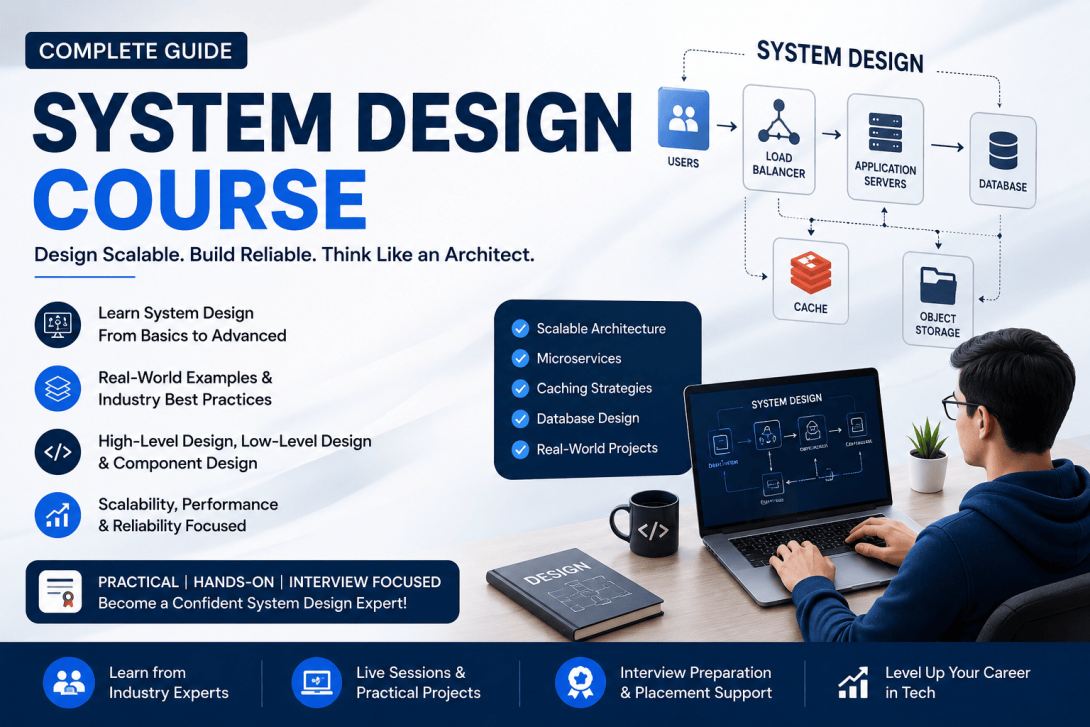
Modern software applications need to support growing numbers of users while maintaining speed, availability, and reliability. Developers who work on large applications must understand how different components interact at an architectural level. A System Design Course can help developers learn these concepts and develop the ability to design systems that are practical and scalable.
What Is High-Level System Design?
High-Level Design (HLD) focuses on the overall structure of a software system. Instead of concentrating on individual classes or functions, HLD explains how major components communicate with one another.
A typical high-level architecture may include clients, application servers, databases, APIs, load balancers, caching layers, storage systems, and messaging services.
Understanding these components helps developers visualize the complete application before implementing individual features.
Why HLD Is Important
When an application grows, simply writing more code does not solve architectural problems. Poor architectural decisions can create performance bottlenecks and reliability issues.
High-level system design helps developers identify these challenges early. It also provides a common architectural view that development, testing, DevOps, and product teams can understand.
Core HLD Concepts
A structured System Design Course should cover several important concepts. These include scalability, availability, reliability, fault tolerance, performance, and maintainability.
Scalability explains how a system handles increasing traffic. Availability focuses on keeping services accessible. Reliability ensures that the system behaves correctly over time.
Developers also need to understand the difference between horizontal and vertical scaling, as well as the role of load balancing and caching.
APIs and Service Communication
Modern applications are often composed of multiple services. These services communicate through APIs and messaging systems.
REST APIs are commonly used for request-response communication, while asynchronous messaging can be useful when tasks do not need immediate responses.
Understanding communication patterns is an important part of designing loosely coupled applications.
Databases and Data Flow
Database selection is another important HLD decision. Developers should understand SQL databases, NoSQL databases, replication, partitioning, indexing, and sharding.
The correct choice depends on the application's data model, traffic requirements, consistency expectations, and scalability goals.
Practice Through Real Examples
Learning HLD becomes easier through practical system design exercises. Developers can design a food delivery platform, online shopping application, social media platform, or video streaming service.
Each problem requires analyzing requirements and selecting appropriate components.
Conclusion
Mastering High-Level System Design helps developers move beyond individual coding tasks and understand how complete software platforms are structured. A well-designed System Design Course can guide learners through architecture, scalability, APIs, databases, caching, and distributed components.
With consistent practice, developers can build stronger architectural thinking and become better prepared for real-world engineering responsibilities.