

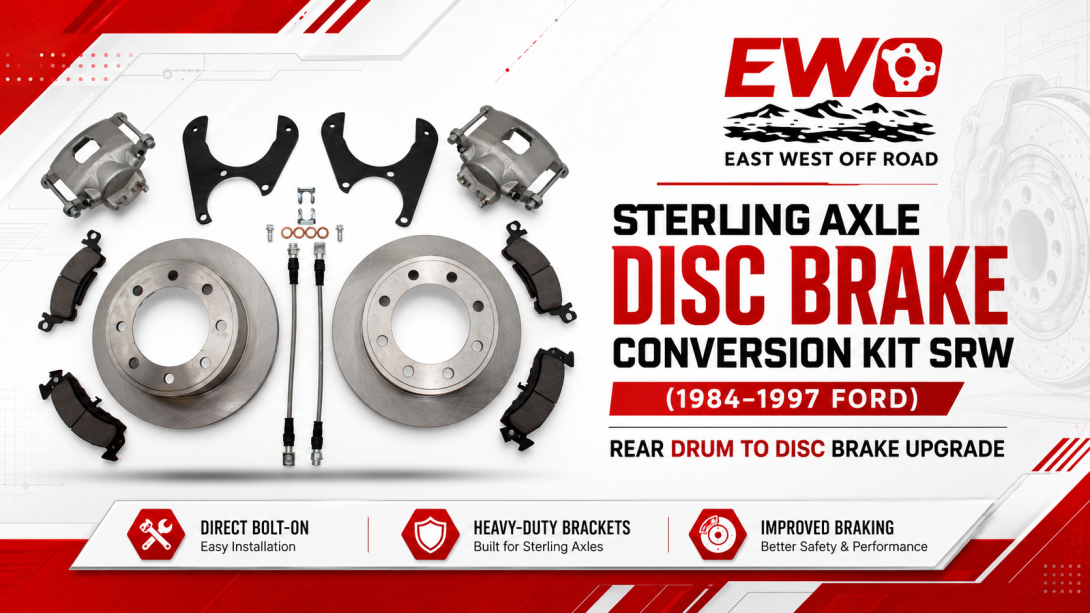
A sterling axle disc brake conversion kit gives owners of compatible 1984–1997 Ford Sterling Single Rear Wheel axles a practical way to replace an older rear drum-brake arrangement with a disc-based system. For heavy-duty Ford trucks, axle swaps, tow rigs, off-road builds, and custom 4x4 projects, a rear disc conversion can simplify brake servicing while providing a modern rotor-and-caliper layout. The key is choosing a conversion designed for the correct Sterling axle, SRW configuration, rotor position, caliper brackets, hydraulic system, and parking-brake requirements.
The East West Off Road E2055 Sterling Axle Disc Brake Conversion Kit is designed specifically around 1984–1997 Ford Sterling SRW rear axle applications and offers options for parking-brake calipers and steel braided brake hoses.
What Is a Sterling Axle Disc Brake Conversion Kit?
A Sterling disc brake conversion replaces the major rear drum-brake components with a rotor-and-caliper system.
A complete conversion system typically revolves around components such as:
- Axle-specific caliper brackets
- Brake rotors
- Rear brake calipers
- Brake pads
- Flexible brake hoses
- Hydraulic fittings
- Mounting hardware
Depending on the selected system, parking-brake hardware or upgraded hoses may also be available.
The purpose is not simply to remove the drums. Every component has to position the caliper correctly over the rotor while remaining compatible with the axle, wheels, hydraulic system, and intended vehicle use.
For Ford owners evaluating a sterling axle disc brake conversion kit, accurate axle identification should come before ordering parts.
Why Convert a Ford Sterling Rear Axle From Drums to Discs?
Ford Sterling rear axles are widely used in heavy-duty truck applications, and many older versions were originally equipped with substantial rear drum brakes.
Drum brakes can work effectively when correctly maintained. However, an aftermarket disc system can offer practical advantages for modified or aging trucks.
Easier Visual Inspection
With disc brakes, the rotor and caliper are more accessible for inspection.
Checking rotor condition, visible pad wear, hydraulic hoses, and caliper condition can be more straightforward than servicing a large drum assembly.
Simplified Friction-Component Service
Disc brake pads are generally easier to access than the internal shoes, springs, and hardware found inside traditional rear drum assemblies.
Heat and Brake-Fade Considerations
Disc brake systems expose more of the rotor to airflow.
For a properly matched heavy-duty system, this can help manage heat during repeated braking.
Reduced Brake Assembly Complexity
A disc setup uses a rotor, caliper, and pad arrangement rather than the larger collection of springs and internal hardware used in many drum systems.
Potential Weight Reduction
Large heavy-duty drum assemblies can be substantial. Some aftermarket conversion systems can reduce rear unsprung mass depending on the exact original and replacement components.
Understanding the Ford Sterling Axle
Before buying parts, it helps to understand what “Sterling axle” means.
Ford introduced Sterling full-floating rear axles across numerous heavy-duty truck applications.
Owners commonly encounter terms such as:
- Ford Sterling axle
- Sterling 10.25 axle
- Sterling 10.5 axle
- Ford full-float rear axle
- F-250 rear axle
- F-350 rear axle
However, these terms should not automatically be treated as interchangeable when ordering a brake conversion.
Axle year, wheel configuration, housing, hub arrangement, and bolt pattern can affect compatibility.
What Does SRW Mean?
SRW means Single Rear Wheel.
A conventional pickup with one wheel on each side of the rear axle is an SRW truck.
This matters because SRW and DRW axle configurations can position hubs, rotors, and wheels differently.
The EWO E2055 product is specifically listed as an SRW conversion for compatible 1984–1997 Ford Sterling applications.
SRW vs. DRW Sterling Axles
A Single Rear Wheel Sterling axle should not automatically be treated as interchangeable with a Dual Rear Wheel version.
DRW means Dual Rear Wheel, commonly called a dually.
Differences can include:
- Hub position
- Wheel mounting configuration
- Rotor placement
- Caliper bracket offset
- Overall axle dimensions
A kit intended for an SRW axle should therefore be purchased only after confirming that the actual axle matches the product's intended configuration.
Why Axle Identification Matters
Many older trucks have been modified over decades.
A vehicle may no longer have the axle originally installed at the factory.
Axle swaps are especially common in:
- Off-road trucks
- Rock crawlers
- Custom 4x4s
- Tow builds
- Restomod projects
- Diesel conversions
For that reason, ordering only by vehicle year and model can be risky.
Verify the actual axle under the vehicle.
Sterling 10.25 Rear Disc Brake Conversion
The Sterling 10.25 is one of the most common terms buyers use when searching for a rear disc upgrade.
A Sterling 10.25 rear disc brake conversion replaces the older drum assembly with an appropriately matched disc brake system.
The conversion still needs to account for:
- Axle configuration
- Rotor dimensions
- Bracket position
- Caliper type
- Brake hoses
- Parking-brake requirements
- Wheel clearance
No one component should be selected independently of the rest of the brake system.
1984–1997 Ford Sterling SRW Applications
The EWO E2055 product targets the 1984–1997 Ford Sterling SRW application range.
That makes it relevant to owners researching older heavy-duty Ford trucks and project axles from this generation.
However, year range alone should not replace actual axle verification.
A previous owner may have changed the axle, hubs, brakes, or wheel configuration.
EWO E2055 Sterling Disc Brake Conversion
East West Off Road identifies its product as:
Sterling Axle Disc Brake Conversion Kit SRW (1984–1997 Ford) | Rear Drum to Disc Brake Upgrade
The current EWO item number is:
E2055
Its product categorization focuses on:
- Sterling axle
- Ford Sterling axle
- Disc brake conversion
- Rear disc brake kit
- Drum-to-disc conversion
- Ford truck brakes
- SRW axle
- Towing upgrades
- Off-road brake kit
- Ford axle parts
- Brake performance upgrade
That keyword cluster closely matches what owners search when planning a heavy-duty Sterling axle brake conversion.
Rear Drum to Disc Brake Upgrade
A rear drum to disc brake upgrade changes the architecture of the rear braking system.
Instead of brake shoes expanding against the inside of a drum, a disc system uses a caliper to clamp brake pads against a rotor.
That makes the system more similar to the disc brakes used on many modern vehicles.
The conversion should still be treated as a complete brake-system modification rather than a cosmetic axle upgrade.
Drum Brakes vs. Disc Brakes on a Heavy-Duty Ford
Both designs have strengths.
Rear Drum Brakes
Traditional heavy-duty drums can provide substantial braking capability and may integrate a mechanical parking brake effectively.
However, servicing them can involve more internal hardware.
Rear Disc Brakes
Disc systems provide easier visual access to the rotor and caliper and can simplify pad replacement and inspection.
For many older heavy-duty Ford builds, serviceability is a major reason for converting.
Rear Disc Brake Conversion for Towing Builds
A Sterling axle is frequently found in trucks designed to carry or tow substantial loads.
Brake-system condition is therefore especially important.
For a tow-oriented truck, a disc conversion should be considered together with:
- Front brake condition
- Vehicle weight
- Tire size
- Master cylinder
- Brake booster
- Brake bias
- Trailer-brake requirements
A rear disc conversion does not replace any properly required trailer braking system.
The entire vehicle should be evaluated as a braking system.
Sterling Disc Brakes for Off-Road Trucks
A Ford Sterling axle is also a popular heavy-duty axle for custom 4x4 projects.
An off road brake kit needs to remain serviceable after exposure to conditions such as:
- Mud
- Water
- Dust
- Rocks
- Road salt
- Trail debris
Disc brakes offer easy visual access after trail use, allowing the owner or technician to inspect the visible rotor, caliper, hose, and pads.
Disc Brakes for Axle-Swap Projects
The Sterling axle can be used outside its original Ford truck application.
Builders may choose one for custom heavy-duty axle projects because of its strength and availability.
When the axle is installed in another vehicle, brake-system compatibility becomes especially important.
The conversion must account for the receiving vehicle's:
- Master cylinder
- Brake lines
- Brake proportioning
- Wheel size
- Tire size
- Vehicle weight
- Parking-brake arrangement
An axle swap should never assume that a brake setup designed for one vehicle will automatically perform identically in another.
What Do Caliper Brackets Do?
The caliper mounting bracket positions the brake caliper relative to the rotor.
Correct positioning is critical because the rotor needs to run properly through the brake-pad area.
Bracket design determines:
- Radial caliper position
- Lateral caliper offset
- Rotor alignment
- Caliper clearance
This is why axle-specific brackets are a critical part of a disc brake conversion.
Why Heavy-Duty Caliper Brackets Matter
A caliper bracket carries braking loads between the caliper and axle housing.
That makes bracket material, thickness, fit, and mounting important considerations.
Current Sterling conversion competitors commonly emphasize heavy-duty steel brackets as a core part of their kits.
For buyers, the important point is simple: the brackets need to be specifically compatible with the Sterling SRW housing and selected brake components.
Choosing Rear Brake Calipers
Several different caliper strategies appear in heavy-duty rear disc conversions.
Some kits use standard hydraulic GM-style calipers.
Others offer integrated parking-brake calipers.
The correct option depends heavily on how the parking brake will work.
Standard Hydraulic Calipers
A conventional hydraulic caliper performs normal service braking when hydraulic pressure moves the piston.
This can be a simple solution when the vehicle already has a separate mechanical parking-brake system.
However, a standard hydraulic caliper may not provide an integrated mechanical parking brake.
Parking Brake Calipers
The current EWO E2055 product offers buyers the option to upgrade to parking-brake calipers.
An integrated parking-brake caliper performs two jobs:
- Hydraulic service braking
- Mechanical parking-brake operation
This can be particularly useful when the original rear drum parking-brake hardware is removed during the conversion.
Why Parking Brake Planning Matters
One of the easiest details to overlook during a drum-to-disc conversion is the parking brake.
The original drum assembly may contain the mechanical system used to hold the vehicle when parked.
Once those drum components are removed, the truck needs another compatible solution.
Potential approaches can include:
- Integrated parking-brake calipers
- Separate mechanical calipers
- Another appropriately engineered parking-brake system
The decision should be made before ordering the conversion rather than after installation has begun.
Parking Brake Caliper vs. Standard Caliper
The best choice depends on the vehicle.
A standard hydraulic caliper can be simpler when the truck already has another functional parking brake.
A parking-brake caliper can reduce the need for a separate rear mechanical braking assembly.
However, integrated parking-brake calipers also require the complete lever, cable, adjustment, and pad arrangement to function correctly.
Steel Braided Brake Hose Option
The current EWO E2055 listing also offers an upgrade to steel braided brake hose.
Flexible brake hoses connect the moving axle/brake assembly with the vehicle's hard brake lines.
Any hose used in a custom brake setup should be compatible with:
- Caliper fitting
- Hard-line fitting
- Hose length
- Axle movement
- Suspension travel
- Routing
A braided outer layer can provide additional abrasion resistance, but correct fitment and routing remain essential.
Rubber vs. Braided Brake Hoses
Both brake-hose types can work effectively when designed for the application.
Rubber Brake Hose
Quality automotive rubber hoses provide the flexibility needed for axle movement and are common in production vehicles.
Braided Brake Hose
A braided outer construction may provide additional protection and can be attractive on custom or off-road builds.
The most important factors remain correct specification, fitting compatibility, and safe routing.
Rear Rotor Considerations
The rotor provides the friction surface used by the brake pads.
Its dimensions affect compatibility with:
- Hub
- Wheel studs
- Caliper
- Bracket
- Brake pads
- Wheel
A conversion rotor needs to match the particular axle and bracket arrangement.
Rotor diameter or bolt pattern alone does not establish complete compatibility.
Rotor Placement Matters
Different rear brake systems can position a rotor differently relative to the axle hub.
This affects the lateral position of the caliper.
A mismatch between rotor placement and bracket offset can prevent the caliper from sitting correctly over the rotor.
For this reason, rotors and brackets should be selected as a matched conversion system.
Wheel Clearance After a Disc Conversion
A disc brake conversion adds a caliper around the rotor, and that caliper must fit inside the wheel.
Important wheel-related considerations include:
- Wheel diameter
- Wheel backspacing
- Caliper-body clearance
- Brake hose clearance
- Parking-brake lever clearance
Aftermarket wheels can vary significantly.
Physical clearance should be confirmed on the actual vehicle.
Brake Pads and Replacement Parts
Long-term serviceability matters on a truck that may remain in use for many years.
Before purchasing a conversion, consider how easily normal wear components can be replaced.
Service items include:
- Brake pads
- Rotors
- Calipers
- Brake hoses
Using commonly available replacement components can simplify future maintenance.
Brake Balance After a Rear Disc Conversion
Replacing rear drums with discs can change rear brake characteristics.
Front-to-rear brake balance is influenced by several factors:
- Front caliper size
- Rear caliper piston area
- Rotor dimensions
- Master-cylinder design
- Proportioning system
- Vehicle weight distribution
- Tire traction
The goal is balanced, predictable braking.
The rear axle should contribute effectively without becoming overly aggressive compared with the front brakes.
Proportioning Valve Considerations
A proportioning valve influences rear hydraulic brake pressure in many vehicle brake systems.
A drum-to-disc conversion may change what the rear brakes require.
Some custom systems use an adjustable proportioning valve, but it should not be treated as a universal solution for mismatched components.
The full braking system should be professionally evaluated after a major conversion.
Master Cylinder Compatibility
A master cylinder moves brake fluid into the calipers.
Caliper piston area and the number of hydraulic pistons influence fluid-volume requirements.
Changing rear brake architecture can therefore affect pedal travel and overall hydraulic behavior.
A master cylinder should not be replaced solely because a disc conversion was installed; instead, the complete system should be evaluated for compatibility.
Brake Booster Considerations
The brake booster assists pedal force on power-brake vehicles.
Brake feel depends on the relationship between:
- Booster
- Master cylinder
- Pedal ratio
- Calipers
- Hydraulic pressure
A disc conversion should be considered as part of this full system.
Brake Pedal Feel After Conversion
A properly matched system should provide predictable pedal behavior.
An unusually soft, long, or inconsistent pedal may indicate an issue that needs diagnosis.
Possible causes can involve:
- Air in the hydraulic system
- Hydraulic leaks
- Excessive caliper clearance
- Hose problems
- Component mismatch
Brake problems should be inspected rather than treated as normal behavior after a conversion.
Brake Bleeding Considerations
Opening a hydraulic brake system introduces the possibility of air entering the lines.
Air compresses much more than brake fluid and can adversely affect pedal feel.
Correct hydraulic bleeding is therefore essential after brake-system work.
Because braking is safety-critical, the exact procedure should follow the component manufacturer's service instructions or be handled by a qualified automotive technician.
Unsprung Weight and Heavy Drum Brakes
Unsprung weight refers to vehicle mass that moves with the wheel and axle rather than being supported by the suspension.
Large heavy-duty drum assemblies can add substantial weight at the axle.
Several Sterling disc conversion manufacturers promote reduced unsprung weight as one benefit of replacing older drum assemblies.
The actual amount of weight reduction depends on the exact original and replacement components.
Brake Fade Considerations
Repeated braking generates heat.
As brake components become very hot, braking behavior can change.
Open rotor-and-caliper systems can provide different cooling characteristics from enclosed drums.
However, actual brake performance still depends on:
- Rotor size
- Pad compound
- Caliper design
- Vehicle weight
- Speed
- Driving conditions
A disc conversion should not be treated as a guarantee against all brake fade.
Maintenance Benefits of Rear Disc Brakes
For many truck owners, easier maintenance is one of the most practical reasons to convert.
A disc system can make it easier to inspect:
- Pad thickness
- Rotor surfaces
- Hydraulic hoses
- Caliper condition
- Leaks
This is especially useful on work trucks and off-road vehicles that receive frequent inspections.
Towing and Brake-System Maintenance
A tow vehicle places significant demands on braking components.
Regular inspection becomes especially important.
Check brake condition based on:
- Vehicle manufacturer recommendations
- Conversion-component recommendations
- Actual towing use
- Component wear
Trailer brakes and brake controllers should also remain properly matched to the towing setup where required.
Off-Road Inspection After Water and Mud
Mud and water can contaminate braking components.
After demanding off-road use, inspect the visible brake system for:
- Packed mud
- Damaged hoses
- Loose hardware
- Abnormal pad wear
- Rotor damage
- Caliper damage
A disc system's open layout can make this visual inspection easier.
Rust and Corrosion Considerations
Brake rotors naturally develop surface oxidation when exposed to moisture.
Calipers, brackets, fittings, lines, and mounting hardware can also be affected by corrosion.
Vehicles used in snow-belt states or near road salt should receive regular brake inspections.
Protective coatings can help, but they do not eliminate maintenance.
Sterling Rear Disc Conversion for Restomod Ford Trucks
Older Ford trucks are increasingly being restored with modern drivability upgrades.
A rear disc conversion can fit naturally into a restomod build that already includes:
- Modern wheels
- Updated suspension
- Improved steering
- Powertrain upgrades
- Tow-oriented modifications
The key is ensuring the braking system is engineered as a whole.
Sterling Rear Disc Conversion for Custom 4x4s
Custom 4x4 builders often choose the Sterling axle for strength.
A compatible disc brake conversion can make the axle easier to integrate into a project where the original drum setup is no longer desired.
However, the receiving vehicle's hydraulic system needs to be considered separately from the axle donor.
Why Choose a Sterling-Specific Conversion Kit?
A universal brake setup creates numerous variables for the builder to resolve.
A Sterling-specific conversion is designed around the geometry of the intended axle.
That can simplify decisions involving:
- Bracket location
- Rotor alignment
- Caliper compatibility
- Axle fitment
For a safety-critical system such as brakes, vehicle-specific compatibility is valuable.
What to Check Before Buying
Before ordering, confirm:
- The axle is a Ford Sterling unit.
- The axle falls within the intended year/configuration range.
- It is an SRW axle rather than an incompatible DRW setup.
- The wheel package provides sufficient brake clearance.
- The selected caliper type matches the parking-brake strategy.
- Brake-hose options suit the intended vehicle and suspension movement.
- The vehicle's overall hydraulic brake system will be evaluated after conversion.
Taking these steps before purchasing helps reduce fitment problems later.
Ford Sterling SRW Rear Disc Brake Kit vs. Piecemeal Parts
Building a conversion from individual components is possible, but it requires the builder to verify every relationship independently.
A complete Ford Sterling SRW rear disc brake kit is designed to reduce those compatibility decisions by organizing the conversion around one axle application.
This is particularly useful for owners who want a defined starting point for their brake upgrade.
Why Consider the EWO Sterling Axle Conversion?
The East West Off Road E2055 product targets a specific use case:
Sterling Axle Disc Brake Conversion Kit SRW (1984–1997 Ford) | Rear Drum to Disc Brake Upgrade
Key current product positioning includes:
- 1984–1997 Ford Sterling application
- SRW rear axle focus
- Rear drum-to-disc conversion
- Ford truck brake upgrade
- Towing and off-road positioning
- Optional parking-brake calipers
- Optional steel braided brake hose
For owners with the correct Sterling axle, this provides a focused alternative to trying to assemble an entire rear disc system from unrelated individual parts.
Professional Installation and Inspection
A rear disc conversion changes safety-critical braking components.
Bracket mounting, hydraulic connections, caliper positioning, rotor clearance, parking-brake function, brake balance, and wheel clearance all need to be correct.
For that reason, installation or final inspection by a qualified brake professional is strongly recommended.
The finished vehicle should not return to normal road or towing use until the complete braking system has been verified.
Frequently Asked Questions (FAQs)
What is a sterling axle disc brake conversion kit?
It is a collection of compatible components designed to replace the rear drum brake system on a Ford Sterling axle with rotors and hydraulic disc brake calipers.
What is EWO E2055?
E2055 is East West Off Road's current Sterling Axle Disc Brake Conversion Kit SRW for compatible 1984–1997 Ford applications.
What years does the EWO Sterling disc brake kit fit?
The current EWO product is listed for 1984–1997 Ford Sterling SRW rear axles.
What does SRW mean?
SRW means Single Rear Wheel, indicating one wheel on each side of the rear axle rather than a dual-rear-wheel configuration.
Will an SRW Sterling brake kit fit a dually axle?
Not automatically. SRW and DRW configurations can use different hub and brake geometry. Use a conversion specifically designed for the axle being installed.
Is this for a Sterling 10.25 axle?
The target application is the older Ford Sterling SRW axle family commonly associated with Sterling 10.25 applications. Verify the actual axle before ordering.
What is a drum-to-disc brake conversion?
It replaces the rear brake drums, shoes, and associated drum hardware with an appropriately matched rotor-and-caliper system.
Why convert a Sterling axle to disc brakes?
Common reasons include easier maintenance, easier inspection, different heat-management characteristics, reduced brake-system complexity, and potentially lower unsprung weight.
Are rear disc brakes always better than drums?
Not in every way. Properly maintained drum brakes can provide substantial braking performance. The advantage of a conversion depends on the vehicle, components, installation, and intended use.
Does the EWO Sterling kit offer parking-brake calipers?
The current EWO listing provides an option to upgrade to parking-brake calipers.
Why would I need parking-brake calipers?
Removing the original rear drums can also remove the factory drum-based parking-brake mechanism. An integrated parking-brake caliper can provide a mechanical parking-brake solution in a compatible setup.
Does EWO offer steel braided brake hoses with the Sterling kit?
The current EWO product page offers a steel braided brake hose upgrade option.
Are steel braided brake hoses required?
Not necessarily. The important factors are correct brake-hose specification, fitting compatibility, routing, condition, and adequate allowance for axle and suspension movement.
Does a disc conversion reduce unsprung weight?
It can, particularly when replacing very heavy drum assemblies, but the actual reduction depends on the specific old and new components.
Will a rear disc conversion improve braking?
A correctly engineered conversion can provide consistent disc brake operation, but overall stopping performance depends on the entire brake system, tires, vehicle weight, and component matching.
Do I need a different master cylinder?
Possibly, but not automatically. Master-cylinder compatibility depends on the complete hydraulic system and selected calipers.
Do I need an adjustable proportioning valve?
Some custom brake systems use one to manage rear brake pressure. Whether one is appropriate depends on the complete front and rear brake system.
Can this conversion be used on a tow truck or tow rig?
A properly matched rear disc conversion can be used as part of a heavy-duty tow build, but braking requirements should be evaluated for the complete loaded vehicle and trailer setup.
Is a Sterling disc conversion suitable for off-road use?
It can be appropriate for compatible off-road and custom 4x4 applications. Brake components should be inspected regularly after exposure to mud, water, and trail debris.
Can I use the Sterling axle in another vehicle?
Sterling axles are used in custom axle-swap projects, but the receiving vehicle's hydraulic brake system, wheel clearance, weight, and parking brake must all be considered.
How do I know if my axle is SRW or DRW?
Identify the actual hub and wheel configuration rather than assuming based only on the truck model. If axle identification is uncertain, have it verified before ordering parts.
Will my existing wheels clear the new calipers?
Clearance depends on wheel diameter, backspacing, caliper dimensions, bracket position, and rotor setup. It should be checked on the specific vehicle.
Does converting to discs eliminate all brake fade?
No. Any braking system can experience performance changes when overheated. Rotor size, pads, calipers, vehicle weight, and driving conditions all matter.
Are disc brakes easier to maintain?
They generally provide easier visual access to pads, rotors, calipers, and hoses than a traditional enclosed drum assembly.
Does the conversion require professional installation?
Professional installation or final inspection is strongly recommended because braking is a safety-critical vehicle system.