

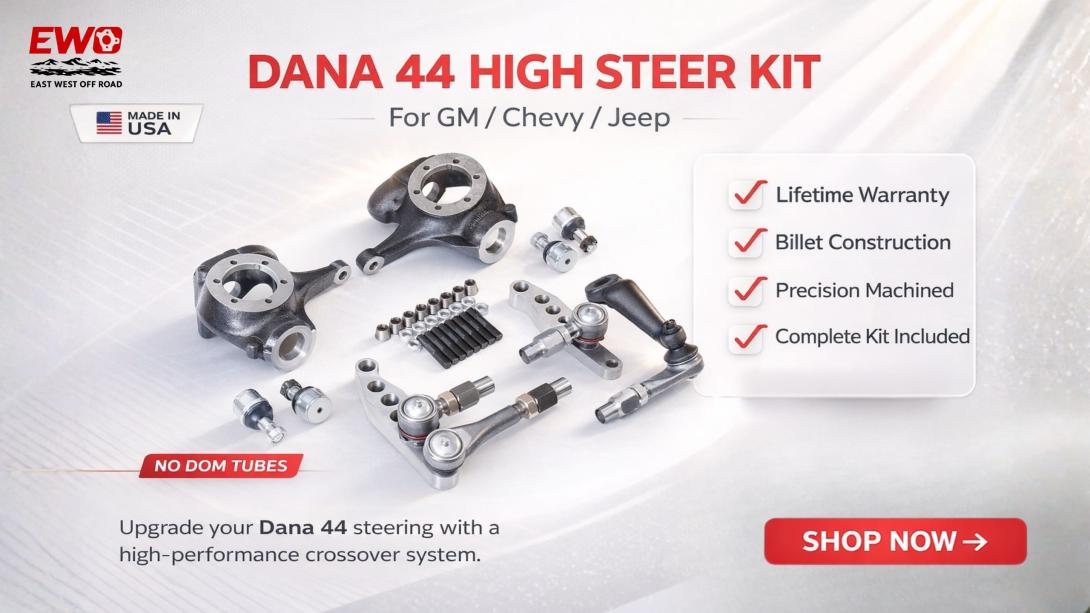
Buy Now: GM / Chevy / Jeep Dana 44 Complete 1-Ton Crossover High Steer Kit
A Square Body Crossover Steering Conversion is a popular upgrade for classic Chevy and GMC 4x4 trucks, especially builds using a Dana 44 front axle, larger tires, and suspension lift. The factory steering arrangement can become less effective as ride height and tire size increase. A properly designed crossover steering system moves the drag link to a high-steer arm on the passenger-side knuckle, creating a stronger and more suitable steering layout for modified off-road trucks.
For K10 and K20 square-body trucks, K5 Blazers, and custom Dana 44 swaps, a complete high-steer conversion can improve steering component strength, provide additional under-axle clearance, and create a better foundation for serious trail use.
Why Choose a Square Body Crossover Steering Conversion?
Classic GM square-body trucks are excellent platforms for off-road builds, but many modified trucks operate far beyond their original factory configuration.
Larger tires, suspension lifts, increased articulation, and aggressive trail driving can place substantially greater loads on the original steering components.
A crossover conversion addresses these challenges by changing the steering linkage layout rather than simply replacing individual factory parts.
Stronger Steering Geometry
A crossover steering system connects the steering box pitman arm to the passenger-side steering arm across the front axle. This creates a more direct steering path compared with many factory-style steering arrangements.
When correctly configured, the system can work better with lifted suspension and larger tires.
Higher Steering Linkage
One of the biggest advantages of high-steer crossover steering is moving the steering linkage higher on the axle.
This can help protect the drag link and tie rod from rocks, ledges, and other obstacles encountered during off-road driving.
Dana 44 High Steer for Square Body Chevy Trucks
The Dana 44 is a popular front axle for classic GM 4x4 builds because of its availability and aftermarket support.
A proper Dana 44 high-steer setup generally requires compatible flat-top knuckles, high-steer arms, steering ends, and correctly configured crossover linkage.
Dana 44 Flat Top Knuckles
Flat-top knuckles provide the mounting surface required for many high-steer arm configurations.
For a GM application, it is important to confirm the correct knuckle configuration before purchasing components. Driver and passenger-side knuckles must match the intended steering arrangement and axle configuration.
1-Ton High Steer Arms
High-steer arms transfer steering forces from the linkage into the knuckles. Heavy-duty arms are particularly important for trucks running large tires or seeing frequent rock-crawling use.
The steering arms should be matched with the appropriate mounting studs, nuts, tapers, and steering ends.
For builders looking for a complete system, the GM/Chevy/Jeep Dana 44 1-ton crossover high steer kit provides the major high-steer components in one package.
Square Body K10 and K20 Crossover Steering
K10 and K20 trucks are common candidates for crossover steering conversions.
A lifted K10 or K20 with larger tires can benefit from a steering layout designed specifically around the modified suspension and axle position.
K10 Crossover Steering
A K10 crossover setup typically uses a Dana 44 or compatible front axle with high-steer knuckles and arms.
The final steering geometry should be checked at ride height, full compression, full droop, and full steering lock.
K20 Heavy-Duty Steering
The heavier-duty K20 platform is also well suited to a 1-ton-style steering upgrade.
When the truck is fitted with larger tires and used for demanding off-road driving, upgrading the steering linkage can help create a more durable overall system.
How Crossover Steering Works
Crossover steering changes the way the steering box controls the front axle.
The steering box turns the pitman arm, which moves the drag link across the axle to the passenger-side high-steer arm. Steering movement is then transferred through the tie rod to the opposite knuckle.
This arrangement can provide a cleaner steering path for many lifted GM 4x4 applications.
Crossover Steering vs. Factory Push-Pull Steering
Factory steering systems often use a push-pull arrangement that can become difficult to maintain correctly after substantial suspension modifications.
Crossover steering changes the steering architecture by routing the drag link across the axle.
The result can be:
- Better linkage positioning
- Increased steering clearance
- Stronger steering components
- Better suitability for lifted trucks
- Improved protection from trail obstacles
- Compatibility with heavy-duty 1-ton steering components
The conversion still needs to be engineered around the vehicle's suspension geometry.
Fixing Steering Problems on Lifted Square Body Trucks
A suspension lift changes the relationship between the axle, steering box, pitman arm, and steering linkage.
This can create undesirable steering behavior if the linkage angles are not properly matched.
Bump Steer Considerations
Bump steer occurs when suspension movement causes unintended steering movement.
A crossover steering conversion can help improve the steering geometry on a lifted truck, but simply installing high-steer arms does not automatically eliminate bump steer.
The drag link and suspension components need to move through compatible arcs.
Pitman Arm Selection
The pitman arm is another important part of the conversion.
Depending on the steering box and suspension height, a dropped pitman arm may be required. A common GM configuration uses a 3-inch drop pitman arm with a 32-spline sector shaft, but compatibility must always be confirmed for the specific steering box.
Never choose a pitman arm solely based on lift height. Verify actual steering geometry and component clearance.
What Components Are Needed?
A complete Square Body Crossover Steering Conversion can include several major components.
Dana 44 Steering Knuckles
High-steer-compatible flat-top knuckles provide the mounting points for the steering arms.
Billet High-Steer Arms
Heavy-duty billet steering arms provide the connection between the knuckles and steering linkage.
Drag Link Ends
GM-style drag link ends such as ES2026R and ES2027L may be used depending on the specific configuration.
Tie Rod Ends
ES2234L and ES2234R-style tie rod ends are commonly associated with GM 1-ton steering configurations.
The correct taper and thread configuration must be confirmed before assembly.
Steering Linkage
The drag link and tie rod connect the steering arms and steering box into a complete system. Builders using a kit without DOM tubing will need to fabricate or source the appropriate linkage material.
1-Ton Steering Upgrade for Square Body Chevy
A 1-ton steering setup is a popular choice for square-body trucks running larger tires.
The term "1-ton" generally refers to the heavy-duty steering components being used, including larger steering ends and robust linkage.
For serious off-road builds, matching all components as a system is more important than simply selecting the largest individual part.
A complete Dana 44 1-ton high-steer crossover system can simplify the process by providing compatible major components for the conversion.
Installation Considerations
A Square Body Crossover Steering Conversion should be installed carefully because steering components are safety-critical.
Before final assembly, inspect the entire steering system for interference and verify movement through the full suspension range.
Check Steering Clearance
Check clearance between the steering linkage and:
- Differential housing
- Differential cover
- Leaf springs
- Shocks
- Wheels and tires
- Frame
- Pitman arm
- Steering box
- Suspension components
The steering should operate from lock to lock without binding.
Check Full Suspension Travel
Do not check clearance only at ride height.
Cycle the suspension through full compression and droop while turning the steering from side to side.
This is particularly important on lifted square-body trucks with long-travel suspension.
Verify Steering Arm Hardware
High-steer arms experience substantial forces. Use the specified studs and hardware and follow the manufacturer's installation and torque requirements.
Incorrect installation can compromise the strength of the entire steering system.
Benefits of a Complete High-Steer Kit
Building a steering system from unrelated components can create compatibility issues.
A complete kit can simplify component selection by bringing together the major parts needed for the conversion.
Benefits may include:
- Compatible high-steer knuckles
- Matching steering arms
- Heavy-duty steering ends
- Correct mounting hardware
- Simplified parts sourcing
- Better component compatibility
- Cleaner installation planning
For a custom build, the East West Off Road Dana 44 steering conversion kit is designed around GM, Chevy, and Jeep Dana 44 high-steer applications.
Is Crossover Steering Right for Your Square Body?
A crossover system makes the most sense when a square-body truck has been significantly modified.
Consider the conversion if your build includes:
- Dana 44 front axle
- Suspension lift
- Large off-road tires
- K10 or K20 platform
- K5 Blazer
- Rock crawling
- Heavy-duty steering components
- Custom 1-ton steering
- High-steer conversion
- Increased axle articulation
For a mostly stock truck with factory-size tires and suspension, a complete crossover conversion may not be necessary.
Frequently Asked Questions (FAQs)
What is a Square Body Crossover Steering Conversion?
It is a steering modification that routes the drag link across the front axle to a high-steer arm, typically using compatible Dana 44 flat-top knuckles and steering arms.
Is crossover steering good for a lifted K10?
Yes. A properly designed crossover system can provide better steering linkage positioning and clearance for lifted K10 applications.
Does crossover steering eliminate bump steer?
Not automatically. Bump steer depends on suspension and steering geometry. The drag link, suspension movement, pitman arm, and axle position must all work together correctly.
Do I need flat-top Dana 44 knuckles?
Most traditional Dana 44 high-steer conversions require a suitable flat-top knuckle or another knuckle specifically designed to accept the high-steer arm.
Can I use 1-ton steering on a Dana 44?
Yes, GM 1-ton-style steering components are commonly used with Dana 44 crossover systems when the steering ends, tapers, knuckles, arms, and linkage are properly matched.
Is crossover steering better than factory push-pull steering?
For many lifted and modified GM 4x4s, crossover steering offers a more suitable steering layout and can provide better linkage placement than the original push-pull arrangement.
Can this work on a K5 Blazer?
A Dana 44 crossover high-steer system can be suitable for K5 Blazer builds when the axle, steering box, suspension, and steering components are compatible.
Do I need DOM tubing?
The exact requirement depends on the kit configuration. A kit supplied without DOM tubing requires the builder to fabricate or source the appropriate drag link and tie rod tubing.
What should I check before installing high steer?
Verify axle compatibility, knuckle type, steering arm mounting, steering-end taper, pitman arm spline, steering box configuration, suspension lift, tire clearance, and full steering/suspension travel.
Final Thoughts
A Square Body Crossover Steering Conversion is a strong upgrade path for modified Chevy and GMC 4x4s using a Dana 44 front axle. By combining flat-top knuckles, high-steer arms, heavy-duty steering ends, and properly designed crossover linkage, builders can create a steering system better suited to lifted suspension and larger off-road tires.
The key is to treat the conversion as a complete steering-geometry project rather than simply installing larger components. Correct parts compatibility, steering angles, clearance, and installation are essential for a reliable and predictable result on the street and trail.