

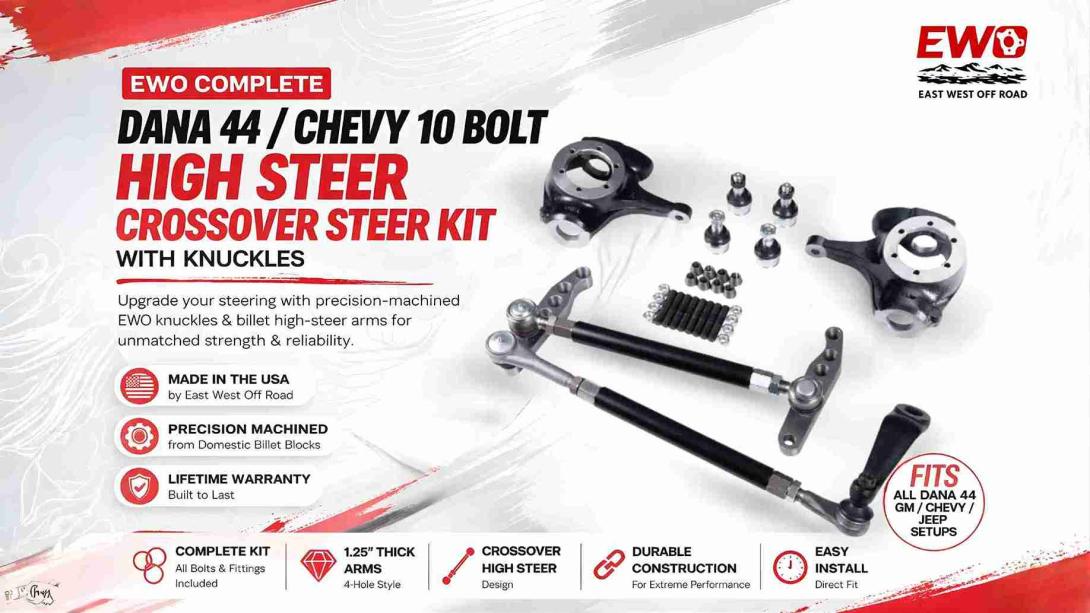
A Square Body Chevy High Steer Upgrade is one of the most important steering modifications to consider when a classic K5 Blazer, K10, K20, Suburban, or GMC 4x4 has been lifted, fitted with larger tires, or built for serious off-road use. Instead of keeping the steering linkage low near rocks and trail obstacles, a properly planned crossover high-steer system relocates key steering connections higher on compatible Dana 44 or Chevy 10 Bolt knuckles while changing the drag-link path to better suit a modified solid-front-axle truck.
For builders moving beyond factory steering geometry, a complete kit can simplify the project by combining flat-top knuckles, billet high-steer arms, GM-style steering ends, DOM tubing, ball joints, pitman-arm components, weld bungs, jam nuts, and related installation hardware in one coordinated package.
Why Square Body Chevy Steering Changes After a Lift
Square Body Chevy and GMC trucks were designed around factory suspension height, tire size, steering-box location, and axle geometry.
Once you modify those variables, the steering system operates in a different environment.
Common upgrades include:
- 4-inch or larger suspension lifts
- Larger off-road tires
- Longer leaf springs
- Custom shackles
- Dana 44 swaps
- GM Corporate 10 Bolt axles
- High-clearance differential covers
- Rock-crawling suspension setups
Each change can affect steering-link angles and clearance.
That is why a serious steering upgrade should be planned around the finished truck instead of simply replacing one worn factory component.
What Is High Steer on a Square Body Chevy?
High steer relocates one or more steering attachment points higher on the axle.
This is normally done with:
- Flat-top steering knuckles
- Bolt-on high-steer arms
- Compatible heavy-duty steering ends
The goal is to position the tie rod, drag link, or both higher than a traditional low-mounted steering arrangement.
This can be especially useful on off-road trucks where a low tie rod is exposed to rocks, ledges, roots, and deep ruts.
High Steer vs. Crossover Steering
High steer and crossover steering are related, but they are not identical.
Crossover Steering
Crossover steering describes the drag-link routing.
Instead of the original push-pull arrangement found on many older GM trucks, the drag link travels across the vehicle toward the passenger side of the axle.
High Steer
High steer describes the vertical position of the steering links.
High-steer arms mount on top of compatible flat-top knuckles and create higher mounting locations.
A well-designed Square Body build may use both crossover steering and high steer together.
Why Crossover Steering Is Popular on Lifted Square Bodies
As a Chevy K5, K10, or K20 is lifted, the original steering arrangement may become less desirable for the new suspension position.
Crossover steering creates a longer drag-link path that gives the builder greater flexibility when working with modified ride height.
This can be especially relevant when building:
- Lifted K5 Blazers
- K10 trail trucks
- K20 work/off-road builds
- Square Body Suburbans
- GMC Jimmy projects
- Custom rock crawlers
The goal should be correct steering geometry—not simply installing the tallest steering arm available.
Dana 44 and Chevy 10 Bolt Axles
Square Body GM trucks commonly appear in high-steer discussions with either a Dana 44 or GM Corporate 10 Bolt front axle.
Both axle families are popular in crossover steering builds.
However, the axle name alone is not enough to confirm fitment.
Before purchasing components, verify:
- Actual axle
- Knuckle type
- Ball joints
- Spindle pattern
- Brake arrangement
- Hub configuration
- Steering-arm interface
Decades-old Square Body trucks frequently have replacement or swapped axles.
Chevy 10 Bolt Crossover Steering Kit
A Chevy 10 Bolt Crossover Steering Kit can provide the major components needed to convert a compatible GM 10 Bolt front axle to crossover/high-steer steering.
This approach is especially useful when the builder wants to avoid piecing together unrelated components from several manufacturers.
A complete system can help coordinate:
- Knuckles
- Steering arms
- Tie rod ends
- Drag link ends
- Pitman arm
- DOM tubing
- Threaded adapters
- Ball joints
Fitment still needs to be checked on the actual truck.
Dana 44 vs. 10 Bolt Crossover Steering
Builders frequently compare Dana 44 vs 10 Bolt Crossover Steering because the two axles appear in many similar GM applications.
The steering principles are similar, but individual outer components can differ.
Important differences may involve:
- Knuckle casting
- Brake components
- Spindles
- Hub arrangement
- Existing steering hardware
Do not assume that every Dana 44 steering part fits every GM 10 Bolt simply because both appear under Square Body trucks.
Dana 44 Flat Top Knuckle Conversion
A Dana 44 Flat Top Knuckle Conversion creates the upper mounting platform needed for traditional high-steer arms.
The flat-top surface allows an arm to sit above the knuckle.
That arm then provides a connection point for the tie rod, drag link, or both.
The knuckle must work with the rest of the outer axle components.
Check:
- Ball joints
- Spindle
- Brakes
- Hub
- High-steer arm
- Stud pattern
- Steering taper
Driver and Passenger Flat Top Knuckles
A Dana 44 driver passenger flat top knuckles package gives builders more flexibility than a passenger-side-only crossover conversion.
With compatible arms on both sides, the system may support:
- High-mounted tie rod
- Crossover drag link
- Full high-steer arrangement
This can be useful on rock crawlers and lifted Square Body trucks where maximizing steering-link clearance is a priority.
Why Billet High Steer Arms Matter
High-steer arms carry steering forces from the linkage into the knuckles.
They should therefore be treated as structural steering components.
The EWO package described for this build uses 1.25 inch billet high steer arms.
When comparing arms, consider:
- Material
- Thickness
- Machining
- Steering-end taper
- Mounting hardware
- Knuckle compatibility
Arm thickness alone does not determine whether a steering setup is correct.
USA-Made Dana 44 Steering Arms
The supplied product information identifies the steering arms as USA-made from domestic billet material.
For buyers specifically searching for USA Made Dana 44 Steering Arms, that can be an important product-selection factor.
Still, country of manufacture should be evaluated alongside:
- Fitment
- Material
- Machining quality
- Hardware
- Steering geometry
A steering arm must work correctly with the complete system.
GM 1-Ton Steering Ends
Many heavy-duty Square Body crossover systems use GM-style steering ends commonly described as “1-ton” steering.
This terminology refers to the steering-end family.
It does not change the truck's:
- GVWR
- Payload
- Axle rating
- Towing capacity
These components are popular because they work well in heavy-duty custom steering systems when paired with the correct tapers and linkage.
ES2026R and ES2027L Drag Link Ends
The supplied EWO kit specification includes ES2026R ES2027L drag link ends.
These ends form the adjustable connections in the drag link.
Exact part identification matters because right- and left-hand threads must be matched to the correct tube adapters and jam nuts.
When replacing ends later, confirm:
- Part number
- Thread direction
- Taper
- Stud orientation
Do not substitute a visually similar steering end without checking specifications.
ES2234L and ES2234R Tie Rod Ends
The kit also specifies ES2234L ES2234R tie rod ends.
These are used in the tie rod portion of the steering system.
Correct fitment depends on:
- Steering-arm taper
- Thread direction
- Tube adapter
- Adjustment range
- Installed articulation
Every threaded and tapered interface needs to match.
1.50 x .250 DOM Tubing Steering Kit
The supplied product configuration includes heavy-wall DOM tubing.
The specified tubing is:
- 1.50-inch outside diameter
- .250-inch wall
- 54-inch supplied tube
- 43-inch supplied tube
That makes the package relevant to shoppers researching a 1.50 x .250 DOM tubing steering kit.
DOM steel is commonly used for custom tie rod and drag link fabrication because it provides a substantial mechanical tube for fabricated off-road steering systems.
Supplied Tube Length vs. Finished Link Length
A 54-inch or 43-inch supplied tube should not automatically be treated as the final installed dimension.
Final steering-link length depends on the actual vehicle.
Factors include:
- Axle width
- High-steer arm position
- Steering-box location
- Pitman-arm position
- Adjustment allowance
- Thread engagement
Mock up the steering first and establish final dimensions before completing fabrication.
7/8-18 Weld Bungs and Jam Nuts
The supplied steering package uses 7/8-18 threaded interfaces.
Weld bungs or tube adapters connect the DOM tubing to the steering ends.
The system also uses left- and right-hand jam nuts.
Opposing thread directions allow adjustment when the tube is configured correctly.
Because the steering links are structural, fabrication quality is critical.
Is It a Bolt-On High Steer Kit?
The phrase Bolt-On High Steer Kit GM 10 Bolt can be misleading if interpreted too literally.
Providing ready flat-top knuckles and high-steer arms may eliminate some of the machining work involved in modifying factory components.
However, a complete crossover project can still involve:
- DOM fabrication
- Welding
- Steering-box changes
- Pitman-arm changes
- Alignment
- Clearance checks
“Bolt-on” should therefore refer only to components specifically designed to bolt together—not the assumption that the entire truck conversion requires zero fabrication.
K10 Crossover Steering Kit No Reaming
Some builders specifically search for a K10 Crossover Steering Kit No Reaming because they want to avoid modifying factory knuckle tapers.
A complete system with matched knuckles, arms, and steering ends can reduce the need for field modification.
However, never assume “no reaming” applies to every truck or every existing component.
Verify the current kit instructions and the actual axle before installation.
Why a 2WD Steering Box Is Required
A traditional Square Body crossover conversion uses a different drag-link path than the factory push-pull arrangement.
The supplied EWO product notes specify a 2wd steering box crossover setup.
The steering-box output determines how the pitman arm moves the drag link.
Before purchasing a box, confirm:
- Model
- Sector shaft
- Spline count
- Rotation
- Mounting
- Hydraulic fittings
A random GM 2WD box should not be installed without verifying these details.
3-Inch Dropped Pitman Arm With 32-Spline Setup
The supplied package includes a 3 inch dropped pitman arm 32 spline configuration.
The pitman arm creates the connection between the steering box and drag link.
Its vertical position affects:
- Drag-link angle
- Frame clearance
- Suspension clearance
- Joint articulation
The amount of drop should work with the complete geometry.
More drop is not automatically better.
Square Body Leaf Spring Clearance
Square Body 4x4s commonly use front leaf springs.
That makes spring clearance one of the most important high-steer checks.
Inspect clearance between:
- Tie rod and spring
- Drag link and spring
- High-steer arms and spring
Check at both normal ride height and full articulation.
A system that clears while parked may interfere when the suspension compresses.
Differential Cover Clearance
Aftermarket differential covers are common on trail trucks.
Large covers may protrude farther than stock.
Check tie rod clearance at:
- Straight ahead
- Full left lock
- Full right lock
- Suspension compression
Mixing high-steer parts with a large differential cover can create clearance problems even when each product fits independently.
Oil Pan and Frame Clearance
High steer moves the linkage away from obstacles below the axle, but that can reduce clearance above it.
Potential interference points include:
- Oil pan
- Engine crossmember
- Frame
- Shock mounts
- Sway-bar components
A good high-steer conversion balances lower trail clearance with safe upper clearance.
Fix Bump Steer Lifted Chevy K5
Owners often search Fix Bump Steer Lifted Chevy K5 when the steering wheel reacts as the front suspension cycles.
Crossover/high steer can help create a better steering layout, but it is not an automatic bump-steer cure.
Bump steer depends on the relationship between:
- Drag-link movement
- Suspension movement
- Pitman-arm location
- Steering-arm location
Poor geometry can still cause undesirable steering even with premium components.
The goal is not simply to raise the drag link. The goal is to place it where the suspension and steering work together correctly.
High Steer for Rock Crawling
A low-mounted tie rod is exposed to trail impacts.
Rock crawling can put steering components directly in contact with:
- Rocks
- Ledges
- Tree roots
- Ruts
High steer relocates the linkage higher and can reduce that exposure.
That is one reason an hd crossover steering kit is popular on serious trail trucks.
High Steer and Large Tires
Large tires create more leverage on the steering system.
This is most noticeable when:
- Turning at low speed
- Rock crawling
- A tire is wedged against an obstacle
- Driving on high-traction surfaces
A heavy-duty crossover system can provide a more substantial steering architecture, but the rest of the front end still needs to be healthy.
Dana 44 Upper Lower Ball Joints Kit
The supplied steering package includes a Dana 44 upper lower ball joints kit.
Replacing knuckles gives convenient access to the ball joints.
Inspecting or replacing them during the conversion can help avoid building new steering around worn pivot points.
Worn ball joints may cause:
- Steering play
- Tire wear
- Alignment changes
- Knuckle movement
Inspect the Steering Box Mounting Area
Classic Chevy frames can experience substantial steering-box loads.
Before installing stronger linkage, inspect:
- Steering-box bolts
- Frame cracks
- Elongated mounting holes
- Existing reinforcement
- Box movement
A heavy-duty tie rod cannot compensate for an unstable steering-box mount.
Inspect the Whole Front Axle
Before completing a Square Body high-steer conversion, also inspect:
- Wheel bearings
- Axle U-joints
- Hubs
- Spindles
- Brakes
- Leaf-spring bushings
- Shackles
- Wheels
- Tires
A complete front-end inspection prevents worn components from being mistaken for problems with the new steering system.
Jeep Dana 44 High Steer Upgrade
The same general high-steer concept can appear in a Jeep Dana 44 high steer upgrade, especially when a compatible Chevy Dana 44 front axle or GM-style outer configuration has been swapped into a Jeep.
Do not assume all Jeep Dana 44 axles use the same knuckles or steering interfaces as Chevy applications.
Physically identify the axle before ordering components.
Why a Complete Kit Helps
A high-steer conversion requires multiple matching components.
Sourcing them individually means confirming:
- Knuckle compatibility
- Arm pattern
- Steering-end taper
- Thread direction
- DOM tubing
- Weld bungs
- Pitman-arm spline
- Ball joints
- Hardware
An EWO complete Dana 44 high steer kit packages the major steering components together, reducing the amount of separate parts matching required.
Complete Kit vs. Arm-Only Upgrade
An arm-only upgrade may make sense if the truck already has:
- Correct flat-top knuckles
- Crossover steering
- Compatible tie rod
- Correct drag link
- Suitable pitman arm
A complete system makes more sense when rebuilding the entire steering arrangement.
This is especially common on trucks where the existing steering is:
- Worn
- Mismatched
- Modified by previous owners
- Unsuitable for the new lift or axle setup
Steering Stops After Installation
After installing new knuckles and steering arms, verify steering stops.
The stops should prevent:
- Tire-to-spring contact
- Tie rod end binding
- Drag-link-end binding
- Axle U-joint overtravel
- Steering-box mechanical overtravel
The steering linkage itself should not become the vehicle's stop.
Full Suspension Travel Check
Before regular road or trail use, cycle the suspension through as much of its expected range as practical.
Check:
- Full compression
- Full droop
- Driver-side articulation
- Passenger-side articulation
- Full left steering
- Full right steering
Inspect every steering connection for binding or contact.
Alignment After the High Steer Upgrade
Any major steering change should be followed by alignment.
Toe
Tie rod length controls toe.
Steering Wheel Centering
Drag-link adjustment affects steering-wheel center.
Caster
Caster strongly affects straight-line stability and return-to-center.
Clearance
Recheck all clearances after final alignment because adjustment can shift linkage positions.
Will High Steer Fix Loose Steering?
Not automatically.
Loose steering can come from:
- Steering-box wear
- Steering shaft
- Ball joints
- Wheel bearings
- Tie rod ends
- Frame movement
- Leaf-spring bushings
A high-steer kit replaces or relocates certain steering components but cannot fix unrelated wear elsewhere in the truck.
Who Should Consider This Upgrade?
A Square Body high-steer conversion is especially relevant for:
- Lifted K5 Blazers
- Chevy K10 builds
- Chevy K20 builds
- GMC K-series trucks
- Square Body Suburbans
- Dana 44 front axle builds
- Chevy 10 Bolt projects
- Rock crawlers
- Trail rigs
- Custom off-road trucks
A near-stock truck with healthy factory steering may not need the same level of modification.
What to Verify Before Ordering
Before buying, confirm:
- Actual axle
- Dana 44 or GM 10 Bolt
- Knuckle configuration
- Spindles
- Brake components
- Ball joints
- Steering-box type
- Sector-shaft spline
- Pitman arm
- Lift height
- Wheel backspacing
- Tire size
- Differential-cover clearance
- Leaf-spring clearance
- Fabrication capability
Taking measurements first is easier than correcting incompatible steering components after installation begins.
Why Choose a Complete Dana 44 Crossover System?
A Complete Dana 44 Crossover Steering System is most valuable when the builder wants to overhaul the entire steering layout rather than upgrade one piece at a time.
The supplied EWO configuration brings together:
- Driver and passenger flat-top knuckles
- 1.25-inch billet high-steer arms
- ES2026R and ES2027L drag-link ends
- ES2234L and ES2234R tie rod ends
- 7/8-18 threaded components
- DOM tubing
- Upper and lower ball joints
- 3-inch dropped pitman arm
- Installation hardware
That gives Square Body builders a coordinated foundation for a full crossover/high-steer project.
Final Thoughts
A Square Body Chevy High Steer Upgrade should be viewed as a complete steering-system project—not simply a way to move the tie rod higher.
A successful build coordinates:
- Dana 44 or Chevy 10 Bolt axle
- Flat-top knuckles
- Billet high-steer arms
- GM-style steering ends
- DOM tie rod and drag link
- 2WD crossover steering box
- Pitman arm
- Ball joints
- Suspension geometry
- Wheel and tire clearance
For lifted K5, K10, K20, GMC, and Suburban projects, crossover high steer can provide a much more purpose-built steering layout for off-road use when the geometry is correctly planned.
The most important step is verifying the truck before ordering. Old Square Bodies often carry decades of previous modifications, so build the steering system around the axle and components actually under the vehicle—not simply what originally came from the factory.
Frequently Asked Questions (FAQs)
What is a Square Body Chevy High Steer Upgrade?
It is a steering conversion that relocates steering attachment points higher on the front axle, commonly using flat-top knuckles and high-steer arms.
What is crossover steering on a Square Body Chevy?
Crossover steering routes the drag link from the steering box across the vehicle toward the passenger-side steering arm instead of using the original push-pull layout.
Is crossover steering the same as high steer?
No. Crossover refers to drag-link routing, while high steer refers to the elevated mounting position of steering linkage.
Which Square Body trucks commonly use high steer?
K5 Blazers, K10s, K20s, GMC K-series trucks, Jimmy models, and Square Body Suburbans are common candidates when heavily modified.
Can high steer work with a Dana 44?
Yes, compatible Dana 44 axles are commonly used in crossover/high-steer builds.
Can a Chevy 10 Bolt use high steer?
Compatible GM Corporate 10 Bolt front axles are also common high-steer applications.
Do I need flat-top knuckles?
Traditional Dana 44/10 Bolt high-steer systems normally require compatible flat-top knuckles or another purpose-designed steering-arm mounting solution.
Does the EWO kit include both knuckles?
The supplied configuration includes driver- and passenger-side flat-top knuckles.
What size are the high-steer arms?
The supplied product specification identifies 1.25-inch-thick billet high-steer arms.
Does the kit include DOM tubing?
Yes. The supplied configuration includes 54-inch and 43-inch DOM tubes.
What size DOM tubing is supplied?
The specified material is 1.50-inch OD with a .250-inch wall.
Are the supplied DOM lengths the final installed dimensions?
Not necessarily. Final link dimensions depend on the actual steering and axle geometry.
What steering ends are included?
The supplied configuration lists ES2026R and ES2027L drag-link ends plus ES2234L and ES2234R tie rod ends.
Does the kit include ball joints?
Yes. Upper and lower Dana 44 ball joints are included in the supplied product specification.
Does crossover steering require a 2WD steering box?
The supplied EWO product information states that a 2WD steering box is required for this crossover setup.
Does the kit include a drop pitman arm?
Yes. The supplied package lists a 3-inch dropped pitman arm with the specified setup.
Will high steer eliminate bump steer on my K5?
Not automatically. Correct high-steer/crossover geometry can help address bump-steer concerns, but the final drag-link and suspension relationship determines the result.
Is high steer useful for rock crawling?
Yes. Moving steering linkage higher can reduce its exposure to rocks and trail obstacles when the system is properly configured.
Can I use high steer with large tires?
High steer and heavy-duty steering are commonly used on large-tire builds, but tires also increase loads on the steering and front axle. The complete front end must be evaluated.
Do I need to weld anything?
The supplied DOM and weld-bung configuration involves steering-link fabrication. Use a qualified fabricator if you are not experienced with structural steering work.
Do I need an alignment after installation?
Yes. Toe, caster, steering-wheel centering, steering stops, articulation, and clearances should be checked after the conversion.
Will high steer fix loose steering?
Only if the looseness comes from components being replaced. Steering-box wear, bearings, ball joints, bushings, or frame movement can also cause play.
What should I inspect before installing high steer?
Inspect the axle, steering box, frame mounts, ball joints, wheel bearings, U-joints, spindles, brakes, leaf springs, wheels, tires, and existing steering hardware.
Where can I buy the complete EWO Square Body high-steer kit?
The East West Off Road Complete Dana 44 / Chevy 10 Bolt High Steer Crossover Steering Kit with Knuckles is available through the Buy Now link at the top of this article.