
The global Soft Drinks Packaging Market is witnessing steady growth as beverage manufacturers respond to changing consumer preferences, expanding retail channels, and increasing demand for convenient and portable drink formats. Packaging plays an important role in protecting beverages, extending shelf life, improving transportation efficiency, and supporting product differentiation in a competitive beverage industry.
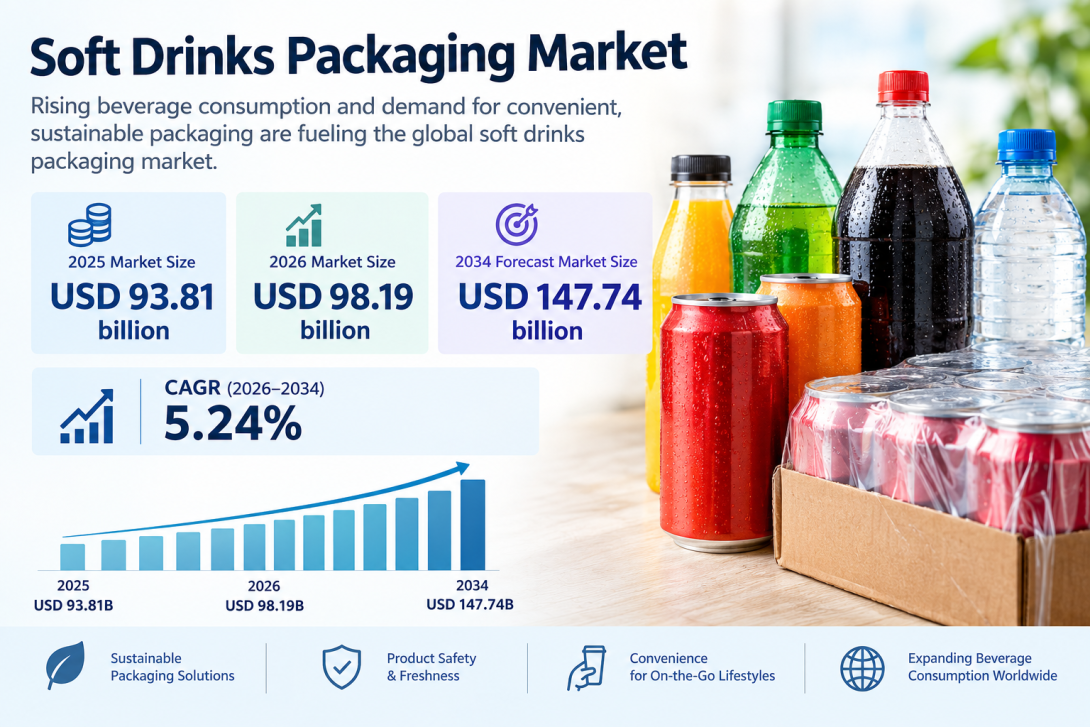
According to Fortune Business Insights, the global soft drinks packaging market size was valued at USD 93.81 billion in 2025. The market is projected to grow from USD 98.19 billion in 2026 to USD 147.74 billion by 2034, exhibiting a CAGR of 5.24% during the forecast period.
Rising Consumption of Soft Drinks Supports Market Growth
Growing consumption of carbonated beverages, bottled water, energy drinks, sports drinks, juices, and other ready-to-drink products is supporting demand for packaging solutions. Consumers increasingly prefer beverages that are easy to carry, store, and consume while traveling, working, or participating in outdoor activities.
The expansion of supermarkets, convenience stores, restaurants, foodservice outlets, and online retail platforms is also increasing the need for efficient beverage packaging. Manufacturers are therefore focusing on packaging formats that provide convenience while maintaining product quality.
Increasing Demand for Convenient Packaging Formats
Convenience remains a major factor influencing packaging decisions in the soft drinks industry. Bottles, cans, cartons, and other lightweight formats allow consumers to transport and consume beverages easily.
Single-serve packaging is particularly relevant for on-the-go consumption, while larger containers are commonly used for household and group consumption. Packaging manufacturers are continuously developing lighter designs that can reduce material usage while maintaining the required strength and functionality.
For detailed market insights : https://www.fortunebusinessinsights.com/soft-drinks-packaging-market-119147
Material Analysis
The Soft Drinks Packaging Market includes packaging manufactured from materials such as plastic, metal, glass, paper and paperboard, and other materials.
Plastic packaging remains important because of its lightweight characteristics, flexibility, durability, and suitability for different beverage formats. PET bottles are widely used for soft drinks and other beverages because they are relatively lightweight and convenient for transportation.
Metal packaging, particularly aluminum cans, is also widely adopted due to its recyclability, durability, and ability to provide effective protection for beverages. Glass remains relevant in premium and specialty beverage segments, while paper-based packaging continues to attract attention as manufacturers explore alternative packaging solutions.
Packaging Type Analysis
Based on packaging type, the market can be categorized into bottles, cans, cartons, pouches, and other formats.
Bottles are widely used across multiple soft drink categories because they offer portability and ease of handling. Cans are particularly popular for carbonated soft drinks, energy drinks, and other ready-to-drink beverages.
Cartons and other alternative formats are also being adopted in selected beverage applications. Packaging innovation is increasingly focused on improving convenience, reducing material consumption, and supporting recycling and sustainability objectives.
Growing Focus on Sustainable Packaging
Environmental considerations are becoming increasingly important in the packaging industry. Consumers, retailers, and beverage manufacturers are paying greater attention to packaging waste, recyclability, recycled content, and resource efficiency.
Packaging companies are therefore exploring lightweight containers, recycled materials, recyclable formats, and designs that require fewer resources during production. These developments are influencing product development throughout the Soft Drinks Packaging Market.
The transition toward more sustainable packaging is expected to remain an important trend during the forecast period as businesses seek to balance packaging performance with environmental considerations.
Application Analysis
Soft drinks packaging is used across several beverage categories, including carbonated soft drinks, juices, energy drinks, sports drinks, bottled water, and other beverages.
Carbonated beverages represent a significant application area because these products require packaging capable of maintaining carbonation and protecting the beverage during transportation and storage. Energy drinks and sports drinks are also generating packaging demand as consumption of functional and performance-oriented beverages expands.
Bottled water remains another important application due to its widespread availability across retail and foodservice channels.
Distribution Channel and Retail Expansion
The expansion of modern retail and e-commerce is contributing to the development of the Soft Drinks Packaging Market. Supermarkets and hypermarkets offer extensive beverage selections, while convenience stores emphasize portable, single-serving formats.
Online grocery and beverage delivery services are also increasing the importance of packaging durability. Products sold through online channels must be capable of withstanding handling and transportation while maintaining their quality until delivery.
Regional Analysis
The Soft Drinks Packaging Market is supported by demand across major regions, including North America, Europe, Asia Pacific, Latin America, and the Middle East & Africa.
Asia Pacific represents an important market due to its large consumer base, growing urban population, expanding beverage industry, and increasing demand for packaged drinks. Rising disposable incomes and the development of modern retail networks are also supporting packaging demand across the region.
North America benefits from established beverage consumption patterns, developed retail infrastructure, and ongoing packaging innovation. The region is also experiencing increasing interest in recyclable and lightweight packaging formats.
Europe is witnessing continued attention toward sustainable packaging, recycling, and circular-economy initiatives. These factors are influencing packaging design and material selection across the beverage sector.
Latin America and the Middle East & Africa are also expected to present opportunities as packaged beverage consumption and retail infrastructure continue to develop.
Competitive Landscape
The competitive landscape of the Soft Drinks Packaging Market includes packaging manufacturers, material suppliers, and companies specializing in beverage containers and packaging technologies.
Market participants compete based on packaging quality, production capacity, material efficiency, sustainability characteristics, design capabilities, and supply-chain reach. Companies are also investing in lightweight packaging, recycled materials, and innovative container designs to address changing customer and regulatory requirements.
Recent Industry Developments
Recent industry developments have increasingly focused on lightweight packaging, recycled content, improved recyclability, and production efficiency. Manufacturers are working to reduce the amount of material used in packaging while maintaining structural performance.
The introduction of new container designs and investments in recycling infrastructure are also influencing the market. Beverage producers and packaging companies are increasingly collaborating to develop solutions that support both product protection and sustainability goals.
Get Free Sample PDF: https://www.fortunebusinessinsights.com/enquiry/request-sample-pdf/soft-drinks-packaging-market-119147
Future Outlook
The Soft Drinks Packaging Market is expected to maintain steady growth through 2034 as beverage consumption expands and manufacturers continue to invest in convenient and efficient packaging formats.
The market is projected to increase from USD 98.19 billion in 2026 to USD 147.74 billion by 2034, registering a CAGR of 5.24% during the forecast period. Rising demand for ready-to-drink beverages, expanding retail networks, convenient packaging formats, and continued development of sustainable materials are expected to remain important factors shaping the industry's future.
Related Reports
Uncover Japan’s Market Trends - Explore the Latest - Soft Drinks Packaging Market - Insights