
The global Smart Glass Market Trends is witnessing significant growth as industries increasingly adopt advanced glass technologies that improve energy efficiency, privacy, comfort, and functionality. Smart glass can change its transparency, tint, or light transmission properties in response to electrical signals, sunlight, or temperature. It is increasingly used in buildings, automobiles, aircraft, consumer electronics, and other applications.
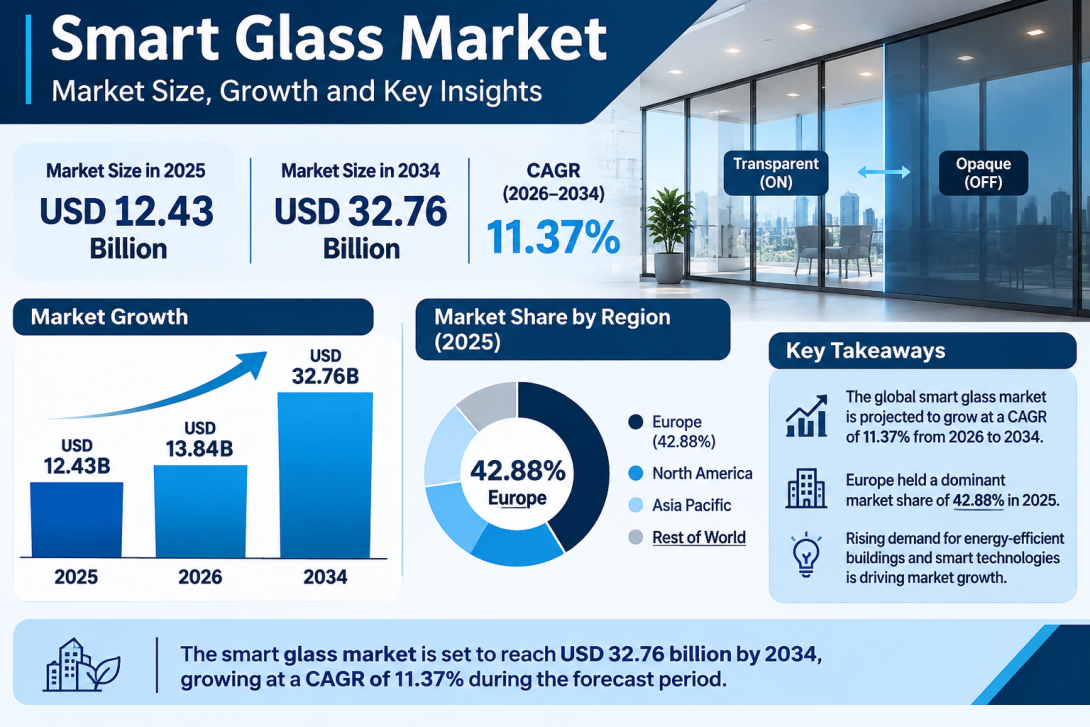
According to Fortune Business Insights, the global Smart Glass Market size was valued at USD 12.43 billion in 2025. The market is projected to grow from USD 13.84 billion in 2026 to USD 32.76 billion by 2034, exhibiting a CAGR of 11.37% during the forecast period (2026–2034). Growing demand for energy-efficient buildings, advanced automotive glazing, and modern architectural designs is supporting market expansion. Europe dominated the market with a share of 42.88% in 2025.
Growing Demand for Energy-Efficient Buildings
Increasing awareness of energy consumption and sustainable construction is driving the adoption of smart glass in residential and commercial buildings. Smart glass windows can regulate sunlight, reduce glare, and help control indoor temperatures, potentially lowering heating, ventilation, and air conditioning requirements.
Architects and construction companies are increasingly incorporating smart glazing into offices, hotels, hospitals, and modern residential properties. Government initiatives promoting energy-efficient infrastructure and green buildings are also encouraging the adoption of advanced glass technologies.
Rising Adoption in Automotive and Transportation
The automotive industry is becoming an important application area for smart glass. Manufacturers are integrating smart glass into sunroofs, windows, windshields, and vehicle interiors to improve passenger comfort and reduce exposure to excessive sunlight.
The increasing production of electric vehicles is further supporting demand for advanced glazing solutions. Smart glass can help manage heat entering vehicle cabins, potentially reducing the cooling requirements of electric vehicles and supporting improved energy efficiency. Its application in aircraft, trains, and other transportation systems is also expanding.
For detailed market insights : https://www.fortunebusinessinsights.com/smart-glass-market-102569
Technology Analysis
Based on technology, the Smart Glass Market is segmented into polymer dispersed liquid crystal (PDLC) glass, suspended particle device (SPD) glass, electrochromic glass, photochromic glass, and thermochromic glass.
Polymer Dispersed Liquid Crystal (PDLC) Glass: PDLC technology allows glass to switch between transparent and opaque states through electrical control. It is widely used in privacy windows, partitions, conference rooms, and healthcare facilities.
Suspended Particle Device (SPD) Glass: SPD glass adjusts light transmission by controlling suspended particles within the material. It is used in automotive sunroofs, architectural windows, and applications requiring adjustable sunlight and glare control.
Electrochromic Glass: Electrochromic glass changes its tint when an electrical voltage is applied. It is suitable for energy-efficient buildings, automotive windows, and commercial glazing systems.
Photochromic Glass: Photochromic glass changes its optical properties in response to light exposure. It offers applications in eyewear and specialized glazing products.
Thermochromic Glass: Thermochromic glass responds to temperature changes, adjusting its light transmission characteristics. It is used in building applications that require passive solar control.
Application Analysis
By application, the market is categorized into architectural, automotive and transportation, consumer electronics, power generation, and others.
Architectural applications include smart windows, building façades, glass partitions, skylights, and commercial glazing. The technology supports modern building designs while improving daylight management and indoor comfort.
Automotive and transportation applications include vehicle windows, panoramic roofs, aircraft windows, and other glazing systems. Consumer electronics applications are associated with advanced displays and specialized glass products. Power generation applications include innovative glazing technologies designed to support solar energy generation and building-integrated energy solutions.
Regional Analysis
The Smart Glass Market is geographically segmented into Europe, North America, Asia Pacific, South America, and the Middle East & Africa.
Europe: Europe dominated the global market with a share of 42.88% in 2025. The region benefits from energy-efficiency initiatives, sustainable construction practices, advanced automotive manufacturing, and increasing adoption of smart building technologies.
North America: Market growth is supported by investments in modern commercial infrastructure, energy-efficient buildings, automotive innovation, and smart home technologies.
Asia Pacific: Rapid urbanization, expanding construction activities, and growing automotive production are creating opportunities for smart glass manufacturers. Increasing investments in modern infrastructure are also supporting regional growth.
South America: Growing construction activities and gradual adoption of advanced building technologies are contributing to market development.
Middle East & Africa: Modern commercial developments, infrastructure investments, and demand for energy-efficient architectural solutions are creating opportunities for smart glass applications.
Competitive Landscape
Companies operating in the Smart Glass Market are focusing on product innovation, technological improvements, manufacturing capabilities, and strategic partnerships. Manufacturers are developing smart glass solutions with improved switching speed, optical clarity, durability, and energy performance.
Competition is influenced by product quality, technology differentiation, production costs, application diversity, and the ability to meet industry-specific requirements.
Recent Industry Developments
The smart glass industry is witnessing advancements in switchable glazing, electrochromic technologies, and automated light-control systems. Manufacturers are increasingly integrating smart glass with building automation systems to improve energy management and occupant comfort.
Automotive companies are also exploring advanced glazing technologies for panoramic roofs, privacy features, and improved thermal management. These developments are expanding the potential applications of smart glass across multiple industries.
Get Free Sample PDF: https://www.fortunebusinessinsights.com/enquiry/request-sample-pdf/smart-glass-market-102569
Future Outlook
The global Smart Glass Market is expected to experience strong growth through 2034, driven by increasing demand for energy-efficient infrastructure, advanced automotive technologies, and modern architectural solutions. The growing focus on sustainability and smart building development is expected to create new opportunities for manufacturers.
Technological advancements in electrochromic, SPD, PDLC, and other smart glass solutions are likely to improve product performance and expand commercial applications. With a projected CAGR of 11.37% during 2026–2034, the market is positioned for continued expansion as industries increasingly adopt intelligent glazing technologies to improve efficiency, comfort, and functionality.
Related Report
Explore Japan’s Market Opportunities - Latest - Smart Glass Market Trends - Insights