

Global investments in smart building technologies are projected to surpass $120 billion by 2026, nearly 40% of these projects fail to realize their expected operational ROI? The culprit is rarely the predictive software or the IoT sensors themselves; it is the underlying data foundation. You simply cannot operate a "smart" facility built upon "dumb," uncoordinated design data.
The Architecture, Engineering, and Construction (AEC) industry is currently navigating a profound identity shift. Driven by volatile supply chains, severe skilled labor shortages, and aggressive global sustainability mandates (such as the EU’s Energy Performance of Buildings Directive), building owners are demanding highly efficient, interconnected facilities. However, the transition from traditional construction to an autonomous, data-driven building requires a bridge. Building Information Modeling (BIM) serves as that bridge—and specifically, the digital integration of Mechanical, Electrical, and Plumbing (MEP) systems forms the critical nervous system of these modern structures. If your firm is just beginning its digital transformation journey, understanding MEP BIM is no longer an optional technological upgrade; it is your new operational baseline.
Here is a beginner's guide to how integrating MEP BIM services fundamentally transforms project delivery and paves the way for true smart building capabilities.
Demystifying MEP BIM: Moving Beyond 3D Drafting
To understand the value of MEP BIM, we must first abandon the misconception that it is merely 3D CAD on steroids. Historically, AEC professionals treated mechanical and electrical design as an isolated, geometric exercise. We drew lines to represent pipes and squares to represent air handling units, hoping they would fit within the architectural constraints on-site.
BIM shifts this paradigm from purely geometric coordination to semantic data integration. In a mature MEP model, a digital variable air volume (VAV) box is not just a 3D cube; it is a relational database. It contains embedded, highly specific metadata: the manufacturer’s specifications, exact physical dimensions, voltage requirements, thermal performance metrics, and warranty expiration dates. According to industry tracking by the Dodge Construction Network, while over 70% of firms claim to use BIM, a significant portion still only leverages it for basic visualization. True MEP BIM integration means populating your digital models with the operational data required to eventually run the physical building. It is the literal foundation of the Digital Twin.
Proactive Problem Solving: The Economics of Clash Detection
For general contractors and project managers, the most immediate and tangible benefit of integrating MEP BIM is pre-construction risk mitigation. In traditional 2D workflows, architectural, structural, and MEP teams operate in disciplinary silos. This fragmentation routinely leads to costly job-site discoveries such as a massive HVAC trunk line intersecting directly with a load-bearing steel beam.
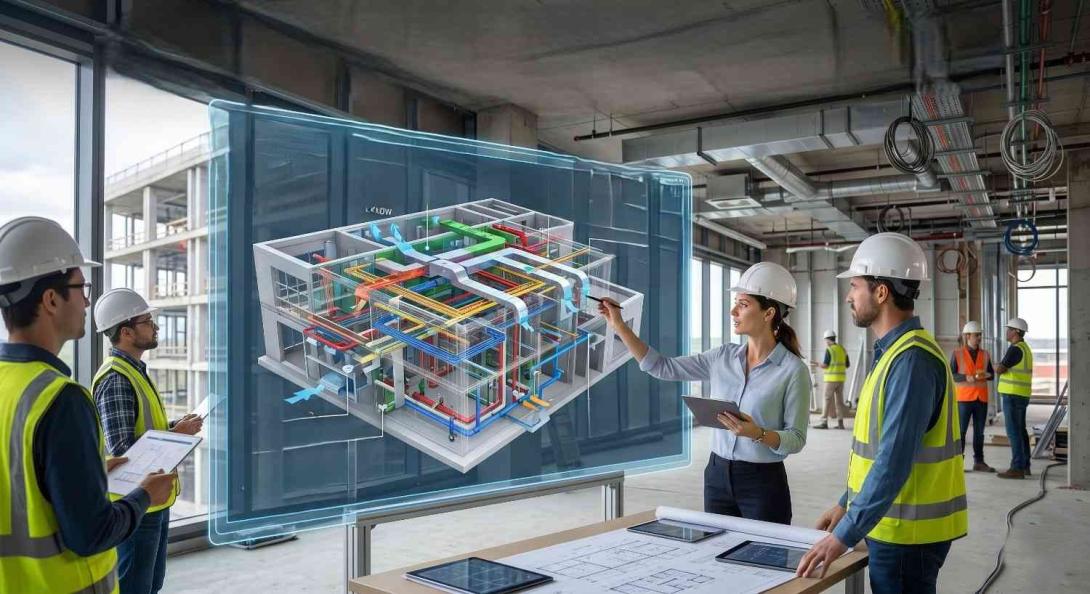
By centralizing all disciplines into a single, federated 3D environment (often using platforms like Navisworks or BIMcollab), Virtual Design and Construction (VDC) teams can run automated clash detection. This software digitally flags spatial interferences before a single material is ordered or a shovel hits the dirt. Resolving a "hard clash" digitally costs mere fractions of a cent in engineering time, whereas fixing that same error in the field—factoring in labor, wasted materials, and schedule delays can drain thousands of dollars from your profit margin. Studies consistently demonstrate that BIM-enabled clash detection reduces on-site rework expenses by 20% to 30%, aggressively protecting the contractor's bottom line while compressing the overall construction schedule.
The Data-Driven Handover: Empowering Facility Management
The true lifecycle value of MEP BIM is realized long after the ribbon-cutting ceremony. Historically, the handover process was an afterthought. Facility managers—the stakeholders responsible for 80% of a building's total lifecycle costs—were typically handed a chaotic mountain of outdated 2D drawings and analog maintenance binders.
Integrating MEP BIM effectively digitizes this handover. By structuring data according to global exchange standards like CO Bie (Construction Operations Building Information Exchange), the construction team delivers a fully searchable, intelligent digital replica of the facility. When connected to a Computerized Maintenance Management System (CMMS), this model allows facility operators to shift from reactive firefighting to predictive maintenance. For those looking to dive deeper into the mechanics of this critical lifecycle transition, I highly recommend exploring this comprehensive guide on Integrating MEP BIM Services for Smarter, Safer, and More Efficient Building Systems. It perfectly breaks down how early digital integration secures long-term operational viability and tenant safety.
Actionable Takeaways for AEC Leaders
Transitioning to an integrated BIM workflow does not require an overnight, disruptive overhaul of your firm's operations. To begin leveraging these tools effectively, implement the following steps:
- Start with a Pilot Project: Do not attempt to roll out firm-wide MEP BIM standards on a massive, high-stakes hospital build. Select a mid-sized commercial project with a forgiving schedule to test software integrations and team capabilities.
- Define Your LOD Early: Utilize a BIM Execution Plan (BEP) to explicitly define the Level of Development (LOD) required for your MEP assets at each phase. Knowing whether you need a basic geometric placeholder (LOD 200) or a data-rich, as-built asset (LOD 500) prevents scope creep and wasted engineering hours.
- Bring the Trades to the Table: Break down the traditional silos immediately. Mandate the involvement of your MEP specialty contractors during the Schematic Design (SD) phase to ensure your digital models reflect real-world constructability constraints.