

If you’re ready to Shop Jeep JKU tie rod and drag link kit options for a modified 2007–2018 Wrangler Unlimited, choosing the right system involves more than simply finding the biggest steering bars available. Your suspension lift, tire size, axle configuration, steering geometry, wheel clearance, tie rod ends, and intended use all affect which steering setup makes sense for your build.
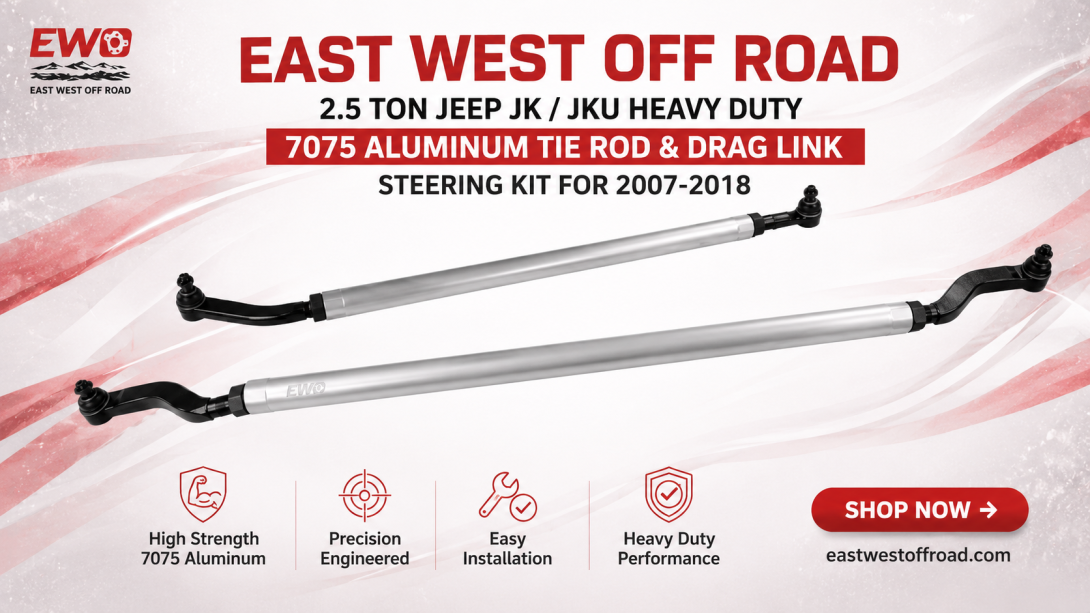
For Jeep owners looking to replace the factory linkage with a complete heavy-duty system, the East West Off Road 2.5 Ton Jeep JK / JKU Heavy Duty 7075 Aluminum Tie Rod & Drag Link Steering Kit combines a 7075 aluminum tie rod and drag link with steering configurations for different lift heights. It is designed for 2007–2018 Jeep Wrangler JK and JKU applications and gives buyers a complete steering-linkage upgrade rather than requiring them to source the two primary links separately.
What Should You Look for When Shopping for a Jeep JKU Steering Kit?
The best Jeep steering kit is not simply the one with the largest advertised components.
A well-matched steering system should work with the rest of your Wrangler’s front-end configuration.
Before purchasing, compare:
- Model-year compatibility
- JK and JKU fitment
- Tie rod construction
- Drag link construction
- Steering-end size and design
- Suspension lift requirements
- Factory-location vs. flipped drag link configuration
- Wheel and tire clearance
- Front axle configuration
- Steering stabilizer compatibility
- Adjustment method
- Replacement-part availability
- Installation requirements
- Alignment requirements
A complete Jeep JKU steering kit should be evaluated as part of the vehicle’s steering and suspension system rather than as an isolated pair of bars.
That becomes increasingly important when your Wrangler Unlimited has larger tires, aftermarket wheels, a suspension lift, upgraded axles, or frequent trail use.
Why Upgrade the Tie Rod and Drag Link Together?
The tie rod and drag link perform different jobs, but both are central to steering operation.
Replacing them as a matched system can make more sense than upgrading one while leaving the other factory component in place.
The Tie Rod Connects the Front Wheels
The tie rod links the steering knuckles and helps both front wheels turn together.
It also determines front toe adjustment.
Because of its relatively low position on the JK/JKU front axle, the tie rod can also be exposed to trail obstacles.
Owners running larger tires or using their Jeeps in rock-crawling environments often consider the factory tie rod one of the steering components worth evaluating early in the build.
The Drag Link Transfers Steering Input
The drag link transfers movement from the steering box and pitman arm toward the passenger-side steering knuckle.
Its angle and mounting position are particularly important on a lifted Jeep.
This is why buying a Jeep JKU drag link kit requires more consideration than simply choosing a stronger-looking component. Lift height and track-bar relationship can affect how the system should be configured.
When both components need attention, a complete Shop Jeep JKU tie rod and drag link kit solution provides a coordinated way to upgrade the primary steering linkage.
Why Jeep JKU Owners Upgrade the Factory Steering System
A factory Wrangler Unlimited can cover thousands of road and trail miles with its original steering components.
Problems often begin when the Jeep’s configuration becomes significantly different from stock.
Common modifications include:
- Larger off-road tires
- Wider wheels
- Different wheel backspacing
- Suspension lifts
- Heavy bumpers
- Winches
- Underbody armor
- Upgraded axles
- Frequent trail use
- Rock crawling
Larger tires are especially important.
A larger tire creates additional leverage at the steering knuckle. At low speeds, such as when turning on rock or uneven terrain, steering components may experience considerably different loads than they would with the factory wheel-and-tire package.
That is one reason a Jeep Wrangler JK steering upgrade is frequently paired with larger tire and suspension upgrades.
Why 7075 Aluminum Is Used in Heavy-Duty Jeep Steering
Material is one of the first specifications buyers notice when comparing steering kits.
7075 aluminum is widely valued in performance applications because of its high strength-to-weight characteristics.
For a steering system, that can provide a combination of substantial component construction without automatically adding the weight of an equally large steel steering bar.
A 7075 aluminum tie rod Jeep JK or JKU configuration is therefore attractive to drivers building:
- Lifted daily drivers
- Weekend trail rigs
- Overland Jeeps
- Rock crawlers
- Larger-tire Wrangler builds
- Dual-purpose street and trail Jeeps
However, material should never be the only buying factor.
Bar dimensions, tie rod ends, thread design, steering geometry, clearance, fitment, and installation quality matter too.
When you buy 7075 aluminum tie rod kit components, evaluate the entire steering system rather than purchasing based on the aluminum grade alone.
What Is a 2.5-Ton Jeep Steering Kit?
The term 2.5 ton Jeep steering kit is used in the off-road aftermarket to describe a heavy-duty steering component class.
It does not mean your Wrangler suddenly gains a 2.5-ton payload capacity.
It also does not change the Jeep’s GVWR, axle rating, towing limit, or factory weight ratings.
Instead, the terminology generally refers to oversized steering components designed for demanding aftermarket applications.
For buyers considering a heavily modified Wrangler, a 2.5 ton Jeep steering kit can provide a more substantial steering-linkage solution than stock-style replacement components.
Why a 2.5-Ton Kit Makes Sense for Modified JKU Builds
Not every Jeep JKU needs a 2.5-ton steering system.
But the upgrade becomes more relevant as a build becomes more demanding.
A 2.5 ton heavy duty steering kit for Jeep Wrangler JK or JKU may be worth considering when the vehicle:
- Runs larger tires
- Has already bent factory steering components
- Sees regular off-road use
- Is used for rock crawling
- Has a suspension lift
- Needs both tie rod and drag link replacement
- Is undergoing a complete front-end rebuild
- Uses heavy aftermarket wheels
- Is built for mixed street and trail use
Rather than repeatedly replacing individual factory-style components, some owners prefer to upgrade the complete linkage at once.
2007–2018 Jeep Wrangler JKU Tie Rod Kit Fitment
The JKU designation commonly refers to the four-door Wrangler Unlimited produced during the JK generation.
For buyers searching for a 2007-2018 Jeep Wrangler JKU tie rod kit, year range is only the beginning of fitment verification.
You should also know:
- Front axle type
- Suspension lift height
- Wheel diameter
- Wheel backspacing
- Tire size
- Steering stabilizer arrangement
- Knuckle configuration
- Track-bar setup
- Existing aftermarket steering components
A previous owner may also have modified the vehicle.
Never assume a used Jeep still has the exact factory axle, steering knuckles, track bar, or suspension arrangement.
Lift Height Is Critical When Choosing a Drag Link Configuration
One of the most important choices when ordering an upgraded JKU steering kit is drag-link mounting position.
Lifted vehicles can require different configurations than stock or moderately lifted Jeeps.
The East West Off Road kit provides two steering configurations.
Factory Location / Under the Knuckle
For 3.5 inches of lift or less, the kit is available in a factory-location / under-the-knuckle configuration.
This maintains the knuckle-side connection in the lower factory-style location.
Buyers may search for this option using phrases such as:
- Jeep JK factory location drag link
- Factory location drag link for Jeep JK under 3.5 inch lift
- Under the knuckle steering kit for Jeep JK
- Jeep JKU drag link factory location
This configuration may be appropriate when the vehicle does not require a flipped drag link.
Flip Kit / Over the Knuckle
For more than 3.5 inches of lift, the kit is available with a flip / over-the-knuckle configuration.
A Jeep JK flip drag link kit moves the knuckle-side attachment into an upper position.
This configuration is relevant for searches such as:
- Flip drag link kit for Jeep JK with over 3.5 inch lift
- Over the knuckle drag link kit Jeep Wrangler JKU
- Buy Jeep JK flip drag link
- Lifted Jeep JKU steering kit
- Heavy duty drag link Jeep Wrangler for sale
The correct configuration should be determined by the vehicle’s actual suspension and steering geometry.
Why Drag Link and Track Bar Geometry Matter
When a Jeep is lifted, steering geometry changes.
The drag link and track bar each move through arcs as the suspension cycles.
Their geometry needs to work together correctly.
Simply relocating one component without considering the other can create undesirable steering behavior.
This is particularly relevant when performing an over-the-knuckle or flip conversion.
Before modifying drag-link position, evaluate:
- Track-bar angle
- Track-bar mounting points
- Drag-link angle
- Suspension lift height
- Axle position
- Steering travel
- Component clearance
- Bump-stop configuration
A heavy-duty steering kit should strengthen the mechanical linkage without creating avoidable geometry problems.
Buying a Steering Kit for a Jeep Running Larger Tires
Owners often start looking for upgraded steering shortly after moving to larger tires.
That is understandable.
Larger tires create more leverage through the wheel, hub, steering knuckle, tie rod, and drag link.
A steering kit for Jeep JK running larger tires should therefore be selected with the complete build in mind.
Before ordering, inspect:
- Ball joints
- Wheel bearings
- Track bar
- Steering box
- Control-arm bushings
- Steering stabilizer
- Wheels
- Tires
- Alignment
A new tie rod and drag link cannot compensate for badly worn ball joints or a loose track bar.
Strong steering linkage works best when the rest of the front end is also maintained correctly.
Heavy-Duty Steering for Rock Crawling
Rock crawling can expose steering parts to extreme situations.
The front tires may become wedged against rocks while steering input is being applied. The tie rod can contact trail obstacles directly. Suspension articulation changes steering angles continuously.
For these builds, owners often search for a heavy duty steering kit for rock crawling Jeep JK or Wrangler Unlimited.
Useful characteristics to consider include:
- Substantial steering bars
- Heavy-duty steering ends
- Appropriate ground clearance
- Serviceable components
- Proper lift-height configuration
- Replacement-part availability
- Easy adjustment
- Accurate alignment capability
A 2.5 ton steering kit for Jeep JKU rock crawler should still be selected according to the exact vehicle configuration.
More size does not eliminate the need for proper geometry.
Is a Heavy-Duty Steering Kit Suitable for a Daily Driver?
Yes, a properly matched steering system can be used on a street-driven Jeep.
Many modified Wranglers serve double duty.
They commute during the week and go off-road on weekends.
A steering kit for daily driven and trail used Jeep JKU needs to work correctly in both environments.
For street use, pay particular attention to:
- Correct toe
- Steering-wheel centering
- Joint condition
- Tire wear
- Fastener torque
- Track-bar condition
- Steering geometry
- Wheel clearance
For trail use, durability, impact resistance, articulation, and serviceability become increasingly important.
A good dual-purpose build balances both sets of requirements.
What Makes a Good Jeep JKU Tie Rod?
When comparing tie rods, look beyond diameter alone.
Important factors include:
Material
7075 aluminum, steel, and chromoly designs each use different engineering approaches.
Diameter
Larger diameter can be part of a heavy-duty design, but diameter alone does not determine overall system quality.
Steering Ends
The ends connect the tie rod to the steering knuckles and must match the intended steering system.
Adjustability
Toe must be adjustable so the front wheels can be aligned properly.
Clearance
The tie rod must clear the wheels, differential cover, stabilizer, and other front-end components throughout steering travel.
Replacement Parts
Knowing how replacement ends, boots, or hardware can be sourced later is useful for a trail vehicle.
Heavy-Duty Tie Rod Ends: What Buyers Should Compare
When you shop heavy duty tie rod ends for Jeep, compare more than the advertising headline.
Review:
- Stud dimensions
- Joint construction
- Boot design
- Thread size
- Articulation
- Greaseability where applicable
- Replacement availability
- Hardware
- Warranty terms
Search phrases such as forged 1.25 inch tie rod ends for Jeep Wrangler JK, 4130 chromoly tie rod ends for Jeep JK steering, and 4340 hardened ball stud tie rod ends Jeep Wrangler refer to specific construction features that may vary between products.
Do not assume every 1-ton or 2.5-ton steering system uses identical ends.
Verify the specifications of the exact kit you plan to purchase.
What Makes a Good Jeep JKU Drag Link?
Drag-link design deserves the same attention as the tie rod.
Important considerations include:
- Material
- Diameter
- Steering ends
- Thread engagement
- Adjustment range
- Lift compatibility
- Pitman-arm connection
- Knuckle connection
- Factory vs. flipped position
- Track-bar relationship
If your Jeep already has substantial suspension modifications, confirm how the drag link needs to be positioned before ordering.
A correctly configured Jeep JKU drag link kit should be selected according to the actual lift and steering layout of the vehicle.
Dana 30 vs. Dana 44: What Should JKU Owners Check?
Wrangler JK and JKU vehicles may use different front axle configurations depending on model, trim, and previous modifications.
Common buyer searches include:
- Jeep JK steering upgrade for stock Dana 30 axle
- Jeep JK Dana 30 steering kit
- Jeep JKU steering kit for stock Dana 44 front axle
- Jeep JK Dana 44 steering kit
- Dana 30 Dana 44 steering kit
Before buying, physically identify the axle and steering configuration on your Jeep.
This becomes especially important with used vehicles because axle swaps and aftermarket housings are common in modified Wranglers.
7075 Aluminum vs. Steel Tie Rod and Drag Link Kits
Both materials can be used effectively in aftermarket steering systems.
The better choice depends on product engineering and your priorities.
7075 Aluminum
Common reasons buyers consider 7075 aluminum include:
- High strength-to-weight ratio
- Corrosion resistance
- Popularity in premium off-road components
- Reduced weight compared with similarly oversized steel designs
Steel and Chromoly
Steel and chromoly steering systems are also common because they can provide substantial strength and durability when properly designed.
Instead of asking which material is universally better, compare:
- Total component design
- Bar diameter
- Wall or solid construction
- Steering-end design
- Installation requirements
- Serviceability
- Fitment
- Warranty
- Weight
- Price
The best steering system is the one that fits the vehicle and intended use correctly.
What About Solid 2-Inch Steering Bars?
Drivers comparing 2.5-ton systems often encounter 2 inch solid aluminum steering bars for Jeep JK in product descriptions.
Larger steering bars may provide substantial component construction, but clearance needs to be considered.
A large-diameter bar needs enough room around:
- Differential covers
- Wheels
- Tires
- Steering stabilizer hardware
- Sway-bar components
- Suspension brackets
This is one reason wheel backspacing and front-end modifications should be reviewed before purchasing oversized steering components.
Should You Buy a Tie Rod Only or a Complete Kit?
This depends on your Jeep.
A tie rod alone may make sense when:
- The drag link is relatively new
- The drag link is in excellent condition
- You only damaged the tie rod
- Your build does not require broader steering changes
A complete tie rod and drag link system may make more sense when:
- Both components are original
- Both joints show wear
- The Jeep is undergoing a major build
- The vehicle runs larger tires
- You want a coordinated steering upgrade
- The Jeep sees frequent trail use
- You are changing drag-link configuration because of lift height
For many modified vehicles, upgrading the two primary links together avoids mixing an upgraded tie rod with an aging factory drag link.
Jeep JKU Steering Kit Installation: What Happens Afterward?
Installing the parts is only one part of the project.
After installation, the steering must be correctly adjusted and inspected.
Set Front Toe
Tie rod length controls toe.
The new tie rod needs to be adjusted to the correct specification.
Center the Steering Wheel
Drag-link adjustment affects steering-wheel position.
The wheel should be correctly centered after installation.
Inspect Full Steering Travel
Turn from lock to lock and verify clearance.
Check the steering system through suspension movement where appropriate.
Check Hardware
Steering fasteners need to be installed and torqued according to the applicable product and vehicle specifications.
Get an Alignment
Professional alignment is a smart final step after major steering work.
A Jeep JK steering kit that requires professional alignment should not be considered fully installed until steering geometry and alignment have been verified.
Does a New Tie Rod and Drag Link Fix Loose Steering?
It depends on the source of the looseness.
Worn tie rod or drag link ends can contribute to steering play.
But looseness can also come from:
- Ball joints
- Track-bar bushings or joints
- Loose track-bar bolts
- Steering-box wear
- Intermediate steering shaft
- Wheel bearings
- Control-arm bushings
- Loose hardware
Diagnose the source instead of replacing random components.
If multiple steering linkage joints are worn, a complete kit may address several issues at once.
Will a Jeep JKU Tie Rod and Drag Link Kit Fix Death Wobble?
A steering kit should not be purchased as a guaranteed death-wobble cure.
Death wobble can involve several front suspension and steering components.
Possible contributors include worn joints, loose hardware, track-bar movement, ball joints, alignment issues, wheel or tire problems, and other front-end wear.
Replacing worn tie rod or drag link components may be part of the repair, but the entire front end should be inspected.
Will a Drag Link Upgrade Fix Bump Steer?
Not necessarily.
Bump steer is related strongly to steering and suspension geometry.
The relationship between the drag link and track bar matters particularly on lifted solid-axle Jeeps.
Installing a heavier drag link without addressing incorrect geometry will not automatically solve the issue.
This is another reason to select factory-location or flip configurations according to the complete suspension setup.
How to Compare Jeep JKU Steering Kit Prices
The lowest advertised price does not always represent the lowest total project cost.
When comparing Jeep JK steering upgrade kit price, determine what comes with each system.
Ask:
- Are both tie rod and drag link included?
- Are steering ends included?
- Is additional hardware required?
- Does installation require drilling?
- Does installation require reaming?
- Will you need a steering stabilizer clamp?
- Is track-bar relocation required?
- Are replacement steering ends readily available?
- Is professional alignment required?
- Are there multiple steering configurations?
- What warranty support is provided?
Comparing the complete installed system provides more useful information than comparing base prices alone.
What to Check Before You Order
Use this quick checklist before placing your order.
Confirm Your Model Year
The target application is 2007–2018 JK/JKU.
Confirm Your Suspension Lift
This helps determine factory-location versus flip configuration.
Confirm Your Axle
Know whether your Jeep has its original axle or an aftermarket replacement.
Measure Wheel and Tire Clearance
Oversized steering hardware may require more room.
Review Your Track Bar
Drag-link and track-bar geometry should be evaluated together.
Inspect Other Front-End Parts
Check ball joints, wheel bearings, track-bar joints, and steering-box condition.
Determine Your Use Case
A stock-height commuter, overland Jeep, lifted daily driver, and rock crawler have different requirements.
Who Should Consider the EWO 2.5-Ton Steering Kit?
The East West Off Road system is particularly relevant to owners who want:
- A complete tie rod and drag link upgrade
- 7075 aluminum steering links
- Heavy-duty steering construction
- A system for a 2007–2018 JK or JKU
- Options based on suspension lift height
- A factory-location configuration
- A flip / over-the-knuckle configuration
- Steering upgrades for larger-tire builds
- Steering components for trail use
It may be especially appealing to Jeep owners who would rather purchase a complete system than assemble a steering package from unrelated components.
When Should You Replace Your Jeep JKU Steering Linkage?
There is no single mileage interval for every modified Jeep.
Inspection is more useful than mileage alone.
Look for:
- Joint looseness
- Torn dust boots
- Bent linkage
- Visible impact damage
- Steering play
- Difficulty maintaining alignment
- Abnormal tire wear
- Loose steering hardware
- Components contacting other parts
- Excessive movement during steering input
Trail vehicles should be inspected more frequently because impacts and extreme articulation can place additional demands on steering components.
Why Buy a Complete Heavy-Duty Steering System?
A complete kit gives you an opportunity to address the steering linkage as a system.
Rather than replacing one worn factory component today and another several months later, you can evaluate:
- Tie rod
- Drag link
- Steering ends
- Alignment
- Lift geometry
- Track bar
- Steering stabilizer
- Wheels and tires
at the same time.
For Jeep owners planning serious suspension and tire upgrades, this can make the steering system part of the overall build rather than an afterthought.
Shop Jeep JKU Tie Rod and Drag Link Kit With the Right Configuration
The best time to choose a steering kit is after you understand your Jeep’s exact setup.
If your Wrangler Unlimited is running a suspension lift, large tires, aftermarket wheels, or regularly sees difficult trails, an upgraded tie rod and drag link system can be a logical part of the build.
The East West Off Road 2.5 Ton Jeep JK / JKU Heavy Duty 7075 Aluminum Tie Rod & Drag Link Steering Kit provides a complete 2007–2018 steering-linkage option with configurations for Jeeps at different lift heights.
Before ordering, confirm your lift, axle, wheels, tires, track-bar setup, knuckle configuration, and available component clearance.
Doing that homework before you order Jeep JKU steering upgrade kit components helps ensure that the parts you purchase make sense for your actual vehicle—not just the specifications on a product page.
Frequently Asked Questions (FAQs)
What is the best Jeep JKU tie rod and drag link kit?
The best kit depends on your model year, suspension lift, axle, tires, wheels, steering geometry, and intended use. For heavily modified Jeeps, a complete heavy-duty tie rod and drag link kit may be preferable to replacing individual stock-style components.
Does this steering kit fit a 2007–2018 Jeep Wrangler JKU?
The East West Off Road 2.5-ton steering kit is designed for the 2007–2018 Jeep Wrangler JK/JKU platform. Owners should still verify axle and aftermarket modifications before ordering.
What is included in a complete tie rod and drag link steering upgrade?
A complete steering-linkage kit is centered around an upgraded tie rod and drag link. Included ends, hardware, clamps, and other components vary by product, so buyers should review the current product listing before purchasing.
Is 7075 aluminum strong enough for off-road steering?
7075 aluminum is a high-strength alloy commonly selected for demanding performance applications. For steering, the complete system design—including dimensions, steering ends, connections, and fitment—matters in addition to material.
Why choose a 2.5-ton steering kit?
A 2.5-ton system targets buyers looking for oversized heavy-duty aftermarket steering components for modified vehicles, especially Jeeps running larger tires or seeing demanding off-road use.
Does “2.5 ton” increase my Jeep's weight rating?
No. A 2.5-ton steering designation does not change the Wrangler's payload, GVWR, axle rating, or towing capacity.
Can I install a JKU tie rod and drag link kit on a stock-height Jeep?
That depends on the specific kit and configuration. Always verify the manufacturer’s fitment requirements before ordering.
Which drag link configuration do I need for a 3-inch lift?
For the EWO kit, the factory-location / under-the-knuckle option is listed for 3.5 inches of lift or less. The rest of your steering and suspension configuration should also be checked.
Which steering configuration is designed for more than 3.5 inches of lift?
The EWO kit offers a flip / over-the-knuckle configuration for Jeeps with more than 3.5 inches of lift.
What is a Jeep JK flip drag link kit?
A flip drag link configuration relocates the knuckle-side drag-link connection above the steering knuckle. It is commonly considered on taller lifted Jeeps when the rest of the steering and track-bar geometry supports the change.
Is an over-the-knuckle steering setup better?
Not automatically. It should be selected because it works with the vehicle's suspension geometry and lift configuration—not simply because it places the linkage higher.
Do I need an alignment after installing a new tie rod and drag link?
Yes. Tie rod adjustment affects toe, and drag-link adjustment affects steering-wheel centering. The vehicle should be properly aligned after steering work.
Can a heavy-duty steering kit fix death wobble?
It may replace worn steering-linkage components that contribute to front-end problems, but it is not a guaranteed death-wobble fix. Track bars, ball joints, bearings, tires, alignment, suspension joints, and hardware should also be inspected.
Is a 7075 aluminum steering kit good for rock crawling?
7075 aluminum heavy-duty steering systems are commonly considered for demanding off-road builds. Correct sizing, geometry, clearance, installation, and surrounding front-end condition remain important.
Can I use a heavy-duty steering kit on a daily-driven JKU?
Yes, as long as the system is compatible with the vehicle and is installed, aligned, and maintained correctly.
Will a larger tie rod clear my wheels?
That depends on steering-bar diameter, steering-end dimensions, wheel diameter, wheel backspacing, and other modifications. Clearance should be verified before purchasing.
Does a JKU steering upgrade work with larger tires?
Heavy-duty steering upgrades are commonly installed on Jeeps running larger tires because bigger tires can create additional leverage through the steering system. The rest of the front end should also be maintained appropriately.
Should I replace the tie rod and drag link at the same time?
If both components are old, worn, damaged, or being upgraded for a major build, replacing both as a complete system can be practical. If one component is already in excellent condition, replacing both may not always be necessary.
What should I inspect before buying a Jeep JKU steering kit?
Check your axle, lift height, wheels, tire size, track bar, steering stabilizer, ball joints, wheel bearings, knuckles, and existing steering modifications.
Where can I buy the EWO 2.5-ton Jeep JKU steering kit?
You can purchase the 2.5 Ton Jeep JK / JKU Heavy Duty 7075 Aluminum Tie Rod & Drag Link Steering Kit directly from East West Off Road using the Buy Now link at the top of this guide.