
The global Cellulosic Ethanol Market is gaining momentum as governments, energy companies, and industrial stakeholders seek renewable alternatives to conventional fossil fuels. Cellulosic ethanol is produced from non-food biomass, including agricultural residues, forestry waste, grasses, and other lignocellulosic materials. Its ability to utilize waste-based feedstocks makes it an important area of interest within the transition toward lower-carbon energy systems.
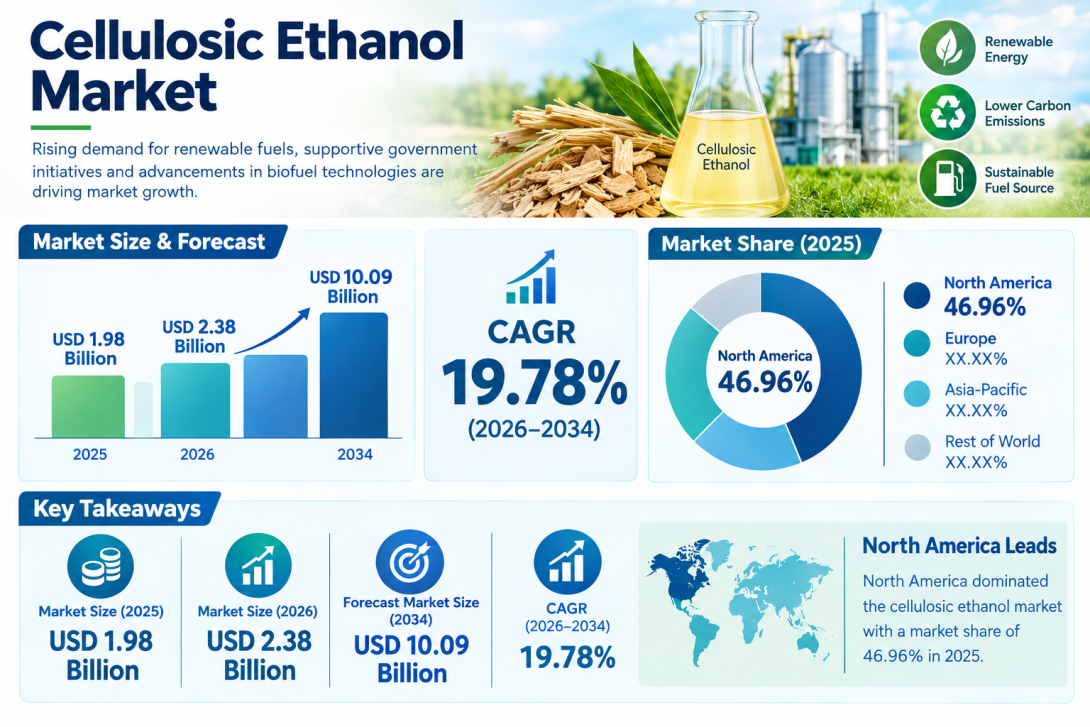
According to Fortune Business Insights, the global cellulosic ethanol market size was valued at USD 1.98 billion in 2025. The market is projected to grow from USD 2.38 billion in 2026 to USD 10.09 billion by 2034, expanding at a CAGR of 19.78% over the forecast period. North America dominated the cellulosic ethanol market with a market share of 46.96% in 2025.
Growing Demand for Renewable Transportation Fuels
The increasing focus on reducing greenhouse gas emissions from the transportation sector is supporting demand for renewable fuels. Cellulosic ethanol offers an alternative pathway because it can be produced from agricultural and forestry residues rather than food crops.
The use of non-food feedstocks also helps address concerns associated with conventional biofuels that depend on edible crops. As countries introduce renewable fuel policies and pursue emissions-reduction targets, the demand for advanced biofuels is expected to increase.
Rising Availability of Lignocellulosic Feedstocks
Agricultural residues such as corn stover, wheat straw, rice straw, and other plant-based waste materials represent important feedstock sources for cellulosic ethanol production. Forestry residues and dedicated energy crops can also provide raw materials for commercial production.
Converting these materials into ethanol can create additional value from biomass that might otherwise be discarded or burned. Improvements in biomass collection, pretreatment, and conversion technologies are expected to support the wider utilization of these feedstocks.
For detailed market insights : https://www.fortunebusinessinsights.com/cellulosic-ethanol-market-118980
Feedstock Analysis
The Cellulosic Ethanol Market can be analyzed based on feedstock into agricultural residues, forestry residues, energy crops, municipal waste, and other biomass sources.
Agricultural residues represent an important feedstock category because of their widespread availability and potential for large-scale collection. Forestry residues can also provide a consistent source of lignocellulosic material in regions with developed forestry industries.
Energy crops are being explored for dedicated ethanol production, while municipal and other waste streams offer additional opportunities for converting discarded materials into renewable fuels.
Process Technology Analysis
Cellulosic ethanol production involves several stages, including feedstock preparation, pretreatment, enzymatic hydrolysis, fermentation, and ethanol recovery. Technological improvements in these processes are important for increasing conversion efficiency and reducing production costs.
Pretreatment technologies are particularly important because lignocellulosic biomass has a complex structure that makes it more difficult to break down than conventional ethanol feedstocks. Advances in enzymes, microorganisms, and integrated processing systems are helping improve the commercial potential of cellulosic ethanol production.
Application Analysis
The primary application of cellulosic ethanol is in transportation fuels, where it can be blended with gasoline or used as part of renewable fuel programs. The fuel can contribute to diversification of transportation energy sources while supporting efforts to reduce dependence on petroleum-based fuels.
As vehicle technologies and fuel standards evolve, advanced biofuels are expected to remain relevant, particularly in segments where liquid fuels continue to play an important role.
Government Support and Environmental Focus
Government policies are an important factor influencing the development of the Cellulosic Ethanol Market. Renewable fuel standards, emissions-reduction programs, financial incentives, and investments in advanced biofuel technologies can encourage producers to develop new facilities and improve existing production processes.
Environmental considerations are also increasing interest in fuels made from waste and non-food biomass. The ability to utilize agricultural and forestry residues gives cellulosic ethanol an important role in discussions surrounding renewable energy and circular resource utilization.
Regional Analysis
North America dominated the Cellulosic Ethanol Market in 2025, accounting for 46.96% of the global market. The region's leading position is supported by investments in advanced biofuel technologies, the availability of agricultural residues, and supportive renewable fuel policies.
The U.S. represents a significant market within North America, supported by its large agricultural sector and continued focus on developing alternative transportation fuels. Research and investment in commercial-scale cellulosic ethanol technologies are also contributing to regional development.
Europe is expected to maintain significant interest in advanced biofuels due to its focus on renewable energy, emissions reduction, and sustainable transportation. Meanwhile, Asia Pacific offers considerable long-term potential because of its large agricultural sector, expanding energy demand, and availability of biomass resources.
Competitive Landscape
The competitive landscape includes companies and technology developers involved in advanced biofuel production, biomass processing, enzyme technologies, and renewable energy solutions. Market participants are focusing on improving conversion efficiency, lowering production costs, securing reliable feedstock supplies, and developing commercially viable production facilities.
Strategic partnerships, technology development, pilot projects, and investments in large-scale facilities are expected to remain important competitive strategies as the market expands.
Recent Industry Developments
Recent developments in the cellulosic ethanol industry have centered on improving biomass conversion technologies and increasing the commercial viability of advanced biofuel production. Companies and research organizations are working on more efficient pretreatment systems, advanced enzymes, fermentation technologies, and integrated biorefinery processes.
There is also growing interest in facilities capable of converting multiple types of biomass into renewable fuels. Such flexibility can help producers address variations in feedstock availability and improve resource utilization.
Get Free Sample PDF: https://www.fortunebusinessinsights.com/enquiry/request-sample-pdf/cellulosic-ethanol-market-118980
Future Outlook
The Cellulosic Ethanol Market is expected to experience rapid growth through 2034 as demand for renewable transportation fuels increases and technologies for converting non-food biomass continue to advance. Government policies, environmental targets, technological innovation, and the availability of agricultural and forestry residues are expected to remain key market drivers.
The market is projected to increase from USD 2.38 billion in 2026 to USD 10.09 billion by 2034, representing a strong 19.78% CAGR over the forecast period. With continued investments in advanced biofuel technologies and growing emphasis on sustainable energy sources, cellulosic ethanol is expected to become an increasingly important component of the global renewable fuels landscape.
Related Reports
What Everyone Should Know About Japan’s Market - Cellulosic Ethanol Market - Insights