

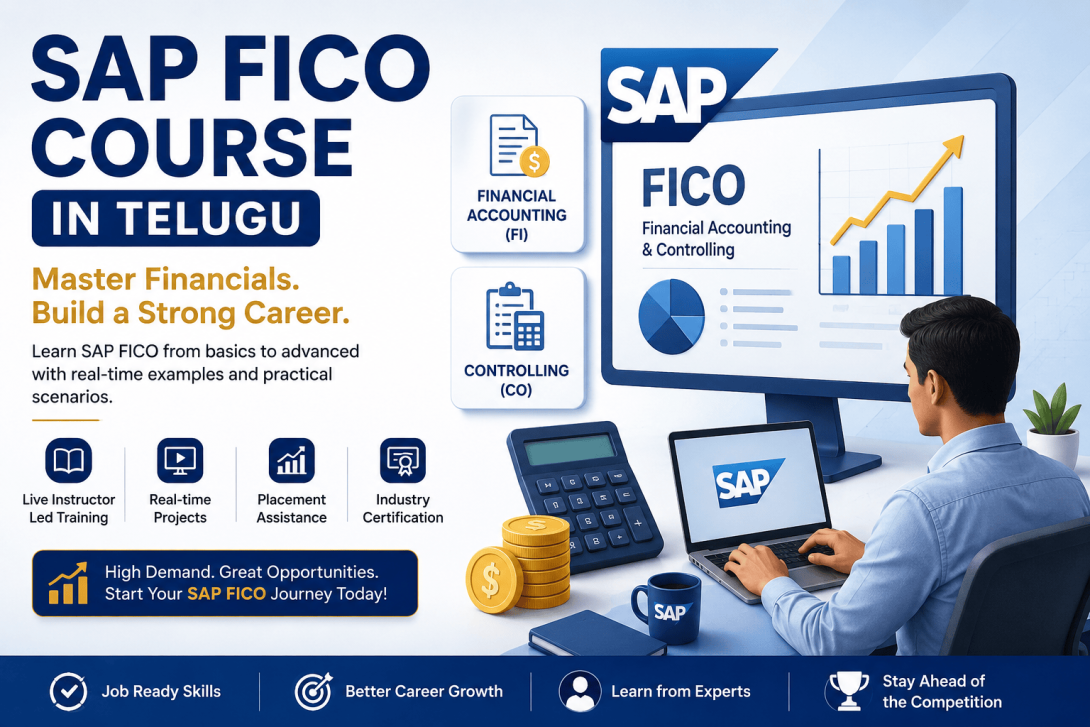
SAP FICO is an important SAP functional area that helps organizations manage financial transactions, accounting activities, cost management, and profitability analysis. For beginners planning to enter the ERP and finance technology field, understanding the right syllabus and learning sequence is essential. A structured SAP FICO Course in Telugu can provide a clear learning path for students and working professionals.
What Is SAP FICO?
SAP FICO combines Financial Accounting (FI) and Controlling (CO). FI primarily handles external financial accounting, while CO focuses on internal cost monitoring and management accounting.
These components work together to provide organizations with useful financial information for reporting and decision-making.
SAP FICO Course Syllabus
A comprehensive SAP FICO syllabus generally begins with accounting fundamentals and gradually introduces SAP organizational structures, configuration, transactions, reporting, and integration.
Module 1: SAP Fundamentals
Beginners first understand SAP ERP concepts, enterprise structures, navigation, and the role of functional modules in business operations.
Module 2: Financial Accounting
The FI section introduces important areas such as:
- General Ledger Accounting
- Accounts Payable
- Accounts Receivable
- Asset Accounting
- Bank Accounting
- Financial reporting
Module 3: Organizational Structure
Students learn concepts such as Company, Company Code, Business Area, Fiscal Year, and Posting Period. Understanding these structures is important before performing financial transactions.
Module 4: Master Data
This area covers financial master data such as General Ledger accounts, customer accounts, vendor accounts, and asset master records.
Module 5: SAP Controlling
The CO section introduces Cost Center Accounting, Profit Center Accounting, Internal Orders, Product Costing, and Profitability Analysis.
Module 6: Integration and Reporting
Learners explore how SAP FICO interacts with other business functions and how financial information can be used for reporting and analysis.
SAP FICO Learning Roadmap
A practical learning roadmap can be divided into several stages.
Stage
Focus Area
1 Basic Accounting
2 SAP Fundamentals
3 SAP FI
4 SAP CO
5 Configuration
6 Business Scenarios
7 Integration
8 Interview Preparation
This approach prevents beginners from becoming overwhelmed by complex concepts.
Why Practical Learning Matters
Reading definitions is useful, but practical SAP FICO training provides a better understanding of how financial processes work. Learners can practice scenarios such as customer invoice processing, vendor payments, journal entries, asset transactions, and cost allocations.
Realistic business cases can help students connect accounting theory with SAP transactions.
Learning SAP FICO in Telugu
Technical terms can sometimes be difficult for beginners. A SAP FICO Course in Telugu can explain complex concepts using familiar language while retaining important SAP terminology in English. This approach can help learners understand concepts more comfortably.
Skills to Develop Alongside SAP FICO
Learners should not focus only on SAP screens and configuration. They should also develop:
- Accounting fundamentals
- Business process understanding
- Problem-solving ability
- Communication skills
- Documentation skills
- Analytical thinking
- Interview preparation
Conclusion
A well-structured SAP FICO Course in Telugu can help beginners progress from accounting fundamentals to SAP FI, CO, configuration, integration, and practical business scenarios. Following a clear learning roadmap and consistently practicing real-world processes can help learners build a stronger foundation for SAP-related career opportunities.