

A rear disc brake conversion replaces an older rear drum-brake setup with rotors, calipers, mounting brackets, brake hoses, pads, and related hardware. For heavy-duty Chevy and GMC trucks, rock crawlers, 4x4s, and custom axle builds, the upgrade can simplify brake servicing while providing a platform for modern rear-disc components. However, a successful conversion involves more than mounting rotors and calipers: axle compatibility, parking-brake function, hydraulic balance, brake-pad selection, hose fittings, wheel clearance, and the master-cylinder system all need to work together.
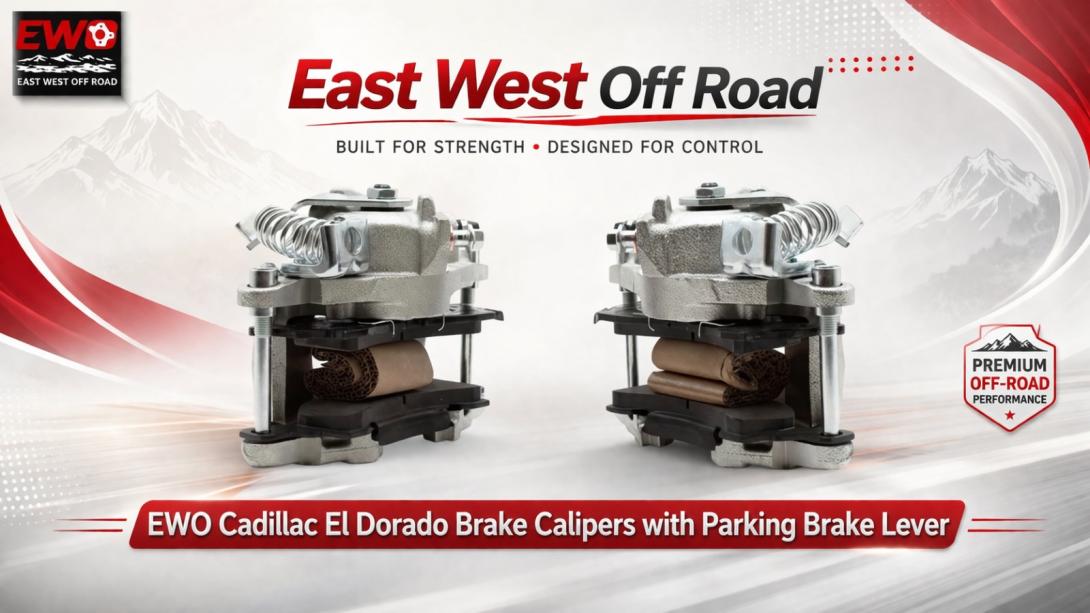
For builders who want to retain a mechanical parking brake during a heavy-duty disc conversion, East West Off Road offers its EWO E63013 Cadillac Eldorado rear brake caliper kit with parking-brake levers for compatible applications.
What Is a Rear Disc Brake Conversion?
A rear disc brake conversion replaces the major components of a drum-brake system with a disc-brake configuration.
A typical system may involve:
- Brake rotors
- Rear brake calipers
- Caliper mounting brackets
- Brake pads
- Flexible brake hoses
- Hydraulic fittings
- Parking-brake components
- Conversion hardware
On a heavy-duty truck or off-road build, the conversion may also require changes elsewhere in the braking system depending on the existing master cylinder, proportioning system, axle, and front brakes.
The goal should be a properly matched braking system—not simply replacing drums with whatever disc components physically fit.
Why Convert Rear Drum Brakes to Disc Brakes?
Rear drums can work effectively when properly designed and maintained, but many truck owners prefer discs for modified or off-road builds.
Easier Brake Inspection
Disc brake pads and rotors are generally easier to inspect visually than internal drum components.
This can be useful on vehicles that are frequently serviced after off-road use.
Simpler Friction Component Access
Pads can often be accessed more directly than drum shoes and internal springs.
That is valuable on trail rigs and working trucks where routine brake inspection matters.
Better Suitability for Custom Axle Builds
Aftermarket disc conversion brackets are available for many heavy-duty axle families.
That allows builders to configure brake systems around:
- GM 14 Bolt axles
- Dana 60 axles
- Sterling axles
- Custom one-ton axle swaps
Parking Brake Options
A properly planned conversion can incorporate an integrated rear disc parking brake using a mechanical parking-brake caliper rather than deleting the parking brake entirely.
What Parts Matter in a Rear Disc Brake Conversion?
The exact components vary by axle and kit, but several major parts deserve careful attention.
Brake Rotors
The rotor must match the:
- Hub
- Bolt pattern
- Caliper
- Bracket position
- Required thickness
- Wheel clearance
Caliper Brackets
The brackets determine where the caliper sits relative to the rotor.
An incorrect bracket offset can prevent proper pad alignment.
Rear Brake Calipers
Different conversions use different calipers.
Some use standard hydraulic GM calipers, while others use an integrated parking brake caliper.
Brake Pads
The pad shape must match the caliper.
Parking-brake calipers may also require specific pad features that interact with the piston mechanism.
Brake Hoses
Hose fittings, banjo-bolt threads, routing, and suspension travel must all be considered.
Parking Brake Hardware
A parking-brake conversion may involve:
- Mechanical caliper levers
- Cables
- Cable brackets
- Return springs
- Adjustment hardware
Rear Disc Conversion With a Mechanical Parking Brake
One of the biggest questions when converting drums to discs is what happens to the parking brake.
Drum brakes often contain their parking-brake components inside the drum assembly.
Removing the drums may remove that entire system.
A parking brake caliper can solve that problem by combining normal hydraulic braking with a mechanical parking-brake mechanism in the same caliper.
This style is also described as:
- Mechanical emergency brake caliper
- Hydro-mechanical rear caliper
- Integrated parking brake caliper
- Rear parking brake caliper
For compatible truck conversions, this can provide a clean alternative to installing a completely separate mechanical brake.
Why Cadillac Eldorado Calipers Are Used in Disc Conversions
Classic 1976-1978 Cadillac Eldorado rear calipers are well known in the truck and off-road conversion market because of their integrated parking-brake design.
Unlike a basic hydraulic rear caliper, the Eldorado-style unit incorporates a mechanical parking-brake lever and internal mechanism.
This makes Cadillac El Dorado brake calipers relevant to builds where the owner wants rear discs while retaining a mechanical park-brake function.
Common applications discussed in the aftermarket include:
- GM 14 Bolt conversions
- Dana 60 conversions
- Sterling conversions
- Chevy K20 builds
- GM V20 builds
- Custom one-ton axles
- Rock crawlers
- Trail rigs
Actual compatibility depends on the specific bracket, rotor, axle, and hydraulic system.
EWO E63013 Parking Brake Calipers
The EWO E63013 is East West Off Road's Cadillac Eldorado rear brake caliper kit with parking-brake lever.
The product is aimed at the same general market as heavy-duty rear disc brake conversion and GM brake-upgrade components.
For builders comparing East West Off Road brake calipers, E63013 should be distinguished from ordinary hydraulic GM calipers because its main attraction is the integrated mechanical parking-brake function.
GM 14 Bolt Rear Disc Conversion
A GM 14 Bolt rear disc conversion is one of the most common heavy-duty truck brake swaps.
The full-float 14 Bolt axle is widely used in:
- Chevy trucks
- GMC trucks
- One-ton builds
- Rock crawlers
- Trail rigs
- Custom 4x4s
Many older versions originally came with large rear drum assemblies.
A 14 Bolt disc brake swap replaces those drums with rotors and calipers mounted to axle-specific brackets.
Parking Brake Options for a GM 14 Bolt
Builders generally need to decide whether the rear disc system will use:
- Standard hydraulic calipers without an integrated parking brake
- Eldorado-style mechanical parking-brake calipers
- Another separate parking-brake system
For a street-driven truck, preserving a functional parking brake may be an important design requirement.
SRW 14 Bolt Disc Brackets
SRW 14 bolt disc brackets are designed for Single Rear Wheel axle configurations.
Before choosing calipers, verify:
- Axle version
- Bracket design
- Rotor position
- Rotor thickness
- Caliper mounting dimensions
- Wheel clearance
An SRW bracket should not automatically be assumed compatible with DRW or Cab and Chassis axle configurations.
DRW Rear Disc Conversion
A DRW rear disc conversion can require different bracket geometry because Dual Rear Wheel hubs change the position of the rotor and wheel assembly.
Builders should identify the exact axle rather than ordering a kit based only on the “14 Bolt” name.
Cab and Chassis Disc Brake Kit
A Cab and Chassis disc brake kit may also require different spacing from pickup-style 14 Bolt conversions.
Axle width, hubs, brackets, and rotor placement all need to be matched.
Dana 60 Rear Disc Conversion
A Dana 60 rear disc conversion is another common upgrade for custom heavy-duty builds.
Dana 60 rear axles were manufactured in numerous configurations, so there is no universal disc conversion for every Dana 60.
Important fitment variables include:
- Axle year
- Housing ends
- Hub design
- Wheel bolt pattern
- Rotor selection
- Bracket design
For a custom Dana 60 build, identify the axle before choosing brackets or calipers.
Sterling 10.25 Disc Brakes
Sterling 10.25 disc brakes are popular on older Ford heavy-duty builds.
Like GM and Dana applications, the correct rear disc system depends on the exact axle generation and bracket design.
A compatible parking-brake caliper may allow the builder to replace drums while maintaining mechanical parking-brake capability.
Chevy K20 Rear Disc Upgrade
A Chevy K20 rear disc upgrade is frequently built around large GM-style calipers and heavy-duty axle components.
Builders may encounter searches for:
- GM K20 brake caliper
- 73-86 GM K20 brake calipers
- Chevy K20 rear disc upgrade
A conventional GM K20-style hydraulic caliper and an Eldorado-style parking-brake caliper should not automatically be treated as interchangeable.
The key difference is whether the caliper incorporates a mechanical parking brake.
GM V20 Truck Brakes
The same principle applies to GM V20 truck brakes and searches for:
- GM V20 brake caliper
- 87-91 GM V20 brake calipers
Before choosing a rear conversion caliper, confirm the actual axle, bracket, rotor, hose, and parking-brake requirements.
3/4 Ton Truck Rear Disc Conversion
A 3/4 ton truck rear disc conversion should be planned around the weight and intended use of the vehicle.
Heavy-duty brake systems need appropriate:
- Caliper piston area
- Rotor dimensions
- Brake pads
- Hydraulic pressure
- Brake balance
Simply installing larger-looking calipers does not guarantee better braking.
1 Ton Axle Disc Swap
A 1 ton axle disc swap may involve even greater vehicle weight and larger tires.
This is where system-level planning becomes especially important.
A heavy-duty conversion should take into account:
- Front brake capacity
- Rear brake capacity
- Master cylinder
- Brake booster
- Brake bias
- Tire size
- Vehicle weight
- Intended use
Off-Road Brake Upgrade Considerations
An off-road brake upgrade may be exposed to conditions normal road vehicles rarely encounter.
These include:
- Mud
- Water
- Rocks
- Sand
- Trail debris
- Heavy axle articulation
Disc systems can make brake inspection more accessible after trail use.
Builders should still routinely inspect pads, rotors, hoses, slide pins, parking-brake levers, and hydraulic fittings.
Why Parking Brake Function Matters
A rear disc conversion that eliminates the original drum parking brake needs another method of mechanically holding the vehicle.
This is why an integrated mechanical system is important to many truck builders.
The parking brake can be especially valuable when:
- Parking on an incline
- Loading or unloading
- Working around the vehicle
- Securing a manual-transmission truck
- Using the vehicle on uneven terrain
The parking brake should be considered during the conversion design—not after the hydraulic system has already been completed.
How a Hydro-Mechanical Rear Caliper Works
A hydro-mechanical rear caliper combines hydraulic service braking with mechanical parking-brake actuation.
Hydraulic pressure operates the normal brake piston when the pedal is pressed.
A mechanical parking-brake lever acts through an internal mechanism when the cable is pulled.
This dual-purpose design is why Eldorado-style calipers are popular in custom rear disc systems.
D122 Brake Pads in Eldorado-Style Conversions
D122 brake pads are commonly associated with large Eldorado-style parking-brake calipers.
An important detail is the brake pads with locking nub design.
The locking feature interacts with the piston and helps maintain the correct piston relationship to the internal parking-brake mechanism.
D122 vs. D52 Pads
The D122 vs D52 pads comparison is particularly important during an Eldorado-type conversion.
The pads may appear similar, but the parking-brake application can require a pad backing plate that engages the piston correctly.
Using the wrong pad can interfere with proper mechanical park-brake function.
Always verify the pad requirement for the exact caliper.
Anti-Rotation Piston Mechanism
The anti-rotation piston mechanism supports the operation of the integrated mechanical parking brake.
Because of this design, a rear parking-brake caliper should not always be serviced exactly like an ordinary front floating caliper.
The correct piston and pad orientation matters.
Pre-Adjusting Rear Calipers
Pre-adjusting rear calipers is an important consideration with some mechanical parking-brake designs.
Excessive clearance between the pad and rotor can contribute to:
- Long parking-brake lever travel
- Weak park-brake holding force
- Excessive pedal travel
The exact adjustment method varies by caliper design and should follow the manufacturer's service procedure.
Because braking is safety-critical, adjustment and final inspection should be handled by a qualified technician if there is any uncertainty.
Adjusting Eldorado Parking Brake Systems
Adjusting Eldorado parking brake mechanisms involves more than simply tightening the parking-brake cable.
The internal caliper mechanism and pad position need to be correctly established first.
Improper adjustment can cause either:
- Parking brake won't hold
- Brake drag
- Excessive heat
- Premature pad wear
Cable tension should not be used to compensate for an incorrectly adjusted caliper.
Ratchet Mechanism Adjustment
A parking-brake caliper may use an internal self-adjusting or ratchet mechanism adjustment system to compensate for pad wear.
If the system is not functioning correctly, the mechanical parking brake can develop excessive travel.
Diagnosis should consider both the internal caliper and the external cable system.
Heavy Duty Parking Brake Lever and Return Spring
The external heavy duty parking brake lever transfers cable movement into the caliper.
The return spring helps return that lever when the brake is released.
Both parts should move freely.
A seized or slow-returning mechanism can cause the rear brakes to drag.
Brake Caliper Coatings and Corrosion Protection
Heavy-duty brake components may be exposed to road salt, moisture, mud, and outdoor storage.
That creates demand for:
- Zinc plated brake calipers
- Clear zinc coated brake calipers
A protective coating can provide additional corrosion resistance, but brake components still require routine inspection.
The current EWO E63013 listing is categorized and tagged around zinc-plated caliper and rear disc conversion applications.
Loaded Rear Brake Calipers
Loaded rear brake calipers generally include brake pads and may include related installation components.
However, sellers use the word “loaded” differently.
Always confirm whether the package includes:
- Brake pads
- Hardware
- Banjo bolts
- Copper washers
- Levers
- Springs
- Hoses
Do not assume every loaded caliper contains the same parts.
GM Dual-Bleeder JB6 Brake Caliper
East West Off Road also lists a separate GM Dual-Bleeder JB6 Brake Caliper (Loaded).
That product should not be confused with EWO E63013.
A JB6-style caliper can be relevant to heavy-duty GM disc conversions, but the buying decision changes when an integrated mechanical parking brake is required.
JB6 GM Rear Calipers vs. Eldorado Calipers
JB6 GM rear calipers and large Eldorado calipers can appear in similar conversion searches because both belong to the heavy-duty GM brake ecosystem.
However, the integrated parking-brake mechanism is the important distinction.
If the build needs a mechanical park brake, confirm that the selected caliper actually includes it.
Large Piston Eldorado Calipers
Large piston Eldorado calipers are frequently searched by builders looking for heavy-duty rear braking.
Piston diameter affects hydraulic requirements.
A larger piston generally requires more fluid volume for the same amount of movement.
That can influence:
- Master-cylinder sizing
- Pedal travel
- Front-to-rear balance
Do not design the hydraulic system around an assumed piston size.
Understanding the “2 15/16 Inch Piston” Search
The term 2 15/16 inch piston appears in searches for large GM brake calipers.
However, not every Eldorado, JB6, or truck caliper uses exactly the same piston dimensions.
Verify the specification of the exact caliper rather than assuming all large GM calipers are identical.
Brake Hose and Banjo Bolt Compatibility
The brake-hose connection is another critical compatibility point.
Common GM searches include:
- 7/16-20 banjo bolt
- 10mm x 1.5 banjo bolt
These thread sizes are not interchangeable.
Some heavy-duty conversion applications use 7/16-20 banjo bolts with copper washers, while other GM calipers use metric fittings.
Always verify the caliper inlet before selecting hoses.
Steel Braided Brake Lines
Steel braided brake lines are commonly used in custom truck conversions.
The hose must accommodate suspension movement without:
- Stretching
- Rubbing
- Kinking
- Contacting the tire
- Contacting the exhaust
The fitting type also has to match the caliper.
A product such as a 26” Steel Braided Front Brake Line Kit – Pair (with Hardware) should not automatically be assumed suitable for a rear conversion simply because the hose is braided.
Application and fitting compatibility still matter.
7 Inch Mounting Pin Spacing
Heavy-duty GM-style brake conversions frequently reference 7 inch mounting pin spacing.
Mounting-pin distance is only one part of compatibility.
Caliper fitment also depends on:
- Rotor diameter
- Rotor thickness
- Bracket offset
- Wheel clearance
- Hose position
Verify the complete assembly.
Bleeding Rear Disc Brakes
Bleeding rear disc brakes removes trapped air from the hydraulic system.
Air can produce a soft or inconsistent pedal because it compresses under pressure.
Caliper orientation matters because the active bleeder must be positioned so trapped air can escape effectively.
Follow the brake-component or conversion-kit manufacturer's bleeding procedure.
Spongy Pedal After Disc Swap
A spongy pedal after disc swap can come from multiple causes.
Potential issues include:
- Air in the system
- Excessive pad clearance
- Incorrect caliper orientation
- Parking-brake calipers not correctly adjusted
- Hydraulic leaks
- Hose expansion
- Master-cylinder mismatch
Repeatedly bleeding the system will not correct every possible cause.
Master Cylinder Upgrade for 4 Wheel Disc
A master cylinder upgrade for 4 wheel disc may be required depending on the vehicle.
Important variables include:
- Master-cylinder bore
- Caliper piston area
- Pedal ratio
- Brake booster
- Front brake setup
- Rear brake setup
The master cylinder needs to work with the entire brake system.
Adjustable Proportioning Valve
An adjustable proportioning valve may be used in a custom conversion to control rear hydraulic pressure.
Brake bias matters because excessive rear braking can cause premature rear-wheel lockup.
The system should be evaluated professionally rather than tuned through guesswork.
Residual Pressure Valve Removal
Residual pressure valve removal is another topic commonly associated with drum-to-disc swaps.
Some older drum-brake hydraulic systems use residual-pressure arrangements that may differ from a disc-brake setup.
However, brake systems vary significantly.
A valve should not be removed solely because another conversion required it.
Confirm the design of the existing master cylinder and hydraulic system first.
Rear Caliper Slide Pin Lubrication
Proper rear caliper slide pin lubrication helps a floating caliper move correctly.
Sticking slide pins can contribute to:
- Brake drag
- Uneven pad wear
- Reduced braking performance
- Excessive heat
Use the correct brake-compatible lubricant and avoid contaminating the pad or rotor friction surfaces.
Why Parking Brake Cable Geometry Matters
A mechanical parking-brake cable must pull the caliper lever through the intended range without binding.
Important considerations include:
- Cable length
- Lever orientation
- Cable bracket position
- Suspension clearance
- Return movement
Improper cable routing can reduce holding force or prevent the caliper lever from fully releasing.
Street Legal Rear Disc Conversion Considerations
Many owners search for a street legal rear disc conversion.
A disc conversion is not automatically street legal simply because it uses commercially available parts.
Vehicle equipment and inspection requirements vary by location.
For road-driven vehicles, the complete installation should be properly engineered and inspected, including:
- Hydraulic braking
- Parking brake
- Brake hoses
- Mounting brackets
- Wheel clearance
- Brake balance
Choosing Between a Standard Caliper and Parking Brake Caliper
A standard hydraulic rear caliper may be appropriate when the vehicle already has another parking-brake system.
An integrated mechanical caliper is more relevant when the rear disc conversion itself needs to provide the parking brake.
The right choice depends on the complete vehicle design.
EWO Rear Disc Brake Conversion Solution
For builders who specifically need an integrated mechanical parking brake, EWO Cadillac El Dorado Brake Calipers offer the E63013 option for compatible heavy-duty conversions.
The product is relevant to buyers researching:
- EWO Cadillac El Dorado Brake Calipers
- EWO E63013
- East West Off Road brake calipers
- EWO Army brake parts
- GM rear disc brake caliper upgrades
- Off road brake calipers
- Parking brake kits
For GM 14 Bolt, Dana 60, Sterling, K20, V20, and other custom axle projects, the key advantage is the combination of hydraulic rear braking and mechanical parking-brake functionality.
What to Check Before Buying Rear Disc Conversion Parts
Before purchasing any rear disc conversion components, verify:
- Exact axle model
- Axle year or generation
- SRW, DRW, or Cab and Chassis configuration
- Hub design
- Rotor diameter and thickness
- Brake bracket type
- Caliper mounting dimensions
- Parking-brake requirement
- Pad type
- Brake-hose connection
- Wheel clearance
- Master-cylinder compatibility
- Brake proportioning requirements
Matching these components before ordering can prevent expensive fitment problems.
Why the Complete Brake System Matters
A rear disc brake conversion is only as good as the complete system.
Even premium calipers cannot compensate for:
- Incorrect brackets
- Mismatched rotors
- Poor brake balance
- Air in the hydraulic system
- Incorrect pad choice
- Improper parking-brake adjustment
- Incompatible hoses
- Poor wheel clearance
The best conversion is one in which the axle, rotor, caliper, bracket, hoses, hydraulic components, and parking-brake system are designed to work together.
Frequently Asked Questions (FAQs)
What is a rear disc brake conversion?
A rear disc brake conversion replaces rear drum brakes with rotors, calipers, mounting brackets, pads, hoses, and related hardware.
Is a rear disc brake conversion worth it for an older truck?
It can be valuable for trucks where owners want easier brake inspection, modern disc components, or compatibility with a custom heavy-duty axle build. The benefits depend on the vehicle and the quality of the complete conversion.
Can I convert a GM 14 Bolt from drums to discs?
Yes. GM 14 Bolt rear disc conversions are common, but the correct brackets, rotors, and calipers depend on whether the axle is SRW, DRW, or Cab and Chassis.
Can I retain a parking brake after a rear disc conversion?
Yes. One option is an integrated mechanical parking-brake caliper such as an Eldorado-style rear caliper used with compatible conversion components.
Why are Cadillac Eldorado calipers used for rear disc conversions?
The classic Eldorado-style rear caliper combines hydraulic braking with an integrated mechanical parking brake, making it useful for compatible truck and off-road conversions.
What is EWO E63013?
EWO E63013 is East West Off Road's Cadillac Eldorado Rear Brake Calipers With Parking Brake Lever Kit.
Can Eldorado parking-brake calipers be used on a Dana 60?
They can be used in compatible Dana 60 conversion systems. Fitment depends on the brackets, rotors, hubs, and axle configuration.
Can I convert a Sterling 10.25 axle to rear discs?
Yes, rear disc conversions exist for compatible Sterling axle configurations. Verify the axle generation and conversion components before ordering.
What is the difference between an Eldorado caliper and a standard GM rear caliper?
The major difference is the integrated mechanical parking-brake mechanism found in the Eldorado-style design.
What are D122 brake pads?
D122 pads are commonly associated with large Eldorado-style parking-brake calipers and include a backing-plate feature that interacts with the piston.
What is the difference between D122 and D52 pads?
D122 pads include a piston-locking feature used with compatible rear parking-brake calipers. D52 pads may appear similar but do not provide the same feature.
Why won't my parking brake hold after a rear disc conversion?
Possible causes include incorrect caliper adjustment, excessive pad clearance, unsuitable pads, cable problems, a sticking lever, or internal mechanism issues.
Why is my brake pedal spongy after converting to rear discs?
Potential causes include trapped air, excessive caliper clearance, hydraulic leaks, hose expansion, incorrect caliper positioning, or a master-cylinder mismatch.
Do I need a new master cylinder for a rear disc conversion?
Possibly. The answer depends on caliper piston area, master-cylinder bore, pedal ratio, booster configuration, and the complete front/rear brake setup.
Do I need an adjustable proportioning valve?
Some custom conversions require rear brake-pressure adjustment. The correct setup depends on the complete braking system.
What banjo bolt size do rear disc calipers use?
It depends on the caliper. Common GM applications include 7/16-20 and 10mm x 1.5 fittings, which are not interchangeable.
Are steel braided brake lines recommended?
They are commonly used in custom and off-road builds when correctly matched to the caliper fittings, suspension travel, and routing requirements.
Are zinc-plated calipers useful on off-road vehicles?
Zinc plating can provide additional corrosion resistance in environments involving moisture, mud, road salt, and outdoor exposure.
Can a rear disc conversion be used on a street-driven truck?
Yes, provided the complete brake system is properly engineered, installed, inspected, and compliant with applicable vehicle requirements.
Should a rear disc conversion be professionally installed?
Professional installation or inspection is strongly recommended. Brakes directly affect vehicle control, and improper brackets, hydraulic setup, adjustment, or brake balance can create serious safety problems