

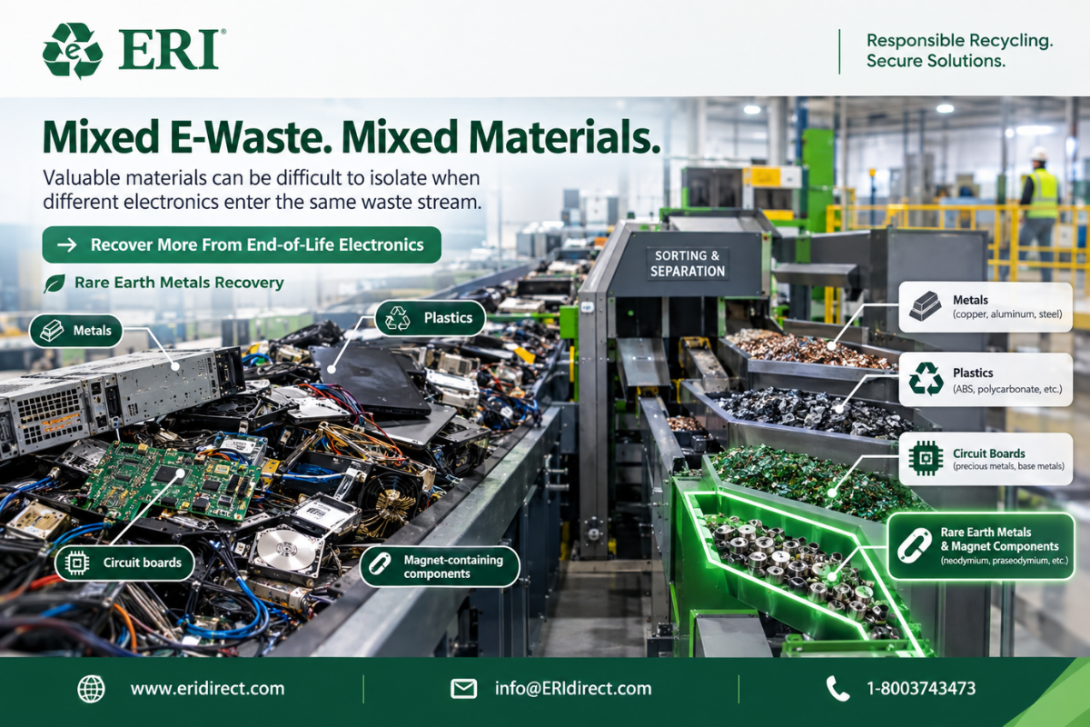
While the organization possesses a huge number of obsolete electronic products, it is tempting to classify all of them as e-waste. The thing is that electronic equipment consists of numerous material components. This peculiarity forms one of the greatest obstacles for extraction of rare earth metals since valuable materials may be found along with plastic, glass, aluminum, copper, circuit boards, batteries, and other types of materials.
The problem concerns electronic equipment containing rare earth elements or permanent magnets. Those materials might be used only in particular parts of the device but not the whole one. Therefore, the collection of the considerable amount of electronic waste does not necessarily form an effective process of recovery. The materials have to go through several steps of separation, dismantling, and extraction.
This differentiation is crucial for companies aiming at increasing the resource efficiency of their recycling schemes. Although the recycling program can manage to get rid of the equipment of the firm effectively, there may be untapped potential of higher material recovery that will remain unnoticed. The issue is whether the downstream process can separate the valuable material streams from the electronic waste.
The efficient separation can contribute to the idea of the circular economy, where the obsolete technologies will be seen not as the material that should be thrown away but as a secondary raw material source. The metals and other commodities separated from the end-of-life electronics might be used as the input for the manufacturing rather than left in the equipment that is no longer used.
In this context, the rare earth metals recovery can be discussed both in terms of recycling and resources management. The goal is not just to recycle more electronics but develop processing pathways that could detect the materials contained in them and send the material streams to further recovery.
For organizations that need to refresh their technology, inquiring about how mixed e-waste is sorted and processed becomes just as critical as inquiring about where the devices will be recycled.