

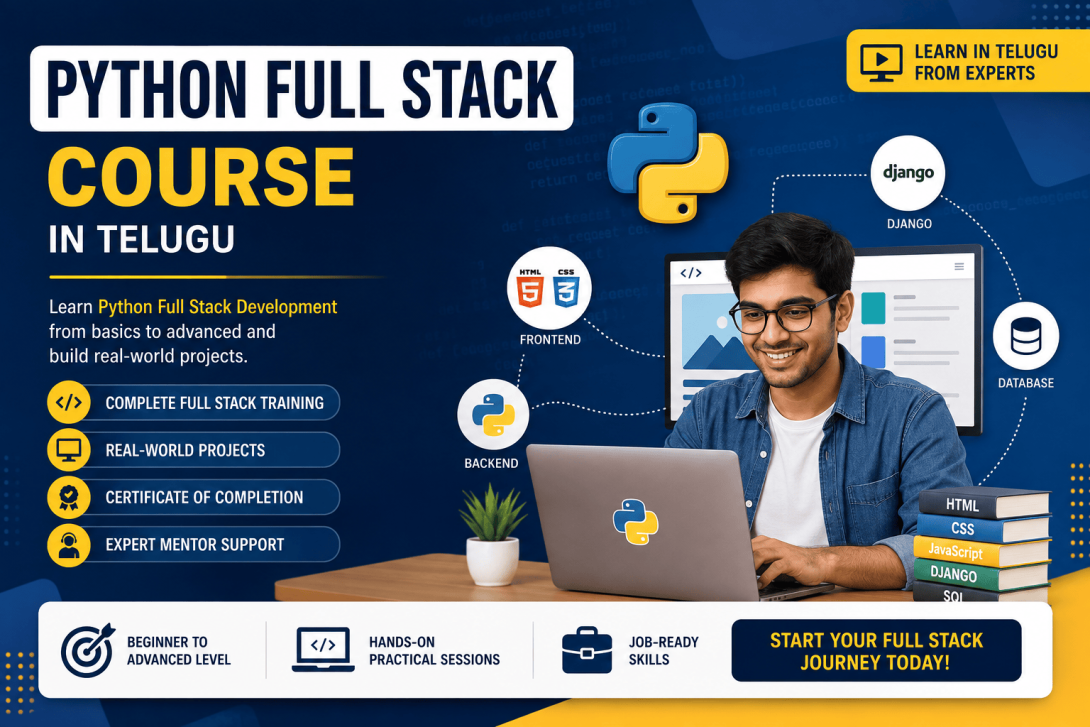
The software industry requires developers who can understand different parts of a web application rather than focusing on only one technology. Full Stack Development provides an opportunity to learn frontend, backend, and database technologies together. For Telugu-speaking students and beginners, a Python Full Stack Course in Telugu can provide a structured way to understand these concepts and apply them through practical development.
Understanding Frontend Development
The frontend is the visible part of a website or application. It determines how users interact with pages, buttons, forms, menus, and other elements. Beginners generally start frontend development with HTML, CSS, and JavaScript.
HTML provides the structure of web pages, while CSS controls layouts, fonts, spacing, and responsive designs. JavaScript adds functionality and allows webpages to respond to user actions.
Learning these technologies gives students a foundation for creating interactive and responsive interfaces.
Learning Backend Development with Python
The backend operates behind the user interface. It handles business logic, authentication, data processing, and communication with databases.
Python is widely used for backend development because its syntax is readable and its ecosystem includes powerful frameworks. Students can learn Python fundamentals before progressing to frameworks such as Django.
Django provides tools for routing, authentication, database interaction, forms, and application management.
Database Technologies
Web applications need databases to store information. User accounts, product details, transactions, and other application data can be managed through databases.
A Python full stack learner should understand SQL, tables, relationships, CRUD operations, joins, and basic database design. Connecting a Django application with a database helps students understand how information moves through a complete application.
Connecting Frontend, Backend and Database
The real value of full stack development comes from understanding how these layers communicate. A user may submit information through a frontend form. The backend receives that information, validates it, and stores it in a database.
When the user requests information later, the backend retrieves the required records and sends them back to the frontend.
This complete flow is an important concept for aspiring developers.
Why Learn Through a Structured Course?
Trying to learn several technologies independently can sometimes create confusion. A Python Full Stack Course in Telugu can organize topics into a progressive learning sequence.
Learners can first understand programming fundamentals, then move toward frontend development, databases, backend frameworks, APIs, and projects.
Conclusion
Python Full Stack Development combines several important areas of web development. Learning HTML, CSS, JavaScript, Python, Django, SQL, and APIs can help beginners understand how complete applications are developed.
With consistent practice and project-based learning, a Python Full Stack Course in Telugu can help learners build a strong technical foundation for pursuing software development opportunities.