

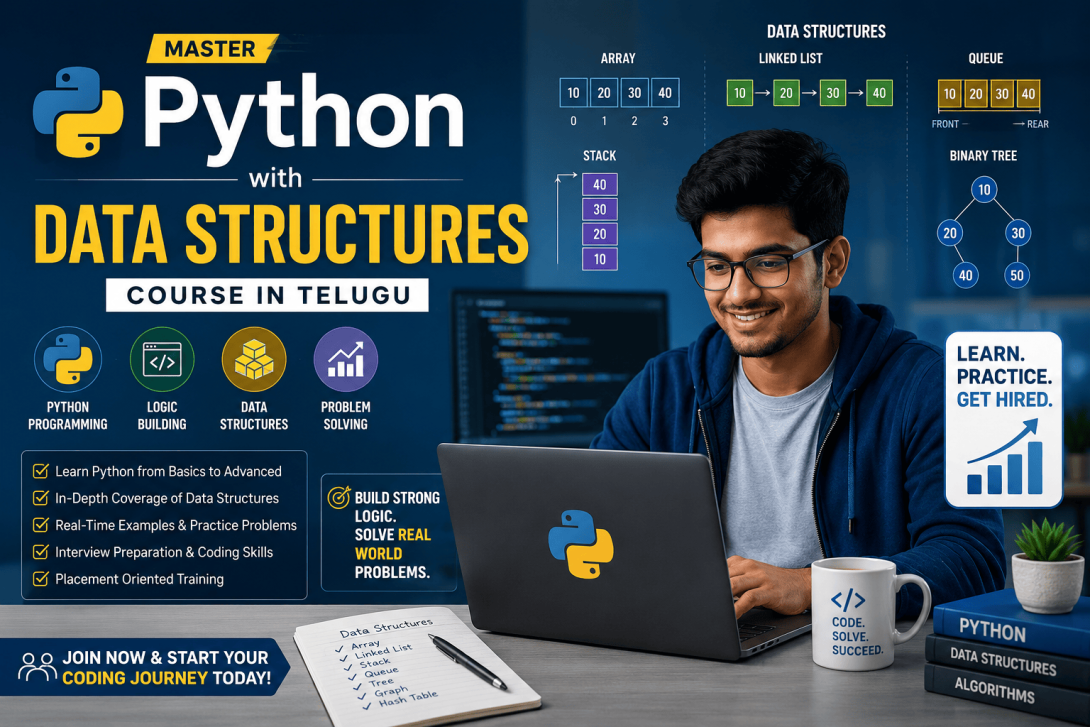
Python is one of the most widely used programming languages in today's technology industry. Its simple syntax and flexibility make it suitable for beginners as well as experienced developers. However, learning Python syntax alone is not enough to become a confident programmer. Developers also need problem-solving skills and an understanding of how data can be stored and processed efficiently. A Python with Data Structures Course in Telugu can help learners develop these essential technical skills step by step.
Strong Python Programming Fundamentals
One of the first skills learners can develop is a solid understanding of Python fundamentals. Beginners can learn about variables, data types, operators, strings, conditional statements, loops, and functions.
These concepts form the foundation of programming. Variables help store information, conditions allow programs to make decisions, and loops help repeat tasks efficiently. Functions make code more organized and reusable.
By understanding these fundamentals, learners can start writing simple programs and gradually move toward more complex coding tasks.
Working with Python Collections
Python provides useful built-in data structures for managing collections of information. Learners can develop practical knowledge of lists, tuples, sets, and dictionaries.
Lists are useful for storing ordered collections of items. Tuples can be used when data should remain unchanged. Sets help manage unique values, while dictionaries store information in key-value pairs.
Understanding these structures helps programmers choose the right method for organizing data based on the requirements of a program.
A Python with Data Structures Course in Telugu can explain these concepts through examples and coding exercises, making it easier for learners to understand how each structure works.
Problem-Solving and Logical Thinking Skills
Programming is closely connected with problem-solving. A developer must understand a problem, break it into smaller parts, and create a logical solution.
Data structures help learners develop this ability. For example, students may need to decide whether a list, dictionary, stack, or queue is suitable for a particular task.
Through regular coding practice, learners can improve their ability to analyze problems and identify efficient solutions. This skill is useful not only for programming but also for coding assessments and technical interviews.
Understanding Stacks and Queues
Stacks and queues are important data structures that introduce learners to different methods of processing information.
A stack generally follows the Last-In, First-Out principle. The most recently added item is usually the first one to be removed. A queue follows the First-In, First-Out principle, where the item added first is processed first.
Learning these concepts helps students understand how different applications manage tasks and data.
Practical exercises can make these topics easier to understand. Learners may write programs to implement stack operations such as push and pop or queue operations such as enqueue and dequeue.
Searching and Sorting Skills
Searching and sorting are important skills for handling data efficiently. Learners can understand how to find a specific element in a collection and how to arrange data in a particular order.
Basic searching techniques may include linear search and binary search. Sorting concepts can introduce learners to methods that arrange numbers, names, or other values.
Understanding these techniques can help students improve their knowledge of algorithms and data processing.
Writing Clean and Structured Code
Another valuable skill is learning how to organize code effectively. Writing a program that works is important, but writing clean and understandable code is equally valuable.
Learners can develop habits such as using meaningful variable names, dividing programs into functions, avoiding unnecessary repetition, and following a logical structure.
These practices make programs easier to read, test, and maintain.
Debugging and Code Analysis
Errors are a normal part of programming. Learning how to identify and fix errors is an important skill for every developer.
During coding practice, learners may encounter syntax errors, logical mistakes, or unexpected output. By analyzing these issues, students can understand how their code behaves and improve their debugging skills.
Regular practice helps learners become more comfortable with finding and correcting mistakes.
Career-Oriented Technical Skills
The combination of Python and data structures can provide a strong foundation for several technology-related learning paths. Learners may later explore areas such as software development, backend programming, automation, data analysis, artificial intelligence, or machine learning.
Data structures can also support preparation for coding tests and technical interviews.
Conclusion
A Python with Data Structures Course in Telugu can help learners develop much more than basic programming knowledge. Students can build Python fundamentals, understand different data structures, improve logical thinking, practice problem-solving, and develop confidence in writing code.
With regular practice and hands-on learning, these skills can create a strong foundation for future technical learning and career growth.