
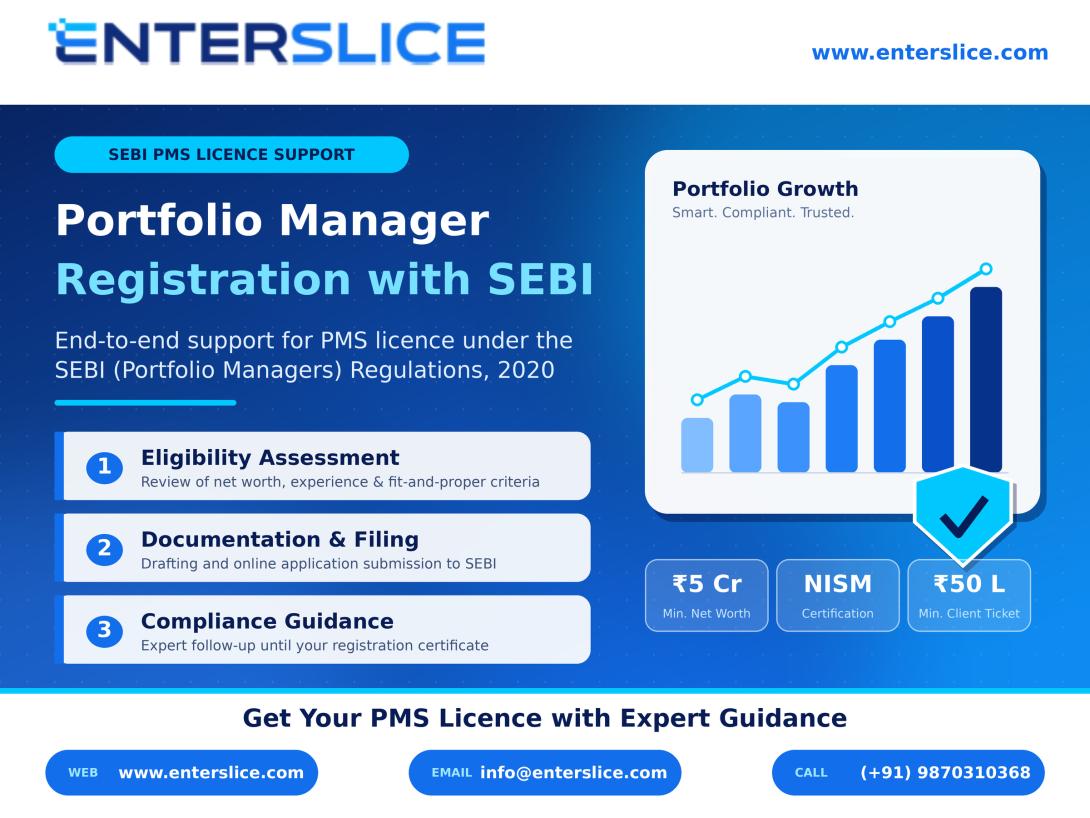
Businesses planning to provide professional investment management services in India must understand the regulatory requirements before entering the portfolio management industry. Portfolio manager registration is a key requirement for eligible entities that intend to manage or advise on client investment portfolios under the applicable regulatory framework.
The Securities and Exchange Board of India (SEBI) regulates portfolio management services to promote transparency, accountability, and investor protection. Obtaining a SEBI Portfolio Manager Registration requires the applicant to meet prescribed financial, organisational, personnel, and compliance requirements.
This guide explains the eligibility criteria, documents, registration process, government fees, benefits, and ongoing compliance requirements for businesses planning to obtain a PMS license in India.
What Is Portfolio Manager Registration?
Portfolio manager registration is the regulatory approval required for an eligible entity to provide portfolio management services in accordance with SEBI regulations.
A portfolio manager manages or advises on investments made on behalf of clients according to an agreed investment strategy and mandate. These services may involve investments in shares, debt instruments, and other permitted securities.
The applicable regulatory framework is the SEBI (Portfolio Managers) Regulations, 2020, as amended. SEBI has also notified the Portfolio Managers Regulations, 2026, which are scheduled to come into effect on 1 April 2027. Businesses applying before that date should consider the regulations currently in force and prepare for the transition where relevant.
Types of Portfolio Management Services
Before applying for portfolio manager registration with SEBI, businesses should identify the type of service they intend to provide.
Discretionary Portfolio Management
Under discretionary portfolio management, the portfolio manager makes investment decisions for the client within the agreed mandate and applicable regulatory requirements.
Non-Discretionary Portfolio Management
In this arrangement, the portfolio manager may recommend or facilitate investment decisions, while the client retains decision-making authority as agreed.
Advisory Services
Advisory services involve providing investment recommendations to clients. The precise regulatory treatment depends on the activities performed, so applicants should confirm whether their proposed business falls within the portfolio manager framework or another applicable SEBI registration category.
Eligibility Criteria for SEBI Portfolio Manager Registration
An applicant must satisfy the applicable eligibility conditions before submitting its application.
Minimum Net Worth
Under the current SEBI Portfolio Managers Regulations, the prescribed minimum net worth is ₹5 crore. The applicant must maintain the required net worth in accordance with the regulatory definition and provide appropriate financial evidence.
Suitable Business Structure
The applicant must meet the legal-structure requirements prescribed under the applicable regulations. Its constitutional documents and proposed business activities should be consistent with the intended portfolio management services.
Qualified Principal Officer and Employees
The applicant must satisfy the applicable qualification, experience, and certification requirements for its principal officer and relevant personnel. These requirements should be checked against the latest regulatory provisions before the application is filed.
Fit-and-Proper Requirements
SEBI evaluates whether the applicant and relevant persons satisfy the prescribed fit-and-proper criteria. Background, integrity, financial soundness, and relevant regulatory history may be considered.
Adequate Infrastructure
The business should have suitable office facilities, technology, record-keeping systems, risk management arrangements, and internal controls to support its proposed activities.
Documents Required for Portfolio Manager Registration
Preparing the supporting documents in advance helps applicants identify gaps before filing. Depending on the applicant's circumstances, the documents may include:
- Certificate of incorporation and constitutional documents.
- PAN and registered office address proof.
- Details of directors, shareholders, and key managerial personnel.
- Audited financial statements and supporting financial records.
- Net-worth certificate issued by a qualified professional.
- Qualifications, experience, and applicable certification details of the principal officer and relevant employees.
- Business plan outlining the proposed services and operating model.
- Details of office infrastructure, technology, staffing, and risk management arrangements.
- Compliance policies, internal controls, and organisational structure.
- Draft client agreements and applicable disclosure documents.
- Prescribed declarations and other supporting information required by SEBI.
The final checklist should be prepared using the latest application form and regulatory instructions.
Step-by-Step Process for Portfolio Manager Registration with SEBI
Step 1: Assess Eligibility
Review the proposed business structure, net worth, personnel qualifications, experience, and infrastructure against the applicable SEBI requirements.
Step 2: Prepare the Documentation
Compile the incorporation documents, financial records, net-worth certificate, business plan, personnel details, compliance policies, and other required information.
Step 3: File the Application
Submit the application in the prescribed format, generally Form A under the current framework, through the applicable SEBI application process. Pay the required application fee.
Step 4: Respond to SEBI Queries
SEBI reviews the application and supporting documents. If clarification or additional information is requested, the applicant should provide a complete and timely response.
Step 5: Pay the Registration Fee
Once SEBI communicates that the relevant registration requirements have been satisfied, pay the applicable registration fee within the prescribed period.
Step 6: Receive Registration and Prepare for Operations
After the requirements are met, SEBI grants the registration certificate. The business should ensure that client documentation, operational systems, reporting arrangements, and compliance procedures are ready before commencing regulated activities.
The approval timeline depends on the completeness of the application, the applicant's readiness, and the regulatory review.
Fees for PMS License in India
Under the existing fee schedule in the SEBI (Portfolio Managers) Regulations, 2020, the prescribed regulatory fees are:
Fee component
Amount
Application fee
₹1,00,000
Registration fee upon approval
₹10,00,000
Fee to keep registration in force
₹5,00,000 every three years
These amounts relate to regulatory fees. Professional consultancy charges, staffing, technology, office infrastructure, audit, and other business expenses are additional.
Applicants should verify the latest applicable fee schedule and payment instructions before submitting their application.
Benefits of Obtaining a PMS License
Regulatory Recognition
Registration establishes that the entity has received SEBI approval to operate as a portfolio manager, subject to applicable conditions.
Investor Confidence
A registered business can demonstrate its regulatory status and commitment to investor-protection requirements.
Better Operational Controls
The registration process encourages businesses to establish suitable investment policies, risk management procedures, client documentation, reporting systems, and internal controls.
Business Development
Registration provides the regulatory foundation for developing portfolio management services within the permitted framework and building relationships with eligible investors.
Compliance Requirements After Registration
Obtaining a PMS license is only the beginning. Registered portfolio managers must continue to meet applicable regulatory obligations.
These may include maintaining the prescribed net worth, providing client disclosures and reports, maintaining records, addressing investor grievances, following the applicable code of conduct, and meeting reporting and audit requirements.
Businesses should maintain a compliance calendar, monitor regulatory changes, and review internal policies periodically. They should also assess any changes in ownership, control, personnel, or business activities to determine whether regulatory notification, approval, or disclosure is required.
How Enterslice Can Assist with Portfolio Manager Registration
Enterslice assists businesses with understanding regulatory requirements and preparing for portfolio manager registration with SEBI. Depending on the engagement, support may include eligibility assessment, documentation assistance, application coordination, responses to regulatory queries, and guidance on ongoing compliance.
Before beginning the process, businesses should evaluate their financial readiness, proposed investment management model, personnel, and operational arrangements.
Most popular services :
Mortgage Guarantee Company Registration
Virtual cfo
Regulatory Compliance and Advisory Services
Legal due diligence
Transmission of Shares
Duplicate share certificate
Frequently Asked Questions
1. What is portfolio manager registration?
It is the regulatory approval required for an eligible entity to provide portfolio management services under the applicable SEBI framework.
2. What is the minimum net worth required for a PMS license?
Under the current SEBI Portfolio Managers Regulations, the prescribed minimum net worth is ₹5 crore, subject to the applicable regulatory definition.
3. What are the fees for portfolio manager registration with SEBI?
The existing fee schedule prescribes an application fee of ₹1 lakh, a registration fee of ₹10 lakh upon approval, and a fee of ₹5 lakh every three years to keep the registration in force.
4. Which documents are required for SEBI Portfolio Manager Registration?
Common documents include incorporation records, financial statements, net-worth certification, personnel qualifications, business plans, infrastructure details, compliance policies, and prescribed declarations.
5. How long does the registration process take?
The timeline depends on the completeness of the application, regulatory queries, and SEBI's review. Applicants should avoid relying on a fixed approval period.
6. Can an individual apply for a PMS license?
Applicants must satisfy the eligible-entity requirements under the applicable regulations. The proposed legal structure should be checked before beginning the application.
7. Is compliance required after receiving registration?
Yes. Registered portfolio managers must maintain applicable financial requirements, reporting systems, client disclosures, records, and other regulatory obligations.
8. Are the Portfolio Managers Regulations, 2026 already effective?
SEBI has notified the Portfolio Managers Regulations, 2026, with an effective date of 1 April 2027. Businesses should check the regulations applicable on the date of their application and prepare for the transition where necessary.