
The global Pharmaceutical Excipients Market plays an important role in the pharmaceutical industry by supporting the development, manufacturing, stability, and delivery of medicines. Pharmaceutical excipients are inactive ingredients added to drug formulations to improve their stability, appearance, solubility, taste, consistency, and release characteristics. They are widely used in tablets, capsules, syrups, injections, creams, and other pharmaceutical products.
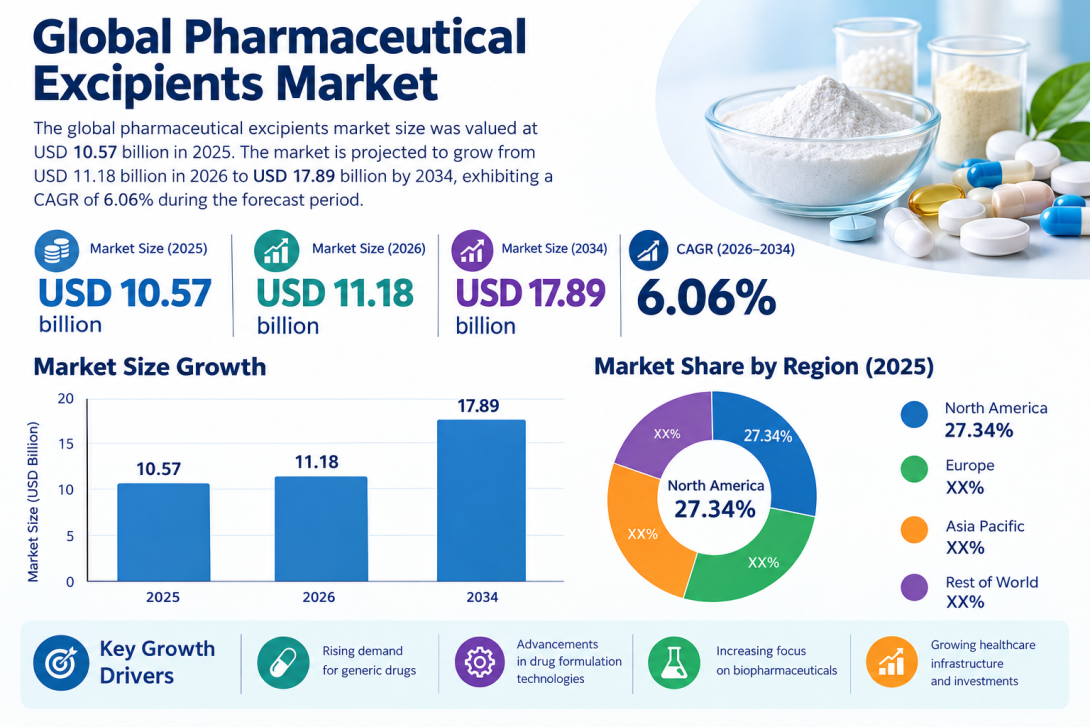
According to Fortune Business Insights, the global Pharmaceutical Excipients Market size was valued at USD 10.57 billion in 2025. The market is projected to grow from USD 11.18 billion in 2026 to USD 17.89 billion by 2034, exhibiting a compound annual growth rate (CAGR) of 6.06% during the forecast period. Increasing pharmaceutical production, rising demand for generic medicines, and continuous advancements in drug formulation technologies are expected to support market growth.
Growing Demand for Pharmaceutical Products
The increasing demand for medicines is a major factor driving the Pharmaceutical Excipients Market. Population growth, the rising prevalence of chronic diseases, and expanding access to healthcare are encouraging pharmaceutical companies to increase production across various therapeutic categories. Excipients are essential to producing consistent and effective formulations that meet quality requirements.
The growing use of generic medicines is also creating opportunities for excipient manufacturers. Generic drug producers require suitable ingredients to maintain product stability, ensure consistent manufacturing, and achieve the required drug-release performance. As pharmaceutical companies expand their product portfolios, demand for specialized excipients is expected to increase.
For detailed market insights : https://www.fortunebusinessinsights.com/pharmaceutical-excipients-market-115935
Advancements in Drug Formulation Technologies
Innovation in drug formulation is contributing to the development of the Pharmaceutical Excipients Market. Modern medicines often require excipients that improve the solubility, absorption, stability, and controlled release of active pharmaceutical ingredients. These requirements are particularly important for complex formulations and drugs with challenging physicochemical properties.
Manufacturers are developing multifunctional excipients that can perform several roles within a single formulation. Such ingredients may simplify manufacturing processes, improve product consistency, and reduce formulation complexity. The development of excipients suitable for advanced drug delivery systems is also creating new opportunities for market participants.
Type Analysis
Based on type, the Pharmaceutical Excipients Market includes several categories of functional ingredients used in drug manufacturing.
- Binders: These ingredients help hold formulation components together and are commonly used in tablet manufacturing.
- Fillers and diluents: They provide the required volume and help ensure uniformity in solid dosage forms.
- Disintegrants: These excipients support tablet breakup after administration, helping the drug become available for dissolution.
- Lubricants and glidants: They improve powder flow and reduce friction during pharmaceutical manufacturing.
- Coating agents: These materials protect dosage forms, improve appearance, mask unpleasant tastes, and may support controlled drug release.
- Preservatives and other excipients: These ingredients help maintain product quality or provide specific formulation functions, depending on the medicine.
Demand across these categories depends on dosage-form requirements, formulation complexity, and pharmaceutical manufacturing volumes.
Functionality Analysis
Functionality is an important consideration in excipient selection. Different ingredients serve as binders, fillers, solvents, stabilizers, emulsifiers, preservatives, sweeteners, and release-modifying agents.
Functional excipients help pharmaceutical companies address challenges associated with drug solubility, stability, processing, and patient acceptability. For liquid formulations, stabilizers and preservatives can help maintain product quality. In solid dosage forms, binders, disintegrants, and lubricants support efficient production and consistent performance.
As formulation requirements become more specialized, demand for high-quality excipients with well-defined functional properties is expected to increase.
Formulation Analysis
The Pharmaceutical Excipients Market serves multiple formulation categories, including oral solid, oral liquid, topical, and parenteral formulations.
Oral solid formulations, such as tablets and capsules, require excipients that support compression, disintegration, dissolution, and product stability. Oral liquid formulations, including syrups and suspensions, use ingredients that help maintain uniformity, viscosity, taste, and stability.
Topical formulations, such as creams, gels, and ointments, depend on excipients that provide suitable texture, consistency, and application properties. Parenteral formulations require carefully selected ingredients that meet stringent quality and safety requirements. These different formulation needs create demand for a broad range of excipient types.
Regional Analysis
North America dominated the Pharmaceutical Excipients Market in 2025, accounting for 27.34% of the global market. The region benefits from established pharmaceutical manufacturing capabilities, substantial research and development activity, and demand for advanced drug formulations. Quality standards and continued innovation also influence excipient selection.
Europe remains an important market due to its established pharmaceutical industry, regulatory framework, and emphasis on product quality. Demand for specialized ingredients and advanced formulations supports regional opportunities.
Asia Pacific is expected to offer growth opportunities through expanding pharmaceutical manufacturing, increasing generic drug production, and improving healthcare access. The presence of pharmaceutical production hubs also supports demand for formulation ingredients.
South America may benefit from growing healthcare needs and pharmaceutical manufacturing activity. Market development will depend on investment, regulatory requirements, and access to quality raw materials.
The Middle East & Africa presents opportunities associated with expanding healthcare infrastructure and pharmaceutical supply capabilities. Greater investment in local manufacturing may contribute to future demand for pharmaceutical excipients.
Competitive Landscape
The Pharmaceutical Excipients Market includes manufacturers competing through product quality, technical expertise, innovation, regulatory compliance, and supply-chain reliability. Companies focus on developing ingredients that meet the changing requirements of pharmaceutical producers while maintaining consistent performance across manufacturing batches.
Research and development, specialized product portfolios, and technical support are important competitive factors. Manufacturers that can provide reliable ingredients for conventional and advanced formulations may be better positioned to address evolving industry needs.
Recent Industry Developments
Industry developments in pharmaceutical excipients increasingly focus on multifunctional ingredients, improved formulation performance, and enhanced manufacturing efficiency. Manufacturers are also investing in research to develop excipients suitable for complex drug delivery systems and formulations with demanding stability requirements.
Regulatory compliance and supply-chain transparency remain important considerations. Pharmaceutical companies increasingly evaluate ingredient quality, traceability, and consistency when selecting suppliers. These priorities are encouraging excipient manufacturers to strengthen quality management systems and technical capabilities.
Get Free Sample PDF: https://www.fortunebusinessinsights.com/enquiry/request-sample-pdf/pharmaceutical-excipients-market-115935
Future Outlook
The global Pharmaceutical Excipients Market is expected to experience steady growth through 2034. According to Fortune Business Insights, the market is projected to increase from USD 11.18 billion in 2026 to USD 17.89 billion by 2034, registering a CAGR of 6.06% during the forecast period.
Growing demand for medicines, expanding generic drug production, and advancements in formulation technologies are expected to create opportunities for market participants. Future growth will also depend on product innovation, regulatory compliance, ingredient quality, and dependable supply chains. As pharmaceutical formulations become more sophisticated, excipients will continue to play an essential role in developing stable, effective, and reliable medicines.
Related Reports
Explore Japan’s Market Opportunities - Latest - Pharmaceutical Excipients Market - Insights