

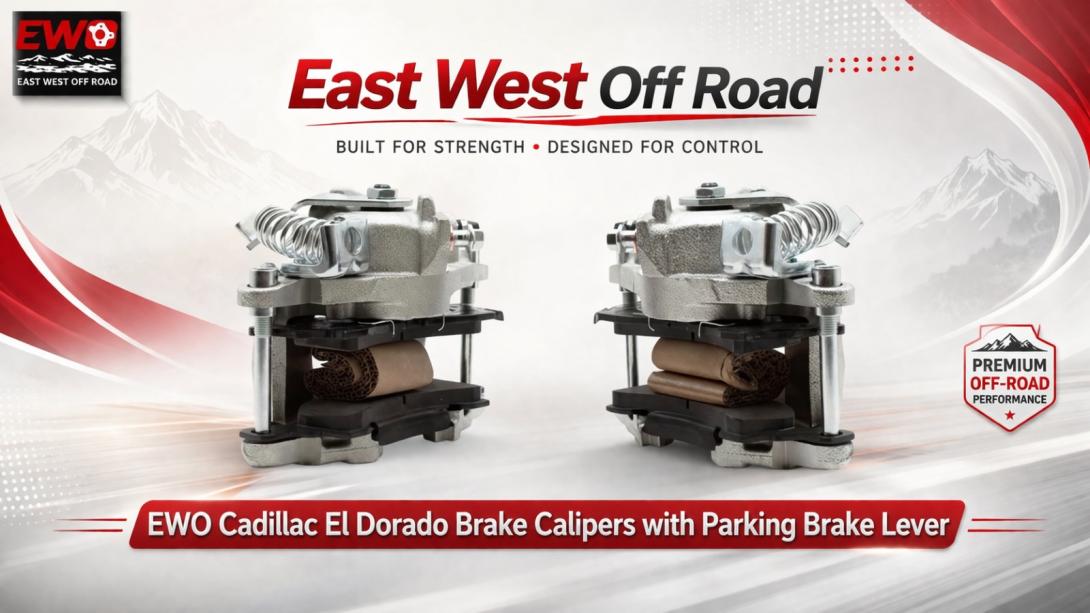
A parking brake caliper is one of the most useful components for a truck, 4x4, or custom axle build that needs rear disc brakes without losing a mechanical parking brake. Unlike a standard hydraulic rear brake caliper, an integrated parking brake caliper can provide normal service braking through hydraulic pressure while also using a separate mechanical lever to hold the vehicle when parked. This makes the design especially valuable for GM 14 Bolt rear disc conversions, Dana 60 builds, Sterling axle swaps, Chevy K20 upgrades, and other heavy-duty off-road projects.
For builders looking for a purpose-built rear disc solution, East West Off Road offers the EWO E63013 Cadillac Eldorado rear brake caliper kit with parking brake levers for compatible conversion applications.
What Is a Parking Brake Caliper?
A parking brake caliper combines two braking functions within one caliper assembly.
During normal driving, hydraulic brake pressure moves the piston and clamps the brake pads against the rotor.
When the parking brake is applied, a mechanical lever operates an internal mechanism that moves or maintains the piston against the pads without relying only on hydraulic pressure.
This type of caliper is often described as:
- Integrated parking brake caliper
- Mechanical emergency brake caliper
- Hydro-mechanical rear caliper
- Rear disc parking brake caliper
- Park brake caliper
- Emergency brake caliper
The integrated design can be particularly useful when converting an older truck from rear drum brakes to discs.
How an Integrated Parking Brake Caliper Works
The main advantage of an integrated parking brake caliper is that the service brake and parking brake share the same rotor and brake pads.
Hydraulic Service Brake Function
When the brake pedal is pressed, hydraulic pressure enters the caliper.
That pressure moves the piston toward the rotor.
The brake pads clamp the rotor and create the friction needed to slow the vehicle.
Mechanical Parking Brake Function
The mechanical parking-brake lever operates independently from normal pedal pressure.
A cable pulls the external lever, which activates the internal parking-brake mechanism.
This allows the caliper to hold the rotor while the vehicle is parked.
Because the mechanical system interacts with the caliper piston, correct adjustment is important.
Why Parking Brake Calipers Are Used in Rear Disc Conversions
One of the biggest challenges in a rear disc brake conversion is retaining a functional parking brake.
A basic hydraulic rear caliper may stop the vehicle effectively during normal braking but provide no mechanical way to hold it when parked.
Builders then have several options:
- Integrated parking brake caliper
- Separate mechanical parking brake caliper
- Drum-in-hat parking brake
- Driveline parking brake
For many older heavy-duty axle conversions, the integrated caliper design offers a compact solution because the service brake and park brake use the same rotor.
Why Cadillac Eldorado-Style Calipers Became Popular
The classic Cadillac Eldorado rear caliper is well known in the truck-disc-conversion market because it combines a large hydraulic caliper with an integrated mechanical parking brake.
The 1976-1978 Cadillac Eldorado rear calipers are especially relevant in heavy-duty conversion discussions.
Their general size and mounting style made them useful for custom axle conversions involving heavy GM-style disc brake brackets.
That helped make the El Dorado parking brake caliper a common choice for:
- GM 14 Bolt axles
- Dana 60 axles
- Dana 70 conversions
- Sterling axles
- Custom 1-ton builds
- Heavy-duty trail rigs
Exact compatibility still depends on the bracket, rotor, axle, and hydraulic system.
Parking Brake Caliper vs. Standard Rear Disc Caliper
The most important difference is the mechanical parking-brake mechanism.
Standard GM Rear Disc Brake Caliper
A conventional GM rear disc brake caliper generally performs hydraulic braking only.
Advantages may include:
- Simple design
- Easy servicing
- Common pads
- Fewer internal mechanical parts
However, a separate parking-brake solution may be required.
Integrated Parking Brake Caliper
A parking-brake caliper combines hydraulic braking and a mechanical parking brake.
Advantages include:
- One caliper for two functions
- Cleaner rear-disc conversion layout
- No separate mechanical caliper required in many setups
- Useful for compatible street-driven truck conversions
The tradeoff is that the mechanical mechanism requires correct adjustment and maintenance.
Parking Brake Caliper vs. Drum-in-Hat Parking Brake
Modern rear disc systems frequently use a small drum parking brake inside the rotor hat.
That approach keeps the service brake and parking brake separate.
An integrated caliper uses the rear disc pads for both functions.
Integrated Caliper Advantages
- Fewer separate brake assemblies
- Compact design
- Popular with many older axle conversion brackets
- Simplified component count
Drum-in-Hat Advantages
- Parking brake is independent of the hydraulic caliper
- Service-caliper replacement does not affect parking-brake hardware
- Common on many modern OEM systems
The best choice depends on the axle, available conversion kit, wheel space, intended use, and service preferences.
EWO Cadillac El Dorado Parking Brake Calipers
The EWO Cadillac El Dorado Brake Calipers are designed around the classic integrated parking-brake concept.
The current East West Off Road product is listed as:
EWO E63013 – Cadillac Eldorado Rear Brake Calipers With Parking Brake Lever Kit
This makes the product relevant for builders looking for East West Off Road brake calipers rather than searching for used or unknown-condition original components.
The product category is centered around rear disc brake conversion and parking-brake applications.
GM 14 Bolt Rear Disc Conversion
A GM 14 Bolt rear disc conversion is one of the most common uses for a parking brake caliper.
The GM 14 Bolt full-float axle is widely used in:
- Chevy trucks
- GMC trucks
- rock crawlers
- trail rigs
- custom 4x4s
- heavy-duty axle swaps
Many older versions were equipped with large rear drum brakes.
A 14 Bolt disc brake swap can replace those drums with rotors and floating calipers.
If the truck also needs a mechanical parking brake, an Eldorado-style caliper can be used with compatible conversion components.
SRW 14 Bolt Disc Brackets
SRW 14 bolt disc brackets are designed around Single Rear Wheel axle configurations.
Before choosing a caliper, verify:
- Bracket offset
- Rotor diameter
- Rotor thickness
- Caliper mounting spacing
- Hub configuration
- Hose routing
- Wheel clearance
Do not assume every 14 Bolt disc bracket accepts every parking-brake caliper.
DRW Rear Disc Conversion
A DRW rear disc conversion can require different brackets and rotor positioning than an SRW axle.
Dual Rear Wheel hubs change the overall brake packaging.
The parking brake caliper may still be appropriate, but the entire conversion must be matched to the DRW axle configuration.
Cab and Chassis Disc Brake Kit Applications
A Cab and Chassis disc brake kit can also differ from ordinary pickup-style 14 Bolt conversions.
Hub width and bracket offset may vary.
Identify the exact axle before ordering rotors, brackets, or calipers.
Dana 60 Rear Disc Conversion
A Dana 60 rear disc conversion is another popular application for integrated parking brake calipers.
Dana 60 axles were produced in many configurations, however.
Compatibility can depend on:
- Axle year
- Housing ends
- Hub design
- Rotor selection
- Wheel bolt pattern
- Caliper bracket
- Wheel diameter
For custom Dana 60 projects, choose the complete brake system around the actual axle rather than the Dana 60 name alone.
Sterling 10.25 Disc Brakes
Sterling 10.25 disc brakes are frequently upgraded on older Ford heavy-duty axle builds.
A parking brake caliper can be used in compatible conversion systems where the bracket and rotor are designed around the caliper.
This gives builders another option for retaining a mechanical parking brake after deleting factory drums.
Chevy K20 Rear Disc Upgrade
A Chevy K20 rear disc upgrade may use either conventional GM hydraulic calipers or an integrated park-brake design.
Common searches include:
- GM K20 brake caliper
- 73-86 GM K20 brake calipers
- Chevy K20 rear disc upgrade
The correct choice depends on whether the build requires an integrated mechanical parking brake.
A standard front-style GM caliper does not automatically provide that function.
GM V20 Truck Brakes
The same issue applies to GM V20 truck brakes.
Builders commonly search:
- GM V20 brake caliper
- 87-91 GM V20 brake calipers
- GM V20 truck brakes
When planning a rear disc conversion, do not assume that a standard V20 hydraulic caliper and an Eldorado parking-brake caliper are functionally identical.
Verify the complete conversion design.
3/4 Ton Truck Rear Disc Conversion
A 3/4 ton truck rear disc conversion should be planned around more than simply replacing drums.
The complete brake system can include:
- Rotors
- Caliper brackets
- Parking brake calipers
- Brake pads
- Flexible brake hoses
- Hard brake lines
- Parking-brake cables
- Master cylinder
- Proportioning components
Vehicle weight, tire size, axle type, and hydraulic balance should all be considered.
1 Ton Axle Disc Swap
A 1 ton axle disc swap places even greater emphasis on selecting appropriate brake components.
Heavy vehicles and large off-road tires can create substantial braking demands.
This is why heavy-duty off road brake calipers are frequently paired with one-ton axle conversions.
The caliper should still be matched to the rotor, master cylinder, brake bias, and actual vehicle use.
Hydro-Mechanical Rear Caliper Explained
The term hydro-mechanical rear caliper describes the dual-function design well.
“Hydro” refers to hydraulic service braking.
“Mechanical” refers to the parking-brake lever and internal mechanism.
This combination is what makes an Eldorado-style rear caliper different from an ordinary front-style GM floating caliper.
Mechanical Emergency Brake Caliper Benefits
A mechanical emergency brake caliper can provide an independent mechanical means of applying the rear brakes when parked.
That is particularly useful on vehicles that originally relied on drum-brake parking hardware.
After a rear disc swap, removing the drums also removes the original internal parking-brake components.
An integrated park-brake caliper replaces that function within the disc-brake assembly.
D122 Brake Pads for Parking Brake Calipers
Pad selection matters more on this style of caliper than many builders realize.
Large Eldorado-style calipers are commonly associated with D122 brake pads.
One important characteristic is the brake pads with locking nub design.
This feature interacts with the piston and helps prevent unwanted rotation.
That relationship is important to the internal parking-brake mechanism.
D122 vs. D52 Pads
The D122 vs D52 pads question frequently appears during Eldorado brake conversions.
The pads can look very similar.
However, the D122 design includes a piston-engagement feature associated with the rear parking-brake caliper.
The D52 pad may not provide the same locking feature.
Using the correct pad is important because the internal mechanism depends on the piston maintaining the intended orientation.
Always verify the pad specification for the actual caliper.
Anti-Rotation Piston Mechanism
The anti-rotation piston mechanism is one of the details that separates a mechanical parking-brake caliper from a simple hydraulic caliper.
The internal parking-brake mechanism needs to maintain correct piston position as the pads wear.
This is also why piston orientation and pad engagement matter during installation.
Why the Caliper Piston May Rotate
If you notice the caliper piston rotating, remember that parking-brake calipers can use a screw-type internal mechanism.
The piston should not simply be treated like a standard front brake piston.
Incorrect piston positioning can contribute to:
- Excessive pad clearance
- Weak parking brake
- Long brake-pedal travel
- Incorrect parking-brake lever movement
Follow the service procedure for the specific caliper instead of forcing the piston.
Pre-Adjusting Rear Calipers
Pre-adjusting rear calipers is important on hydro-mechanical parking-brake designs.
If excessive clearance exists between the brake pads and rotor, the mechanical parking brake may use too much lever movement before clamping the rotor.
That can make the brake feel weak even when the cables are tight.
Correct initial adjustment helps establish the operating position of the piston and mechanical mechanism.
Adjusting Eldorado Parking Brake Mechanisms
Adjusting Eldorado parking brake systems requires understanding that cable tension is not the only adjustment.
The internal mechanism must first be correctly positioned.
Depending on the caliper design, adjustment can involve cycling the parking-brake lever so the internal mechanism advances the piston closer to the pads.
Because the brake system is safety-critical, follow the exact manufacturer's procedure and have the completed conversion inspected if you are unsure about the setup.
Ratchet Mechanism Adjustment
Many integrated rear calipers use a self-adjusting or ratcheting mechanism.
The ratchet mechanism adjustment helps compensate for brake-pad wear.
If the mechanism does not adjust correctly, symptoms can include:
- Parking brake won't hold
- Excessive lever travel
- Excessive pedal travel
- Poor rear brake response
Cable adjustment alone may not correct an internal adjustment problem.
Why a Parking Brake Won't Hold
If the parking brake won't hold, possible causes include:
- Excessive pad-to-rotor clearance
- Incorrect caliper pre-adjustment
- Wrong brake pads
- Parking-brake cable slack
- Poor cable geometry
- Seized external lever
- Internal mechanism problems
- Contaminated brake pads or rotors
The correct repair depends on the actual cause.
Simply tightening the cable can create brake drag if the caliper mechanism is not correctly adjusted.
Heavy Duty Parking Brake Lever
The external heavy duty parking brake lever converts cable movement into mechanical action inside the caliper.
The lever should:
- Move smoothly
- Return fully
- Avoid binding
- Stay clear of suspension components
- Have proper cable alignment
Corrosion or debris around the external mechanism can interfere with operation.
Why the Return Spring Matters
The return spring helps bring the parking-brake lever back to its released position.
If the lever does not return fully, the brake pads may remain partially applied.
That can cause:
- Brake drag
- Excessive heat
- Premature pad wear
- Rotor damage
Regular brake inspection is especially important on vehicles exposed to mud, water, road salt, or trail debris.
Loaded Rear Brake Calipers
Loaded rear brake calipers generally refer to calipers supplied with brake pads and sometimes related hardware.
This can simplify parts sourcing.
However, “loaded” does not have one universal definition.
Before ordering, verify exactly what the specific kit includes.
Do not assume that brake hoses, banjo bolts, brackets, parking-brake cables, or installation hardware are included unless the listing specifically states so.
Zinc Plated Brake Calipers
Zinc plated brake calipers are especially attractive for off-road and truck applications because brake components are frequently exposed to harsh environments.
A zinc or clear-zinc coating can provide additional corrosion protection against:
- Moisture
- Mud
- Road salt
- Outdoor storage
- Winter conditions
The EWO E63013 listing is positioned within East West Off Road's zinc-plated brake-caliper category.
Protective coating still does not replace routine inspection and maintenance.
No Core Charge El Dorado Calipers
Traditional remanufactured brake calipers may require a core deposit.
This can be inconvenient for a new rear disc conversion because the builder may not have old Cadillac calipers available to return.
That creates strong buyer interest in no core charge El Dorado calipers.
When comparing prices, check whether a core charge is added during checkout because it can affect the actual purchase cost.
Driver and Passenger Side Park Brake Calipers
Parking-brake lever orientation can make left- and right-side caliper identification important.
A driver and passenger side park brake caliper set should be installed so that:
- Parking-brake levers can operate correctly
- Brake hoses route safely
- Bleeders can function properly
- Cables do not interfere with suspension parts
Correct side orientation is especially important for bleeding.
Bleeding Rear Disc Brakes Correctly
Bleeding rear disc brakes is critical after a conversion.
Air trapped in the hydraulic system compresses under pedal pressure and can cause a soft pedal.
The bleeder needs to be positioned where air trapped in the caliper can escape.
If the active bleeder is not near the top of the hydraulic cavity, air may remain inside.
For unusual caliper mounting positions, always follow the conversion-kit manufacturer's bleeding procedure.
GM Dual-Bleeder Caliper vs. Parking Brake Caliper
A GM dual-bleeder caliper can provide additional installation flexibility because bleeders are available in more than one position.
East West Off Road separately lists a:
GM Dual-Bleeder JB6 Brake Caliper (Loaded)
That should not be confused with the EWO E63013 Eldorado parking-brake caliper.
The key difference for many buyers is the mechanical parking-brake function.
Spongy Pedal After Disc Swap
A spongy pedal after disc swap does not always mean the calipers are defective.
Possible causes include:
- Air in the hydraulic system
- Incorrect bleeder orientation
- Excessive rear pad clearance
- Parking-brake calipers not pre-adjusted
- Flexible hose expansion
- Hydraulic leaks
- Incorrect master-cylinder sizing
The entire system should be diagnosed before replacing parts.
Master Cylinder Upgrade for 4 Wheel Disc
A master cylinder upgrade for 4 wheel disc may be necessary in some conversions.
The correct master cylinder depends on variables such as:
- Front and rear caliper piston area
- Master-cylinder bore
- Brake booster
- Pedal ratio
- Vehicle weight
- Desired pedal travel
There is no single master-cylinder upgrade that is correct for every rear disc conversion.
Adjustable Proportioning Valve
An adjustable proportioning valve may be used in a custom brake system to control rear brake pressure.
Rear brakes should contribute enough braking force without locking before the front brakes during hard stops.
A conversion should be evaluated as a complete front-to-rear hydraulic system rather than tuning only the rear calipers.
Residual Pressure Valve Removal
Residual pressure valve removal is frequently discussed during drum-to-disc conversions because some older drum systems used different residual-pressure arrangements.
However, hydraulic configurations vary.
Do not remove a valve simply because another vehicle's conversion required it.
Identify the master cylinder and existing hydraulic system first.
Brake Hose and Banjo Bolt Compatibility
Brake-hose inlet threads are another major fitment detail.
Two commonly researched specifications are:
- 7/16-20 banjo bolt
- 10mm x 1.5 banjo bolt
These are different threads and are not interchangeable.
Some Eldorado-style conversion calipers are associated with 7/16-20 banjo bolts with copper washers, while later metric-style GM calipers may use a metric banjo bolt.
Verify the actual inlet before ordering hoses or fittings.
Steel Braided Brake Lines
Steel braided brake lines are popular in off-road conversions because flexible hoses must accommodate axle and suspension movement.
Correct hose selection should account for:
- Fitting thread
- Banjo orientation
- Full suspension droop
- Full compression
- Steering or axle movement
- Abrasion points
- Exhaust heat
A hose should never become the suspension travel limiter.
Rear Caliper Slide Pin Lubrication
Floating calipers rely on free movement across the slide pins.
Proper rear caliper slide pin lubrication helps maintain even braking pressure on both pads.
Dry, corroded, or seized slide pins can contribute to:
- Uneven pad wear
- Brake drag
- Reduced braking efficiency
- Excessive heat
Use brake-compatible lubricant and avoid contaminating the rotor or friction material.
7 Inch Mounting Pin Spacing
Builders researching GM heavy-duty rear disc conversions often encounter the term 7 inch mounting pin spacing.
Mounting dimension is important, but it is only one part of compatibility.
The caliper must also work with:
- Rotor diameter
- Rotor thickness
- Bracket offset
- Wheel clearance
- Brake hose routing
Verify the complete combination before ordering.
Large Piston Eldorado Calipers
Large piston Eldorado calipers are attractive for heavy-duty conversion projects, but piston diameter should not be selected independently from the rest of the hydraulic system.
A larger piston requires more brake-fluid volume for a given amount of travel.
That can affect:
- Pedal travel
- Master-cylinder requirements
- Brake bias
- Front-to-rear balance
Always verify the actual caliper specification rather than assuming all Eldorado or JB6-style calipers use identical pistons.
D122 Pads vs. D52 Pads and Brake Bias
Pad shape and piston design can affect fitment, but brake bias involves more than pad selection.
Front-to-rear balance depends heavily on caliper piston area, rotor size, tire traction, vehicle weight transfer, and hydraulic pressure.
That is why mixing random front GM calipers into a rear-disc system can produce undesirable brake balance.
Use components designed around the intended conversion.
Parking Brake Calipers for Off-Road Use
An off-road brake upgrade has unique demands.
Mud, water, rocks, suspension travel, and large tires can all affect brake components.
A properly matched integrated parking brake caliper can offer:
- Rear disc service braking
- Mechanical park-brake capability
- Easy pad inspection
- Accessible servicing
- Compatibility with common heavy-duty axle conversions
This combination explains why Eldorado-style off road brake calipers continue to be popular in custom 4x4 builds.
Parking Brake Calipers for Street-Driven Builds
Builders often search for a street legal rear disc conversion.
A functioning parking brake may be an important part of local vehicle-equipment requirements, but installing a specific caliper does not automatically make a conversion street legal.
Requirements vary by jurisdiction.
The complete system should be properly engineered, installed, inspected, and compliant with applicable regulations.
Important Pre-Purchase Fitment Checks
Before ordering a parking-brake caliper, verify the following.
Axle Type
Identify whether the vehicle uses:
- GM 14 Bolt
- Dana 60
- Sterling 10.25
- Dana 70
- Another custom axle
Axle Configuration
Determine whether the axle is:
- SRW
- DRW
- Cab and Chassis
Brake Brackets
Confirm that the conversion brackets are designed for the selected caliper.
Rotor Specifications
Verify rotor diameter, thickness, and offset.
Brake Pad Specification
Confirm the correct brake-pad shape and piston engagement.
Brake Hose Thread
Verify whether the caliper uses 7/16-20, 10mm x 1.5, or another connection.
Parking Brake Cables
Make sure the cable system can operate the caliper levers through the correct range.
Why the Complete Brake System Matters
A premium parking brake caliper cannot fix an incorrectly engineered rear disc conversion.
Every component should work together:
- Caliper
- Rotor
- Pads
- Brackets
- Hydraulic hoses
- Master cylinder
- Proportioning system
- Parking-brake cables
- Wheels and tires
Treat the brake conversion as a complete system rather than a collection of individual upgrades.
Why Choose East West Off Road Brake Calipers?
For builders who need a parking brake as part of a truck rear disc conversion, the rear disc brake conversion solution based around EWO E63013 offers the integrated Eldorado-style concept in a purpose-built product.
Key buyer considerations include:
- Integrated parking-brake function
- Cadillac Eldorado-style architecture
- Suitable for compatible heavy-duty rear disc conversion systems
- Parking brake lever design
- EWO E63013 product identification
- Zinc-plated positioning
- Heavy-duty truck and off-road conversion focus
This makes the product particularly relevant for GM 14 Bolt, Dana 60, Sterling, Chevy K20, GM V20, and other custom axle builds where builders want rear discs while retaining a mechanical parking brake.
Frequently Asked Questions (FAQs)
What is a parking brake caliper?
A parking brake caliper is a rear disc brake caliper that includes a mechanical system for applying the brake independently of normal hydraulic pedal pressure.
How does an integrated parking brake caliper work?
Normal braking uses hydraulic pressure to move the piston. The parking brake uses a mechanical lever and internal mechanism to apply or maintain pressure against the rear brake pads.
Is a parking brake caliper the same as a regular rear brake caliper?
No. A regular hydraulic caliper may not include a mechanical parking-brake mechanism. An integrated parking brake caliper provides both service braking and mechanical park-brake functionality.
Why are Cadillac Eldorado parking brake calipers popular?
Eldorado-style calipers became popular because their integrated mechanical parking brake makes them useful for rear disc conversions on heavy-duty truck axles.
What is EWO E63013?
EWO E63013 is East West Off Road's Cadillac Eldorado Rear Brake Calipers With Parking Brake Lever Kit.
Can a parking brake caliper be used on a GM 14 Bolt axle?
Yes, Eldorado-style parking brake calipers are commonly used with compatible GM 14 Bolt disc conversion brackets and rotors. Exact fitment must be confirmed.
Can I use one on a Dana 60 rear axle?
They can be used in compatible Dana 60 rear disc conversion systems. The bracket, rotor, hub, and axle configuration must match.
Can parking brake calipers work with Sterling 10.25 disc brakes?
They can be used with compatible Sterling conversion systems. Verify the specific bracket and rotor combination.
Are parking brake calipers suitable for Chevy K20 rear disc conversions?
They are commonly considered for K20 and other GM heavy-duty axle conversions when a mechanical parking brake is required.
What are D122 brake pads?
D122 pads are commonly associated with large Eldorado-style parking-brake calipers and include a piston-engagement feature important to the parking-brake mechanism.
What is the difference between D122 and D52 brake pads?
D122 pads include a locking feature that engages compatible parking-brake-caliper pistons. D52 pads may look similar but do not provide the same piston-locking feature.
Why won't my parking brake caliper hold?
Possible causes include improper pre-adjustment, excessive pad clearance, incorrect pads, cable problems, a sticking lever, or internal mechanism issues.
Why is my pedal soft after installing rear disc brakes?
A soft or spongy pedal may result from trapped air, excessive pad clearance, incorrect caliper adjustment, hydraulic leaks, hose expansion, or an improperly matched master cylinder.
Do parking brake calipers need to be pre-adjusted?
Many integrated mechanical parking-brake calipers require correct initial adjustment so the pads are positioned properly relative to the rotor.
Can I just tighten the parking brake cable?
Not necessarily. Cable tension cannot correct every internal caliper-adjustment problem, and overtightening can cause brake drag.
What banjo bolt size do parking brake calipers use?
The correct thread depends on the exact caliper. Some Eldorado-style applications use 7/16-20 hardware, while other GM calipers may use metric fittings such as 10mm x 1.5. Verify before installation.
Should the brake bleeder face upward?
Air naturally rises, so the active bleeder generally needs to be positioned where trapped air can escape effectively. Follow the caliper or conversion-kit manufacturer's bleeding procedure.
Do I need a proportioning valve after a rear disc conversion?
Some custom conversions require changes to rear brake-pressure control. The correct solution depends on the entire braking system and should be determined for the specific vehicle.
Do I need a different master cylinder for rear disc brakes?
Possibly. Master-cylinder bore, caliper piston area, pedal ratio, booster design, and the complete front/rear brake system determine compatibility.
Are parking brake calipers good for off-road trucks?
They can be useful for compatible off-road conversions because they combine rear disc braking with a mechanical parking brake. Proper sealing, corrosion protection, adjustment, inspection, and maintenance remain important.
Are zinc-plated parking brake calipers worth it?
Zinc plating can provide additional corrosion resistance in environments involving moisture, mud, road salt, or outdoor storage.
Is an integrated parking brake better than a drum-in-hat system?
Neither design is universally better. Integrated calipers reduce the number of separate brake assemblies, while drum-in-hat systems separate the parking brake from the hydraulic caliper. The best choice depends on the axle and conversion.
Is professional installation recommended?
Yes. Brakes are a safety-critical vehicle system. Custom brackets, hydraulic plumbing, caliper adjustment, bleeding, parking-brake cable setup, and brake balance should be installed or inspected by a qualified automotive professional.