
The North America and Europe Rubber Fillers Market plays an important role in the rubber manufacturing industry, supporting the production of tires, automotive components, industrial rubber products, footwear, and other rubber-based materials. Rubber fillers are incorporated into rubber compounds to improve strength, durability, stiffness, abrasion resistance, and overall product performance. As automotive production and industrial applications continue to evolve, demand for reliable and cost-effective rubber fillers remains important across both regions.
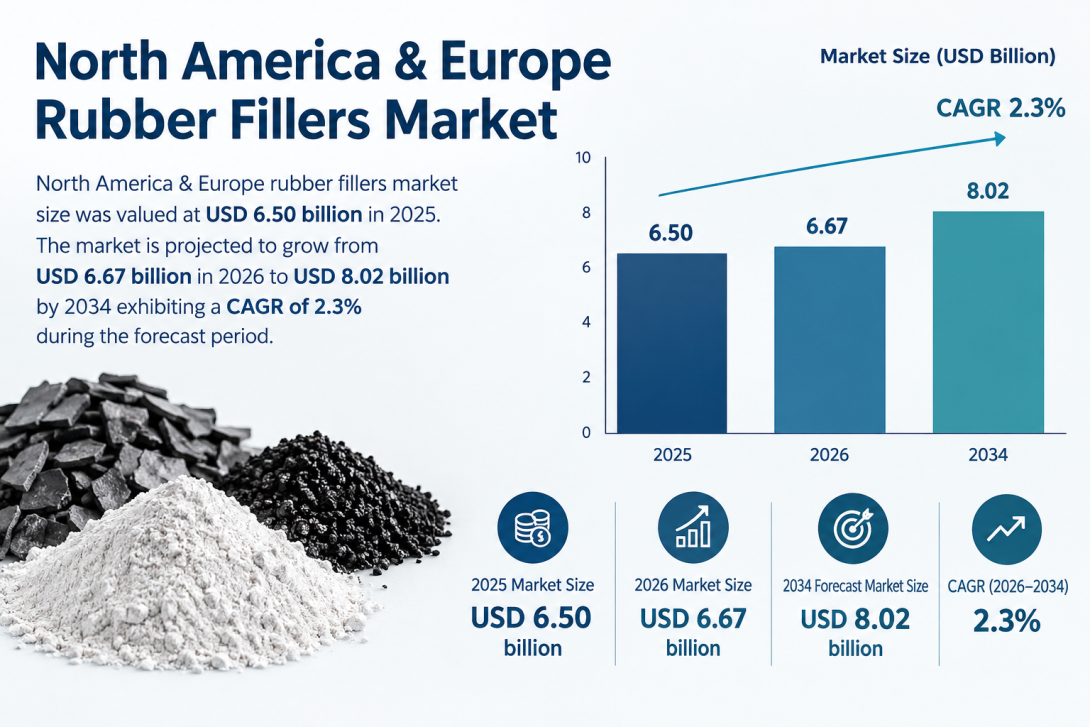
According to Fortune Business Insights, the North America and Europe rubber fillers market size was valued at USD 6.50 billion in 2025. The market is projected to grow from USD 6.67 billion in 2026 to USD 8.02 billion by 2034, exhibiting a CAGR of 2.3% during the forecast period. This growth reflects continued demand from tire manufacturing, automotive production, and industrial rubber applications.
Growing Demand from the Automotive Industry
The automotive industry is a major consumer of rubber fillers, particularly in tire manufacturing and the production of various rubber components. Fillers such as carbon black and silica are widely used to improve tire strength, wear resistance, traction, and other performance characteristics.
In North America, established automotive manufacturing and replacement tire markets support demand for rubber compounds. Europe also represents an important market because of its automotive manufacturing base and focus on vehicle performance, safety, and efficiency. As manufacturers continue to develop advanced tires and durable automotive components, the need for specialized rubber fillers is expected to remain steady.
Increasing Focus on Tire Performance and Durability
Tire manufacturers increasingly focus on improving fuel efficiency, reducing rolling resistance, and extending tire service life. Rubber fillers contribute to these objectives by influencing the mechanical and performance characteristics of rubber compounds.
Silica has gained attention for its role in developing tires with lower rolling resistance, while carbon black remains widely used because of its reinforcing properties and established manufacturing processes. The selection of fillers depends on the intended application, performance requirements, processing conditions, and production costs.
These factors are expected to support continued innovation in rubber formulations across North America and Europe.
For detailed market insights : https://www.fortunebusinessinsights.com/north-america-and-europe-rubber-fillers-market-118815
Material Type Analysis
The North America and Europe Rubber Fillers Market includes several material categories, such as carbon black, silica, calcium carbonate, clay, and other specialty fillers.
Carbon black is widely used in tire manufacturing, automotive rubber components, hoses, belts, and industrial products because it enhances reinforcement and durability. Silica is important in applications requiring specific traction and rolling-resistance characteristics, particularly in modern tire formulations.
Calcium carbonate and clay are used in selected applications to improve processing characteristics, modify material properties, or manage production costs. Specialty fillers may also serve particular performance requirements. The choice of material depends on the balance between product quality, functionality, and cost efficiency.
Application Analysis
Rubber fillers serve a broad range of applications across the automotive, transportation, construction, and industrial sectors.
Tire manufacturing represents a major application area because fillers influence tire strength, abrasion resistance, and overall performance. Demand for replacement tires and original equipment tires supports consumption across both regions.
Automotive components provide another important application, including seals, gaskets, hoses, belts, and vibration-control products. These components require suitable mechanical properties and durability under varying operating conditions.
Industrial rubber products, footwear, construction materials, and other specialized applications also contribute to market demand. The diversity of these end uses helps maintain a broad customer base for rubber filler manufacturers.
Regional Analysis
North America
North America benefits from established tire manufacturing, automotive production, and industrial rubber processing activities. The U.S. is an important contributor to regional demand, supported by its automotive industry and replacement tire market. Manufacturers are also investing in improved rubber formulations to address performance, durability, and manufacturing efficiency requirements.
Europe
Europe represents another significant market, supported by its automotive manufacturing base, tire industry, and industrial production capabilities. Demand for high-performance tires and advanced rubber components contributes to the use of reinforcing fillers such as carbon black and silica. Environmental considerations and efforts to improve vehicle efficiency are also influencing material development and rubber formulation strategies.
Across both regions, manufacturers are expected to prioritize product quality, efficient production processes, and material solutions that meet changing customer requirements.
Competitive Landscape
The competitive landscape includes producers of reinforcing fillers, specialty materials, and industrial additives used in rubber manufacturing. Companies compete through product performance, manufacturing capacity, supply reliability, technical support, and pricing.
Research and development activities remain important as manufacturers seek to improve filler dispersion, enhance rubber compound properties, and develop materials suited to changing tire and industrial applications. Collaboration with tire producers and rubber product manufacturers can also help suppliers address specific performance requirements.
Recent Industry Trends
The rubber fillers industry is experiencing continued development in advanced tire formulations, specialty filler technologies, and more resource-efficient manufacturing processes. Interest in silica-based tire compounds and improved carbon black grades reflects the industry's focus on balancing durability, performance, and efficiency.
Manufacturers are also examining ways to improve material utilization, reduce production waste, and incorporate more sustainable raw materials where technically and commercially feasible. These developments may influence product innovation and purchasing decisions throughout North America and Europe.
Get Free Sample PDF: https://www.fortunebusinessinsights.com/enquiry/request-sample-pdf/north-america-and-europe-rubber-fillers-market-118815
Future Outlook
The North America and Europe Rubber Fillers Market is expected to register steady growth through 2034, supported by demand from tire manufacturing, automotive components, and industrial rubber products. Although the projected growth rate is moderate, continued requirements for durable and high-performance rubber materials are likely to sustain market activity.
According to Fortune Business Insights, the market is projected to increase from USD 6.67 billion in 2026 to USD 8.02 billion by 2034, reflecting a CAGR of 2.3%. Advancements in carbon black and silica technologies, changing tire performance requirements, and improvements in rubber formulation processes are expected to shape future market developments. Suppliers that focus on consistent quality, cost efficiency, and evolving material requirements will remain important to the region's rubber manufacturing value chain.
Related Reports
What’s Driving Japan’s Market? Discover the Latest - North America and Europe Rubber Fillers Market - Insights