
The global Medical Radiation Shielding Market is an important part of the healthcare industry, supporting radiation safety in hospitals, diagnostic imaging centers, cancer treatment facilities, and research laboratories. Medical radiation shielding products help reduce unnecessary exposure to ionizing radiation for healthcare professionals, patients, and other individuals in medical environments. These solutions include protective barriers, lead-lined walls, shielding doors, protective clothing, and specialized materials used in imaging and treatment rooms.
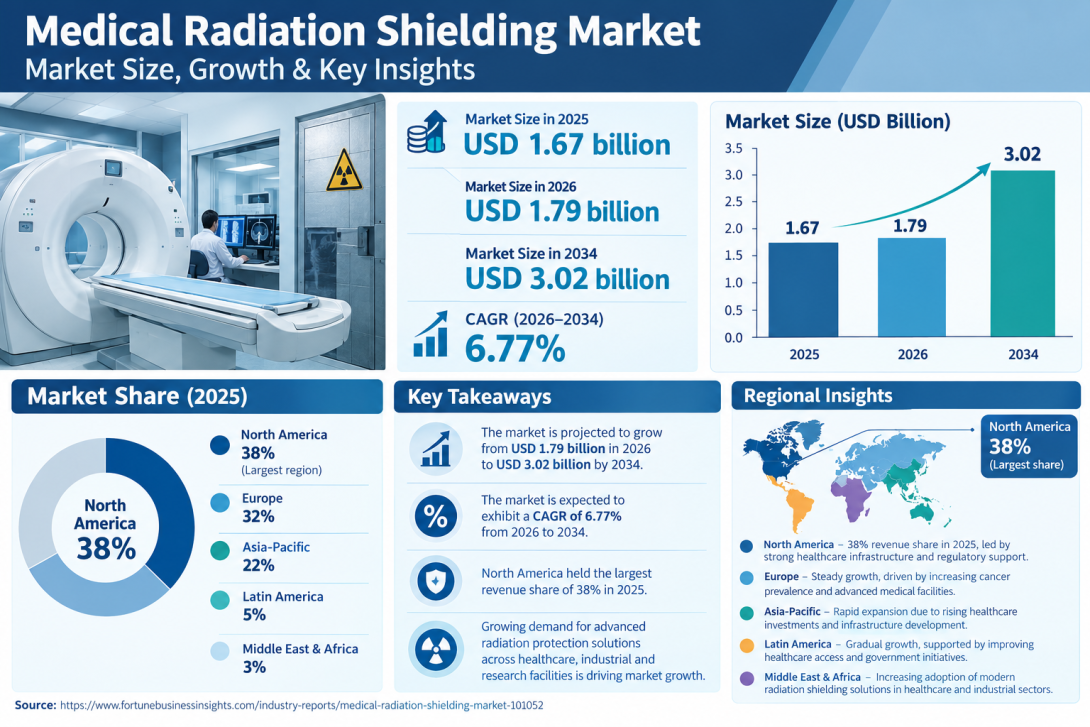
According to Fortune Business Insights, the global Medical Radiation Shielding Market was valued at USD 1.67 billion in 2025. The market is projected to grow from USD 1.79 billion in 2026 to USD 3.02 billion by 2034, registering a compound annual growth rate (CAGR) of 6.77% during the forecast period. Increasing diagnostic imaging procedures, rising cancer treatment requirements, and greater attention to radiation safety are expected to support market expansion.
Increasing Demand for Radiation Safety in Healthcare
The growing use of medical imaging technologies is a major factor driving the Medical Radiation Shielding Market. Procedures involving X-ray systems, computed tomography (CT), and other radiation-based technologies require appropriate protective measures to minimize occupational and environmental exposure.
Hospitals and diagnostic facilities are investing in shielding systems to meet applicable safety requirements and maintain controlled clinical environments. Radiation protection solutions are also important in operating rooms and specialized treatment facilities where imaging equipment is frequently used. As healthcare providers expand their diagnostic capabilities, demand for reliable shielding products is expected to increase.
Rising Cancer Cases and Radiation Therapy Procedures
The growing need for cancer diagnosis and treatment is creating opportunities for the Medical Radiation Shielding Market. Radiation therapy facilities require specialized shielding structures to contain radiation and protect surrounding areas. As healthcare systems invest in oncology services, demand for appropriately designed treatment rooms and shielding materials may rise.
The expansion of specialized cancer centers and advanced treatment technologies is also contributing to market development. Manufacturers are focusing on solutions that meet facility-specific requirements while supporting efficient installation and long-term performance.
For detailed market insights : https://www.fortunebusinessinsights.com/industry-reports/medical-radiation-shielding-market-101052
Product Type Analysis
The Medical Radiation Shielding Market includes building materials, wearable protective products, and other specialized shielding solutions.
- Building Materials: Lead sheets, lead-lined walls, shielding doors, lead glass, bricks, curtains, and other structural components help protect designated areas from radiation exposure.
- Wearables: Protective aprons, thyroid collars, gloves, and other shielding garments are used by healthcare professionals during selected radiation-based procedures.
- Others: This category includes specialized barriers, mobile screens, and customized shielding systems for specific clinical applications.
Demand across these categories depends on facility design, equipment requirements, applicable safety standards, and the nature of medical procedures performed.
Imaging Equipment Analysis
Different medical imaging technologies create specific radiation protection requirements.
X-ray equipment is widely used for diagnostic examinations and may require protective barriers, room shielding, and personal protective equipment.
Computed tomography systems are used for detailed diagnostic imaging and require appropriately designed rooms to control radiation exposure.
Magnetic resonance imaging (MRI) uses magnetic fields and radio waves rather than ionizing radiation. MRI-related shielding requirements are therefore different from those of X-ray and CT systems, often involving radiofrequency shielding instead of conventional radiation protection.
Ultrasound equipment uses sound waves rather than ionizing radiation and does not require conventional ionizing-radiation shielding. Other specialized applications may include nuclear medicine and radiation therapy, depending on the equipment and clinical setting.
End-User Analysis
Hospitals represent an important end-user segment because they perform a wide range of diagnostic imaging, surgical, and treatment procedures. Their need for radiation protection extends across imaging departments, operating rooms, and specialized clinical facilities.
Diagnostic centers require shielding solutions for imaging rooms and related infrastructure. Cancer centers need specialized shielding for radiation therapy equipment and treatment areas. Biopharmaceutical companies, laboratories, and research institutions may also require radiation protection systems for selected research and production activities.
Regional Analysis
North America dominated the Medical Radiation Shielding Market with a revenue share of 38% in 2025. The region benefits from established healthcare infrastructure, widespread use of diagnostic imaging, and a strong focus on radiation safety. Investments in hospital modernization and cancer treatment facilities further support demand.
Europe represents an important market due to its developed healthcare systems, established medical technology industry, and emphasis on radiation protection standards. Demand is supported by the need to maintain and upgrade clinical infrastructure.
Asia Pacific offers growth opportunities through healthcare infrastructure expansion, increasing access to diagnostic services, and rising investment in medical facilities. Growing demand for cancer diagnosis and treatment may further contribute to regional development.
South America may experience increasing adoption as hospitals and diagnostic centers upgrade equipment and strengthen radiation safety practices.
The Middle East & Africa presents opportunities through healthcare infrastructure development, new medical facilities, and investment in specialized treatment services. Market expansion will depend on funding, equipment availability, and the development of technical expertise.
Competitive Landscape
The Medical Radiation Shielding Market includes specialized manufacturers and medical technology companies competing through product quality, technical expertise, customization, and compliance with relevant safety standards. Important industry participants include:
- ETS-Lindgren
- Radiation Protection Products, Inc.
- Veritas Medical Solutions LLC
- RAY-BAR ENGINEERING CORP.
- Gaven Industries Inc.
- Global Partners in Shielding, Inc.
Companies are focusing on developing effective shielding materials, improving installation methods, and providing solutions suited to different imaging and treatment environments. Innovation in lightweight and lead-free materials is also creating opportunities for product differentiation.
Recent Industry Developments
The industry is increasingly exploring lead-free shielding materials, lightweight protective garments, and modular shielding systems. These developments aim to improve usability, installation flexibility, and environmental considerations while maintaining the required radiation protection performance.
Digital planning tools and customized shielding designs are also becoming relevant to healthcare construction projects. As medical facilities adopt advanced imaging and treatment technologies, equipment manufacturers and shielding suppliers must address increasingly specialized facility requirements.
Get Free Sample PDF: https://www.fortunebusinessinsights.com/enquiry/request-sample-pdf/medical-radiation-shielding-market-101052
Future Outlook
The global Medical Radiation Shielding Market is expected to expand steadily through 2034. According to Fortune Business Insights, the market is projected to reach USD 3.02 billion by 2034, increasing from USD 1.79 billion in 2026 at a CAGR of 6.77%.
Future growth will depend on the expansion of diagnostic imaging, increasing demand for radiation therapy, healthcare infrastructure investments, and continued attention to occupational safety. Advances in lead-free materials, modular shielding structures, and customized protection solutions may create additional opportunities. Companies that combine reliable shielding performance with practical design and regulatory compliance will be well positioned to address the evolving requirements of healthcare facilities worldwide.
Related Report
What Everyone Should Know About Japan’s Market - Medical Radiation Shielding Market- Insights