
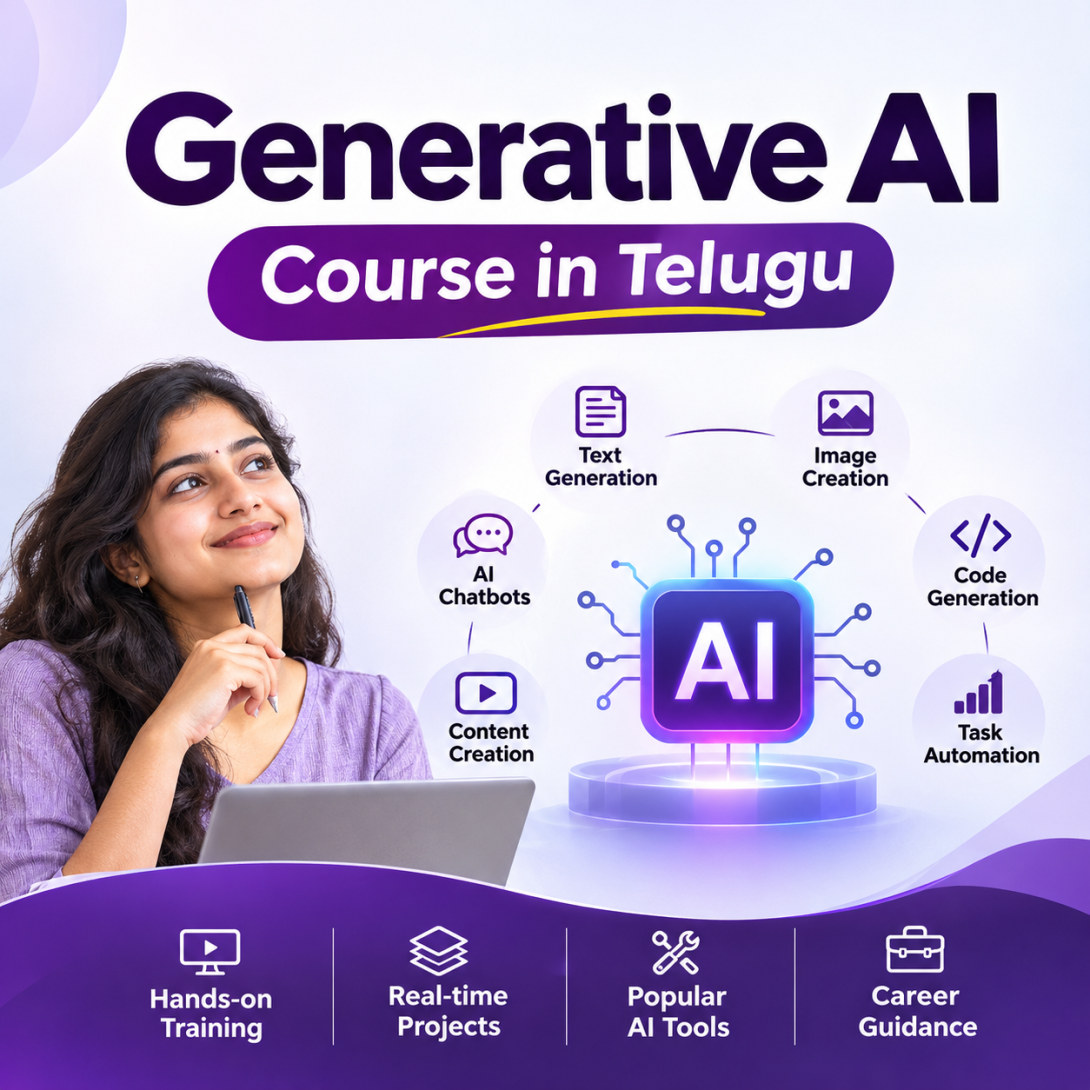
Artificial Intelligence is changing how businesses communicate with customers, manage information, and handle repetitive tasks. AI chatbots and intelligent automation are two important applications making these changes possible. If you want to understand how these technologies work and explore their practical uses, enrolling in a Generative AI Course in Telugu can help you build a foundation in modern AI concepts.
What Are AI Chatbots?
AI chatbots are software applications designed to interact with users through text or voice. They can answer questions, provide information, guide users through processes, and assist with common requests.
Traditional chatbots usually follow predefined rules and respond to specific keywords or menu selections. Modern AI-powered chatbots can use Natural Language Processing (NLP) and Large Language Models (LLMs) to interpret user messages and generate more flexible responses.
For example, an educational website can use an AI chatbot to:
- Explain course details and learning topics.
- Answer frequently asked questions.
- Guide visitors through registration steps.
- Provide information about class schedules.
- Direct users to relevant support resources.
These capabilities can improve the user experience while reducing the need to handle every basic query manually.
Understanding Intelligent Automation
Intelligent automation combines automation technologies with AI capabilities to support tasks that involve information processing and decision-making.
Traditional automation follows predefined instructions. Intelligent automation can use AI to interpret documents, classify information, understand requests, and support more complex workflows.
Consider an organisation receiving hundreds of customer enquiries every day. An intelligent automation workflow could identify the type of enquiry, extract relevant information, prepare a response, and send complex cases to a human support executive.
However, important actions should include suitable validation, permissions, and human review, especially when sensitive information or business decisions are involved.
Technologies Behind AI Chatbots and Automation
Understanding the technologies behind these applications helps learners explore how AI solutions are developed.
1. Natural Language Processing (NLP)
NLP helps computers process and analyse human language. It supports tasks such as identifying user intent, extracting information, and understanding text.
2. Large Language Models (LLMs)
LLMs are trained on large amounts of data and can generate responses based on the input and context they receive. They are commonly used in conversational AI applications.
3. Prompt Engineering
Prompt engineering involves designing clear instructions and providing relevant context to guide an AI model's output. Well-designed prompts can improve the usefulness and consistency of responses.
4. APIs and Integrations
APIs allow chatbots to connect with external applications, databases, and business systems. For example, a chatbot may retrieve course information from a website database.
5. Workflow Automation
Automation tools connect different steps in a process. When combined with AI, they can help classify requests, extract information, and trigger appropriate actions.
Practical Applications Across Industries
AI chatbots and intelligent automation are useful in several business environments.
- Education: Answering student questions, sharing course information, and supporting learning activities.
- Healthcare administration: Helping users access appointment information and administrative guidance, with appropriate privacy controls.
- E-commerce: Responding to product enquiries, checking order information, and assisting with customer support.
- Banking: Supporting routine account-related queries and directing customers to relevant services.
- Human Resources: Helping employees find company policies, onboarding information, and internal resources.
The level of automation depends on the organisation's requirements, available data, security standards, and system integrations.
How to Build a Basic AI Chatbot
Beginners can understand chatbot development through a simple step-by-step approach:
- Identify the purpose: Decide whether the chatbot will answer FAQs, provide course information, or support customer enquiries.
- Prepare relevant information: Collect accurate content that the chatbot can use when responding.
- Choose an AI model: Select a suitable model based on the application's requirements.
- Design prompts: Create instructions that define the chatbot's role, response style, and limitations.
- Connect required systems: Use APIs or other integrations when the chatbot needs access to external information.
- Test different questions: Check whether the chatbot provides relevant and accurate answers.
- Add safety measures: Include data protection, access controls, escalation options, and human review where needed.
A basic chatbot can be created using existing AI platforms. Building a more advanced application may require programming, database knowledge, API integration, and deployment skills.
Skills to Develop for Intelligent Automation
Learners interested in this field can gradually develop the following skills:
- Generative AI fundamentals and LLM concepts.
- Prompt engineering and conversational design.
- Basic Python programming.
- NLP fundamentals.
- API integration and data handling.
- Workflow automation concepts.
- Chatbot testing and evaluation.
- Responsible AI and data privacy practices.
You do not need to master every technology at the beginning. Start with AI fundamentals, practise with simple chatbot examples, and gradually explore technical implementation.
Career Paths Related to Conversational AI
Knowledge of chatbots and intelligent automation can support learning paths in areas such as conversational AI development, AI application development, automation development, and AI solutions support.
The skills and qualifications required vary by role. Technical development positions may require programming, API integration, data management, and software engineering knowledge, while roles focused on AI tools and workflow operations may have different requirements.
Building practical projects and understanding how AI systems work can help learners demonstrate their capabilities.
Start Learning Generative AI with Practical Concepts
AI chatbots and intelligent automation are becoming important parts of modern digital applications. Learning their underlying concepts gives beginners an opportunity to understand how AI can support communication, information processing, and business workflows.
Focus on building a strong foundation, experimenting with AI tools, and practising with small projects. With consistent learning, you can gradually explore more advanced applications and develop skills relevant to the evolving AI ecosystem.