

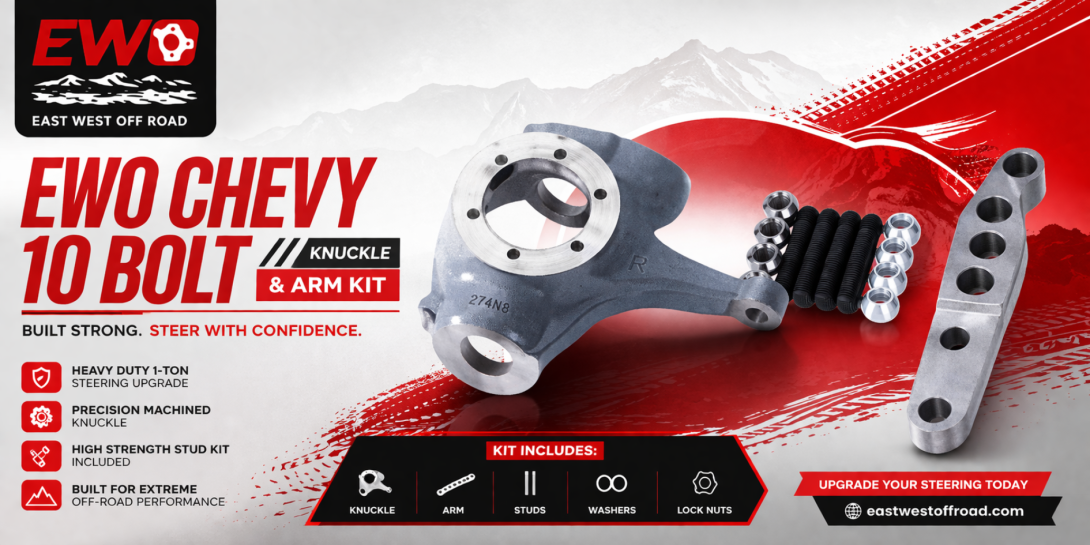
Buy Now: EWO Chevy 10 Bolt Complete Crossover High Steer Kit
A K5 Blazer High Steer Conversion is one of the most effective steering upgrades for a lifted classic Chevy built for serious off-road use. As suspension lift, larger tires, and increased articulation change the original steering geometry, the factory push-pull steering arrangement can become more difficult to manage. A properly designed crossover high-steer system changes the linkage layout, improves component clearance, and gives the front axle a stronger foundation for trail use. For Chevy K5 Blazers equipped with Dana 44 or GM 10-bolt front axles, a complete high-steer setup can be a major improvement in steering control and durability.
Why Consider a K5 Blazer High Steer Conversion?
Classic K5 Blazers are popular platforms for rock crawling, trail riding, hunting rigs, and custom 4x4 builds. However, lifting a K5 changes more than ride height. It also changes the relationship between the steering box, pitman arm, drag link, tie rod, and front axle.
When the steering linkage no longer works through an appropriate range of motion, the result can include bump steer, wandering, reduced steering predictability, and increased stress on steering components.
A high-steer conversion addresses the geometry rather than simply adding another steering stabilizer or replacing one worn component.
Crossover Steering vs. Factory Push-Pull Steering
Factory GM solid-axle steering uses a push-pull style arrangement where the steering linkage works from the steering box toward the axle. On a modified truck, this configuration can become less desirable as suspension height and axle movement increase.
Crossover steering changes the linkage path so the drag link travels across the front axle toward the steering knuckle. The objective is to create a more consistent relationship between steering and suspension movement.
For a lifted K5 Blazer, this can provide:
- Improved steering geometry
- Better clearance around the front axle
- More predictable steering response
- Stronger steering linkage
- Better compatibility with high-steer arms
- Improved durability for large tires and trail use
The exact results depend on the suspension, steering box, axle, ride height, and installation geometry.
How High Steer Improves a Lifted K5 Blazer
One of the biggest reasons builders choose a K5 Blazer High Steer Conversion is to correct steering geometry after lifting the vehicle.
Reducing Bump Steer
Bump steer occurs when suspension movement causes unintended steering movement. A lifted Chevy can experience this when the drag link and suspension travel through incompatible arcs.
A correctly designed crossover system can reduce this problem by repositioning the steering linkage and improving the relationship between the drag link and front suspension.
This is especially important for K5 Blazers used on uneven trails where the front axle may cycle rapidly over rocks, ruts, ledges, and steep approach angles.
Increasing Steering Component Clearance
Low-mounted steering components can be vulnerable during off-road driving. Rocks, ledges, and uneven terrain can put the factory linkage in locations where it may contact obstacles.
High-steer components move key steering connections higher on the axle. This can provide additional clearance and create a cleaner steering layout for an off-road build.
Dana 44 and GM 10-Bolt High Steer Applications
A major advantage of this type of conversion is its relevance to classic GM solid front axles.
The EWO crossover high-steer system is listed for Chevy Dana 44 and GM Corporate 10-bolt front axles and covers multiple classic GM applications, including K5 Blazer, K10, K20, V20, Suburban, and GMC platforms.
For builders working with an axle-swapped K5, understanding the exact axle and knuckle configuration is critical before ordering components.
Dana 44 High Steer Setup
A Dana 44 high-steer configuration typically requires a suitable flat-top steering knuckle and high-steer arm arrangement. These components create the mounting position necessary for crossover steering.
For a Chevy Dana 44, a complete system can be more convenient than sourcing individual knuckles, arms, steering ends, studs, and linkage components separately.
GM 10-Bolt High Steer Setup
GM 10-bolt front axles are also commonly used in classic Chevy 4x4 builds. A properly matched conversion can provide a similar crossover steering layout while addressing the specific requirements of the GM axle.
The key is matching the knuckle, steering arm, drag link, tie rod ends, pitman arm, and steering box geometry rather than mixing incompatible parts.
What to Look for in a K5 Blazer High Steer Kit
Not every high-steer setup is built the same way. When choosing components for a trail-driven K5, look beyond the term "high steer."
Flat-Top Knuckles and Steering Arms
The knuckle is the foundation of a high-steer conversion. A suitable flat-top design provides the mounting surface needed for the steering arm.
The EWO system uses a precision-machined knuckle and a thick steering arm designed as part of the complete crossover steering package.
For builders comparing options, an integrated system can make it easier to match mounting dimensions and steering linkage components.
Heavy-Duty Steering Linkage
The drag link is exposed to significant forces during off-road driving. Large tires, lockers, suspension articulation, and hard steering inputs can increase the load placed on the steering system.
A heavy-duty crossover setup should use appropriately sized tubing and steering ends for the intended vehicle.
For example, the EWO complete system uses heavy-wall DOM drag-link tubing along with metal-to-metal steering ends and high-strength hardware.
Forged Pitman Arm
The pitman arm connects the steering box to the drag link and is therefore a critical part of the crossover geometry.
A properly selected dropped pitman arm can help position the drag link appropriately on lifted applications. However, the correct pitman arm depends on the steering box, lift height, axle configuration, and overall suspension geometry.
Complete K5 Blazer Crossover Steering System
Rather than building a system from unrelated components, many off-road enthusiasts prefer a complete matched kit.
A complete K5 Blazer High Steer Conversion can combine the major components needed to create the crossover steering system, including:
- High-steer knuckle
- High-steer steering arm
- Drag-link tubing
- Drag-link ends
- High-strength studs and hardware
- Tie-rod components
- Pitman arm
- Related mounting hardware
This approach can simplify the build and reduce the risk of combining parts with different thread sizes, tapers, or mounting requirements.
East West Off Road High Steer Kit
For a complete solution, the EWO Chevy 10 Bolt Complete Crossover High Steer Kit is designed around Chevy Dana 44 and 10-bolt crossover applications.
The product listing identifies compatibility with K5 Blazer and other classic GM 4WD applications and describes the kit as a complete crossover high-steer system.
This makes it relevant for builders who want to replace the original steering configuration with a more robust crossover arrangement.
Installation Considerations for a K5 Blazer
A high-steer conversion should not be treated as a simple bolt-on component replacement without checking the complete steering system.
Check the Steering Box
Crossover steering generally requires the steering box and pitman arm to work with the new drag-link direction and position.
The EWO system's product information specifically notes a 2WD steering box requirement for completing the crossover configuration.
Before installation, verify the steering box type, sector-shaft spline, pitman arm compatibility, and available clearance.
Verify Steering Geometry
After installing the components, cycle the suspension through compression and droop while checking the steering.
Look for:
- Drag-link interference
- Tie-rod interference
- Steering arm clearance
- Differential clearance
- Leaf-spring clearance
- Brake-line clearance
- Steering-box travel
- Full left and right steering range
The steering should be checked at ride height and through the full available suspension travel.
Check Thread Engagement and Hardware
High-steer systems use substantial steering hardware, but installation quality remains essential. Confirm that threaded components have proper engagement and that all fasteners are installed according to the manufacturer's specifications.
Do not rely on visual inspection alone when setting up steering components.
Why High Steer Is Popular on Lifted K5 Blazers
The K5 Blazer has become a favorite platform for serious off-road builds because its solid front axle and classic chassis provide an excellent foundation for customization.
Once a K5 receives larger tires and suspension lift, steering becomes one of the systems that deserves serious attention.
A high-steer crossover setup can complement other modifications such as:
- Larger tires
- Front lockers
- Suspension lift
- Long-travel suspension
- Reinforced steering boxes
- Hydro-assist steering
- Upgraded axle shafts
- Heavy-duty wheel bearings
- Stronger tie rods and drag links
High steer should be viewed as part of the complete front-end system rather than an isolated modification.
Choosing the Right Steering Components
For a custom K5 build, component compatibility matters more than simply selecting the largest available part.
Match the Axle
Start by identifying whether your truck uses a Chevy Dana 44, GM Corporate 10-bolt, or another front axle.
Match the Steering Box
Confirm whether the vehicle uses a 2WD or 4WD steering box and verify compatibility with the selected pitman arm.
Match the Lift
The correct drag-link and pitman-arm combination depends heavily on suspension height and geometry.
Match the Intended Use
A street-driven K5 with occasional trail use may have different requirements from a dedicated rock crawler running oversized tires.
Selecting components based on actual vehicle weight, tire size, steering system, and trail use helps create a more reliable build.
K5 Blazer High Steer Conversion vs. Individual Parts
Buying individual parts can make sense for experienced fabricators who already have compatible components. However, it can also create compatibility problems.
A complete kit can reduce the number of variables because the major steering components are intended to work together.
For builders looking for a heavy-duty package, the EWO complete crossover high-steer kit for Chevy applications provides a single-system approach rather than requiring every component to be sourced independently.
This is particularly useful when completing a K5 Blazer restoration or off-road build where reliability and predictable steering are priorities.
When a High Steer Conversion Makes Sense
A K5 Blazer High Steer Conversion is worth considering when the truck has one or more of the following characteristics:
- Significant suspension lift
- Oversized tires
- Frequent off-road use
- Rock-crawling applications
- Poor steering geometry
- Excessive bump steer
- Damaged or weak factory linkage
- An axle swap
- A Dana 44 or GM 10-bolt front axle
- A custom crossover steering build
It is also an attractive upgrade when rebuilding the front axle, because the steering conversion can be incorporated into the project rather than requiring the front end to be disassembled multiple times.
Frequently Asked Questions (FAQs)
What is a K5 Blazer High Steer Conversion?
A K5 Blazer High Steer Conversion changes the original steering linkage arrangement to a high-mounted crossover steering configuration. It is commonly used on lifted K5 Blazers with Dana 44 or GM 10-bolt front axles.
Does high steer help with bump steer on a lifted K5 Blazer?
A properly designed crossover steering system can significantly improve steering geometry and reduce bump steer. However, the final result depends on the complete suspension and steering geometry of the vehicle.
Can high steer be used with a Chevy Dana 44?
Yes. Chevy Dana 44 axles are commonly used with high-steer crossover systems when the correct flat-top knuckle and steering-arm configuration is installed.
Can a K5 Blazer use high steer with a GM 10-bolt?
Yes. GM 10-bolt front axles can be configured for crossover high steering with compatible knuckles, steering arms, drag-link components, and steering-box geometry.
Is a 2WD steering box required for crossover steering?
Some crossover steering systems require a 2WD steering box to achieve the intended steering geometry. The EWO system specifically identifies a 2WD steering box as part of the required configuration.
Does high steer work with a lifted K5 Blazer?
High steer is commonly used on lifted K5 Blazers because it can improve the relationship between the steering linkage and suspension movement while also providing greater steering-component clearance.
What should I check before installing high steer?
Verify the axle type, steering box, pitman arm, knuckle configuration, steering-arm mounting, drag-link length, suspension lift, tire size, and full steering and suspension travel before installation.
Is a complete high-steer kit better than buying individual parts?
A complete kit can make component matching easier and reduce compatibility issues. Individual parts can work well for experienced fabricators who understand the required dimensions, tapers, threads, and steering geometry.
Is the EWO high-steer kit made for K5 Blazers?
The EWO product listing identifies K5 Blazer applications among its compatible classic GM 4WD vehicles and supports Chevy Dana 44 and GM 10-bolt front axle configurations.
Where can I find a complete K5 Blazer high-steer system?
The EWO Chevy 10 Bolt Complete Crossover High Steer Kit is an option for compatible Chevy Dana 44 and GM 10-bolt K5 Blazer applications.
Final Thoughts
A K5 Blazer High Steer Conversion is more than a simple steering upgrade. For a lifted Chevy with a Dana 44 or GM 10-bolt front axle, it can be an important part of creating stronger, cleaner, and more predictable steering geometry.
The key is to build the system as a complete package. Knuckles, steering arms, drag link, pitman arm, steering box, and suspension geometry all need to work together. For serious off-road builds, using a purpose-designed crossover system can make the conversion easier to plan while providing the heavy-duty components needed for demanding trail conditions.
For a complete solution, the EWO Chevy 10 Bolt & Dana 44 Complete Crossover High Steer Kit is designed for compatible K5 Blazer and classic GM 4x4 applications.