

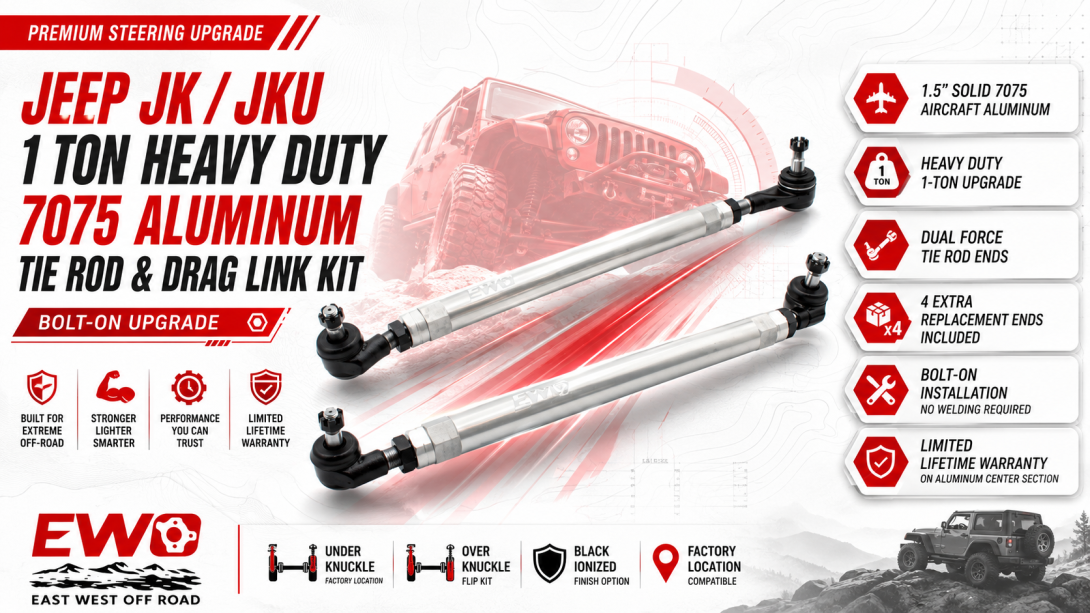
Buy Now: Jeep JK/JKU 1 Ton Heavy Duty 7075 Aluminum Tie Rod & Drag Link Steering Kit
A Jeep JKU drag link kit is an important steering upgrade for 2007–2018 Jeep Wrangler Unlimited JKU models that see larger tires, suspension lifts, rocky trails, and demanding off-road use. The factory steering linkage can become a weak point as tire size and trail loads increase. A properly designed heavy-duty drag link and tie rod system can provide a stronger connection between the steering box and front axle while improving durability for both street and off-road driving.
For Jeep owners building a serious Wrangler, choosing the right steering components is about more than simply installing a thicker bar. Drag-link geometry, joint strength, clearance, lift height, steering travel, and compatibility with the rest of the front suspension all matter.
What Is a Jeep JKU Drag Link Kit?
The drag link is a critical part of the Wrangler's steering system. It transfers steering movement from the steering box through the pitman arm to the steering knuckle, allowing the front wheels to respond when the steering wheel is turned.
A Jeep JKU drag link kit replaces or upgrades the original drag-link components with stronger aftermarket parts designed for increased loads.
This becomes especially valuable when a JKU is equipped with:
- Larger-than-stock tires
- Suspension lift kits
- Heavy-duty wheels
- Increased steering loads
- Aggressive trail use
- Rock crawling or mud terrain
- Additional front-end weight
A complete steering upgrade can also address weaknesses elsewhere in the factory linkage rather than simply reinforcing one individual component.
Why Upgrade the Factory JKU Drag Link?
Factory steering components are designed around the loads and configuration of a stock vehicle. Off-road modifications can significantly increase those loads.
Larger Tires Increase Steering Loads
A 35-inch or larger tire has considerably more leverage against steering components than a stock-size tire. When that tire is wedged against a rock, the steering linkage can experience substantial forces.
This is one reason many off-road enthusiasts choose a heavy duty drag link Jeep setup when building a lifted Wrangler.
Lifted Jeeps Need Proper Steering Geometry
Suspension lifts change the relationship between the steering linkage and front axle. Depending on lift height and suspension configuration, the factory drag-link position may no longer provide the desired geometry.
A high-steer or drag-link flip configuration can be appropriate for certain lifted builds, but it must be matched with the track-bar geometry and other suspension components.
For example, aftermarket systems commonly specify different configurations depending on lift height. Some heavy-duty JK/JKU drag-link systems are designed for stock-location use at lower lift heights and require a flip or high-steer configuration as lift height increases.
What Makes a Heavy-Duty JKU Drag Link Different?
A quality aftermarket steering system focuses on the complete steering assembly rather than simply increasing bar diameter.
Stronger Steering Bar
A heavy-duty steering bar provides greater resistance to bending when the front axle encounters obstacles.
Some aftermarket JK/JKU systems use large-diameter DOM steel tubing, while other premium designs use large-diameter 7075 aluminum. The material choice, diameter, joint design, and manufacturing quality all contribute to overall performance.
Heavy-Duty Steering Ends
The joints are just as important as the main bar. A strong steering tube paired with weak ends can still leave the system vulnerable.
High-quality forged steering ends are designed to withstand repeated steering loads while maintaining articulation.
Adjustable Steering Components
Adjustability is useful when correcting toe or centering the steering wheel after installation. Depending on the design, adjustable left- and right-hand threaded components can make adjustments easier without completely removing the linkage.
7075 Aluminum vs. Steel Steering Components
One of the major choices when shopping for a modern Jeep steering upgrade is material.
7075 Aluminum Steering
7075 aluminum is a high-strength aerospace-grade aluminum alloy commonly used in performance applications where strength and weight matter.
A large-diameter 7075 aluminum tie rod Jeep JK setup can provide a high-strength steering solution while reducing weight compared with an equivalent oversized steel component.
The East West Off Road system uses a heavy-duty aluminum steering design intended for 2007–2018 JK and JKU applications.
Explore the Jeep JK/JKU Heavy-Duty 7075 Aluminum Steering Kit
Steel Steering
Steel remains a popular choice for off-road steering because of its strength, availability, and fabrication versatility. Large DOM steel steering components are commonly used in heavy-duty Jeep builds.
The best choice depends on the intended use, tire size, lift, vehicle weight, steering geometry, and overall build requirements.
Jeep JKU Drag Link Kit vs. Complete Steering Upgrade
Replacing only the drag link can make sense when the rest of the steering system is in good condition. However, heavily modified JKUs often benefit from upgrading both major steering links.
The tie rod connects the steering knuckles, while the drag link connects the steering system to the knuckle. Both components experience demanding loads during off-road driving.
A complete Jeep Wrangler JKU steering kit can therefore provide a more balanced upgrade than replacing one worn component at a time.
This is particularly relevant for owners running:
- 35-inch tires
- 37-inch tires
- 1-ton-style steering components
- Lifted suspension
- High-clearance suspension systems
- Rock-crawling setups
- Heavy-duty front axles
Choosing the Correct Drag Link Configuration
Not every JKU requires the same drag-link configuration.
Factory-Location Drag Link
A factory-location drag link remains below the steering knuckle and can be suitable for stock or moderately lifted applications when geometry remains appropriate.
Drag Link Flip
A Jeep JKU drag link kit designed for a flip configuration relocates the drag link above the steering knuckle.
This can provide additional ground clearance and improve steering geometry on certain lifted Jeeps. However, the entire steering geometry needs to be considered.
Aftermarket manufacturers commonly recommend a flipped drag link for specific lift ranges, while lower lifts may use the standard steering location.
High-Steer Considerations
A high-steer configuration should not be selected solely because it sounds stronger. The drag link, track bar, axle brackets, steering knuckle, wheel clearance, and suspension travel all need to work together.
Incorrect geometry can introduce bump steer or other handling problems.
Why Steering Geometry Matters on a Lifted JKU
When the suspension cycles, the front axle moves relative to the chassis. The track bar and drag link control different aspects of this movement.
Ideally, their geometry should be properly matched so suspension travel does not unnecessarily steer the vehicle.
This is particularly important when installing a lifted Jeep JK steering kit or converting to a drag-link flip setup.
A steering upgrade should therefore be viewed as part of the overall suspension system—not an isolated component.
Benefits of a Heavy-Duty JKU Steering Upgrade
A properly selected steering system can provide several advantages.
Increased Resistance to Bending
Oversized steering components are designed to handle greater loads than lightweight factory-style components.
Better Off-Road Durability
When the steering linkage repeatedly contacts obstacles or experiences high steering loads, heavy-duty components can provide additional durability.
Improved Steering Feel
Worn steering joints can create unwanted movement and vague steering response. Replacing worn components with properly fitted heavy-duty parts can help restore a more precise feel.
Better Compatibility With Large Tires
As tire size increases, steering loads increase as well. A stronger steering system is therefore particularly relevant for Jeeps running aggressive 35-inch and 37-inch tire setups.
When Should You Upgrade Your JKU Steering?
Consider a steering upgrade if you notice:
- Visible bending of the factory drag link
- Excessive steering play
- Damaged or worn steering joints
- Steering wander
- Repeated steering-component failures
- Larger tires than stock
- A suspension lift
- Aggressive off-road use
- Increased front-end loads
However, steering problems should always be diagnosed before assuming the drag link is the cause. Track-bar bushings, ball joints, wheel balance, alignment, loose hardware, and other suspension components can also contribute to steering instability. Real-world Jeep owners frequently report that multiple components may need inspection when diagnosing wobble or steering issues.
Jeep JK and JKU Fitment
The JK and JKU share the same basic front steering architecture, with the JKU being the four-door Wrangler Unlimited configuration.
For a Jeep JKU drag link kit, always verify:
- Model year
- 2-door JK or 4-door JKU
- Left-hand-drive or right-hand-drive configuration
- Front axle
- Lift height
- Drag-link mounting position
- Steering knuckle configuration
- Wheel and tire combination
- Required steering clearance
A properly matched kit is essential for safe and reliable installation.
Why a Complete Steering Kit Can Be Better
A complete steering system allows the major steering components to be selected as a matched package.
The East West Off Road Jeep JK/JKU steering kit is designed around a heavy-duty tie rod and drag link combination rather than treating the two components as unrelated upgrades.
East West Off Road Jeep JK/JKU 1-Ton Heavy-Duty Steering Kit
For Jeep owners looking for an off road steering upgrade, this approach can simplify the process of replacing factory steering components with a stronger system designed for demanding use.
Installation and Setup Considerations
Before installation, inspect the entire front steering and suspension system.
Check Existing Components
Inspect:
- Tie-rod ends
- Drag-link ends
- Track-bar joints
- Ball joints
- Steering knuckles
- Pitman arm
- Steering box mounting
- Track-bar brackets
- Steering stabilizer
- Wheel bearings
Check Clearance
Cycle the suspension and steering through the full range of motion after installation. Verify clearance between the steering components, axle, wheels, differential, suspension links, shocks, and other nearby components.
Verify Steering Geometry
If the drag link position changes, make sure the track-bar relationship is still appropriate. A drag-link flip should be treated as a geometry modification, not simply a bolt-on relocation.
Check Fasteners and Alignment
Use the manufacturer's installation instructions and torque specifications. After steering work, verify steering-wheel position and front-end alignment before normal road use.
Is a 1-Ton Steering Kit Worth It for a JKU?
For a stock daily-driven JKU with stock-size tires, a 1-ton-style steering system may be unnecessary.
For a modified JKU running larger tires, increased lift, and serious off-road terrain, the additional strength can make much more sense.
A 1 ton steering kit JK setup is especially attractive to owners who want to build the steering system around the demands of a heavily modified Wrangler rather than continuing to replace factory-style components.
A Stronger Solution for Serious Jeep Builds
A Jeep JKU drag link kit should be selected according to the complete vehicle configuration. Tire size, lift height, axle type, steering geometry, wheel clearance, and intended driving conditions all affect the right setup.
For demanding JK and JKU builds, a complete heavy-duty system can provide a stronger foundation than relying on stock-size steering components. The East West Off Road system combines a heavy-duty tie rod and drag link configuration for 2007–2018 Jeep JK/JKU applications.
Shop the East West Off Road JK/JKU Heavy-Duty Steering Upgrade
Frequently Asked Questions (FAQs)
What does a Jeep JKU drag link do?
The drag link transfers steering movement from the pitman arm to the steering knuckle, allowing the front wheels to turn when the steering wheel is rotated.
Is a heavy-duty drag link worth it on a lifted JKU?
It can be, particularly on Jeeps with larger tires, suspension lifts, and frequent off-road use. The correct design should also maintain suitable steering geometry for the lift.
What years does a Jeep JKU drag link kit fit?
Many aftermarket JK/JKU steering systems are designed for the 2007–2018 Wrangler platform. Always verify the specific product's stated fitment before purchasing.
Should I upgrade the tie rod and drag link together?
For heavily modified Jeeps, upgrading both can provide a more balanced steering system because both components experience increased loads from larger tires and off-road use.
Is 7075 aluminum strong enough for Jeep steering?
7075 aluminum is a high-strength alloy used in demanding performance applications. The strength of a complete steering system also depends on bar diameter, joint design, manufacturing, and proper installation.
Do I need a drag-link flip on a lifted JKU?
Not necessarily. The appropriate configuration depends on lift height and steering geometry. Some aftermarket systems use a factory-location drag link at lower lifts and a flipped configuration at higher lift heights.
Can a steering upgrade fix death wobble?
A steering upgrade may replace worn or damaged steering components, but it should not be considered a guaranteed cure for death wobble. Track-bar movement, ball joints, alignment, wheel balance, steering joints, and suspension geometry should all be inspected.
What should I check after installing a JKU drag link?
Check all fasteners, steering movement, wheel clearance, suspension clearance, steering-wheel position, alignment, and drag-link/track-bar geometry before driving normally.
Is this type of kit suitable for off-road Jeeps?
A heavy-duty steering system can be particularly useful for off-road Jeeps because larger tires and obstacles place substantially greater loads on the steering linkage.