

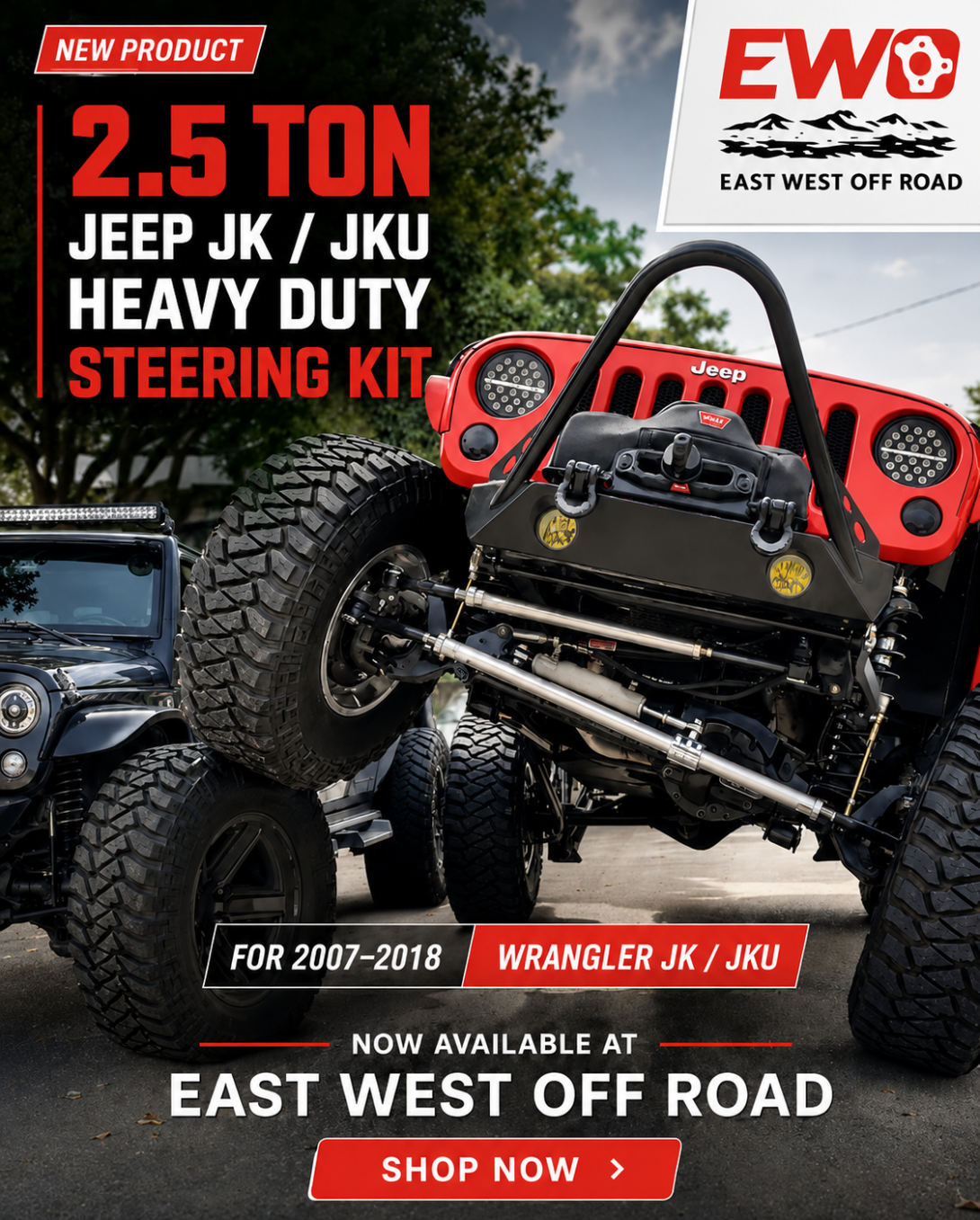
A Jeep JK tie rod and drag link kit is a popular steering upgrade for 2007–2018 Jeep Wrangler JK and JKU models, especially when larger tires, suspension lifts, and aggressive off-road driving place additional demands on the factory steering linkage. Instead of upgrading only the tie rod or drag link, a complete kit allows both major steering links to be replaced as a matched system.
For Jeep owners building a trail rig, rock crawler, overland Wrangler, or street-and-trail JK, choosing the right steering kit requires more than looking at link diameter. Material, steering ends, adjustment, axle configuration, wheel clearance, suspension lift, and steering geometry all deserve consideration.
What Does a Jeep JK Tie Rod and Drag Link Kit Do?
The front steering system of a Jeep JK relies on several interconnected components.
The tie rod connects the steering knuckles and transfers movement between the two front wheels.
The drag link connects the steering system's pitman arm to the steering knuckle and transfers steering input from the steering box.
Because these components work together, replacing both can provide a more consistent upgrade than installing a stronger tie rod while leaving the original drag link in place.
Tie Rod Function
The tie rod is exposed to impacts and bending forces during off-road driving.
When the Jeep's front tire contacts a rock or drops into a rut, forces can be transferred through the steering knuckle into the tie rod.
A stronger aftermarket tie rod can provide greater resistance to bending compared with factory-sized linkage.
Drag Link Function
The drag link transfers steering movement from the pitman arm to the front axle.
Its position also has an important relationship with the front suspension and track bar.
For lifted Jeeps, the drag-link angle should be considered carefully when selecting a replacement or upgraded steering configuration.
Why Upgrade the Factory JK Steering?
A stock Jeep JK can be perfectly functional with its original steering system.
The requirements change when the vehicle receives modifications such as:
- Larger tires
- Suspension lift
- Heavy bumpers
- Winch
- Skid plates
- Armor
- Beadlock-style wheels
- Increased trail use
- Rock crawling
These modifications can increase the loads placed on steering components.
A Jeep JK tie rod upgrade can provide additional strength where the factory linkage may become more vulnerable to bending or trail impacts.
Larger Tires Increase Steering Loads
A larger tire can increase the leverage acting on steering components.
This does not mean that every Jeep with large tires needs the same steering system. Tire size, wheel offset, axle configuration, steering assist, vehicle weight, and driving style all influence the requirements.
The correct approach is to select the steering system around the complete vehicle.
7075-T6 Aluminum Tie Rod and Drag Link
One of the standout features of modern heavy-duty JK steering systems is the use of high-strength aluminum.
A 7075-T6 aluminum steering kit can offer a useful combination of strength and reduced weight compared with very large steel components.
The EWO system discussed in this article uses a heavy-duty 7075 aluminum configuration for the tie rod and drag link.
Aluminum Tie Rod Jeep Wrangler Applications
An Aluminum tie rod Jeep Wrangler setup can be attractive to builders who want stronger steering components without unnecessarily adding weight to the front axle.
However, the material should not be evaluated by itself.
The finished steering assembly also depends on:
- Link dimensions
- Construction
- Thread engagement
- Steering-end design
- Attachment points
- Adjustment range
- Knuckle compatibility
A high-strength material does not compensate for incorrect fitment or poor steering geometry.
2.5 Ton Tie Rod and Drag Link Kit for JK
The term 2.5 ton tie rod and drag link kit is commonly used in the aftermarket to describe a heavy-duty class of steering components.
It does not mean that the Jeep needs to weigh 2.5 tons.
Instead, the terminology generally indicates substantially heavier-duty steering hardware compared with standard factory linkage.
For JK and JKU owners running larger tires and demanding trails, this type of system can provide a significant increase in steering-component capacity.
The 2.5 ton Jeep JK/JKU tie rod and drag link steering kit is designed for 2007–2018 Jeep Wrangler JK and JKU applications.
Jeep JK Tie Rod Upgrade: What Should You Look For?
A good Jeep JK tie rod upgrade should be evaluated as a complete steering component rather than simply choosing the largest available tube.
Diameter
A larger tie rod can provide additional resistance to bending, but increasing diameter can also create clearance considerations.
Check the space between the tie rod and:
- Differential cover
- Wheels
- Tires
- Steering stabilizer
- Axle housing
- Suspension components
Material
Aftermarket JK steering systems can use steel, chromoly-based components, or high-strength aluminum.
7075-T6 aluminum is particularly interesting for builders who want a combination of strength and reduced weight.
Steering Ends
The steering ends connect the linkage to the Jeep's steering components.
When comparing 1.25 inch tie rod ends Jeep JK applications, verify thread size, taper, articulation, and compatibility with the selected tie rod and knuckles.
Similarly, forged tie rod ends Jeep Wrangler applications should be evaluated according to their actual dimensions and mounting configuration rather than material alone.
Wrangler JK Drag Link Upgrade
A Wrangler JK drag link upgrade can improve the durability of the steering connection between the pitman arm and steering knuckle.
The drag link is particularly important because its position affects the relationship between steering and suspension movement.
A heavy-duty replacement should maintain appropriate articulation and steering travel.
Factory Location Drag Link
A Jeep JK factory location drag link can be appropriate for many relatively mild suspension configurations.
A stronger drag link can provide a durability upgrade while retaining the original mounting arrangement.
This can be a practical choice when the Jeep does not require a high-steer or drag-link-flip configuration.
Flip Drag Link Configuration
A lifted JK may require a different drag-link position depending on suspension height and steering geometry.
A Jeep JK flip drag link kit can move the axle-side drag-link connection higher.
This can help create a more suitable drag-link angle on some lifted Jeeps.
However, moving the drag link changes its relationship with the front track bar.
A proper flip setup therefore needs to consider the track-bar mounting position and the rest of the suspension geometry.
Jeep JK Track Bar and Drag Link Geometry
The track bar and drag link are two of the most important components to consider when modifying JK steering.
The track bar controls lateral axle movement.
The drag link controls steering input.
Because both components move through arcs as the suspension cycles, their geometry should be considered together.
Why Geometry Matters on a Lifted JK
When a Jeep is lifted, the angles of the track bar and drag link change.
If the steering system is modified without considering those changes, the vehicle can develop undesirable steering behavior.
A heavy-duty tie rod and drag link can improve component strength, but they do not automatically eliminate bump steer or other geometry-related issues.
For heavily modified Jeeps, the complete steering and suspension configuration should be evaluated before choosing between factory-location and flipped steering.
Jeep JKU Steering Kit for Four-Door Wranglers
The four-door JKU is a common platform for steering upgrades.
A Jeep JKU steering kit can be especially useful when the Wrangler Unlimited has larger tires and additional vehicle equipment.
JKU builds may include:
- Front bumpers
- Winches
- Armor
- Roof equipment
- Recovery gear
- Larger tires
- Suspension lifts
All of these modifications can affect the overall demands placed on the front suspension and steering system.
Jeep Wrangler Unlimited Steering Upgrade
A Jeep Wrangler Unlimited steering upgrade should be matched to the actual weight and use of the vehicle.
A JKU that spends most of its time on pavement has different requirements from a heavily modified JKU used for rock crawling.
The correct steering configuration should therefore be selected according to the vehicle's complete setup.
Jeep JK Dana 30 Steering Kit and Dana 44 Applications
The Jeep JK platform can use different front axle configurations.
A Jeep JK Dana 30 steering kit needs to match the specific Dana 30 steering knuckles and mounting arrangement.
Likewise, a Jeep JK Dana 44 steering kit needs to be checked against the actual Dana 44 configuration.
Dana 30 Fitment
Before installing an aftermarket steering system on a Dana 30-equipped JK, confirm:
- Knuckle configuration
- Steering-end mounting
- Wheel clearance
- Differential-cover clearance
- Steering stabilizer location
- Lift height
Dana 44 Fitment
Dana 44-equipped JKs are frequently used for more heavily modified builds.
However, Dana 44 does not automatically mean that every steering kit will fit.
Always verify the actual steering-end and knuckle configuration.
1.25-Inch Steering Ends and Heavy-Duty Linkage
Heavy-duty steering systems often use substantially larger steering ends than factory components.
The goal is to create a durable connection between the linkage and steering knuckles.
When comparing 1.25 inch tie rod ends Jeep JK options, consider the complete connection:
- Thread diameter
- Thread direction
- Taper
- Misalignment
- Articulation
- Knuckle compatibility
- Available clearance
A steering end that is physically larger is not necessarily the correct choice if its taper or mounting configuration does not match the Jeep.
2 Inch Aluminum Tie Rod Jeep Applications
Some aftermarket manufacturers offer a 2 inch aluminum tie rod Jeep configuration for JK builds.
These very large links can provide substantial bending resistance, but they also require careful clearance planning.
A large tie rod can potentially interfere with wheels, differential covers, steering stabilizers, or other axle components.
For this reason, steering diameter should be considered alongside wheel diameter and backspacing.
Heavy Duty Steering Linkage Jeep Wrangler
A Heavy duty steering linkage Jeep Wrangler setup should be selected around the vehicle's intended use.
Street and Trail JK
A Jeep that sees a mixture of highway driving and moderate trails may benefit from stronger steering linkage while retaining a straightforward factory-style configuration.
Rock Crawler
A dedicated rock crawler can place much greater loads on the steering system.
For these builds, steering strength, clearance, steering geometry, axle strength, and steering-box capacity should all be evaluated together.
Overland Wrangler
An overland build may carry additional equipment and weight.
A stronger steering system can be considered as part of a broader suspension and front-end upgrade.
Off Road Steering Kit Jeep JK: What Else Should You Check?
Selecting an Off road steering kit Jeep JK application is only the beginning.
Before installation, inspect the existing steering and suspension.
Check:
- Ball joints
- Unit bearings
- Track-bar joints
- Steering-box mounting
- Pitman arm
- Tie rod
- Drag link
- Steering stabilizer
- Wheel bearings
- Steering stops
A new tie rod and drag link should not be used to mask wear in another steering or suspension component.
Jeep JK Steering Parts Upgrade: Complete System Approach
A successful Jeep JK steering parts upgrade should consider all the components that influence steering movement.
The major parts include:
Tie Rod
Connects the steering knuckles and transfers movement across the axle.
Drag Link
Transfers steering input from the pitman arm to the steering knuckle.
Track Bar
Controls lateral movement of the front axle and influences steering geometry.
Steering Ends
Provide the articulating connections between steering components.
Pitman Arm
Transfers movement from the steering box to the drag link.
Steering Box
Provides the steering input and must be compatible with the vehicle and steering configuration.
Installation Guide for a JK Tie Rod and Drag Link Kit
Steering installation should be treated as safety-critical work.
Before installation, compare the new components with the original steering system and confirm that the mounting locations and dimensions are correct.
Step 1: Confirm Vehicle Fitment
Verify the Jeep is a 2007–2018 JK or JKU and confirm the front axle and steering configuration.
Step 2: Inspect Existing Components
Check the knuckles, ball joints, unit bearings, track bar, pitman arm, and steering box for excessive wear or damage.
Step 3: Install the Tie Rod
Install the tie rod using the supplied or specified steering ends and hardware.
Do not reuse hardware unless the manufacturer's instructions specifically permit it.
Step 4: Install the Drag Link
Install the drag link in the correct factory or high-steer configuration for the vehicle.
Ensure that the steering ends are properly seated and secured.
Step 5: Check Lock-to-Lock Clearance
Turn the steering fully left and right.
Look for contact with:
- Wheels
- Tires
- Differential cover
- Track bar
- Axle housing
- Sway bar
- Springs
- Shocks
- Steering stabilizer
Step 6: Cycle the Suspension
Check the steering system at ride height, compression, and droop.
Clearance should be verified throughout the suspension's usable travel.
Step 7: Check Alignment
Replacing the tie rod can change toe.
Adjust and verify the front-end alignment as required.
If the drag link position has been changed, verify steering-wheel centering as well.
Common Mistakes When Upgrading JK Steering
Installing a Larger Tie Rod Without Checking Wheels
Wheel diameter and backspacing can affect steering clearance.
Ignoring the Track Bar
A drag-link modification can affect steering geometry and should be evaluated with the track bar.
Mixing Different Steering-End Sizes
Steering ends need compatible threads, tapers, and mounting dimensions.
Assuming Aluminum Is Automatically Better
7075-T6 aluminum offers useful strength-to-weight characteristics, but the entire steering assembly needs to be correctly engineered.
Using the Wrong Steering Configuration
A factory-location drag link, flipped drag link, and high-steer arrangement are not interchangeable without considering geometry.
Skipping a Post-Installation Inspection
Always inspect the completed steering system before serious road or trail use.
Why Choose the EWO JK Tie Rod and Drag Link Kit?
For builders who prefer sourcing the major steering links together, the East West Off Road steering kit provides a dedicated JK/JKU solution.
The EWO 2.5 ton JK/JKU heavy-duty steering kit is designed for 2007–2018 Jeep Wrangler JK and JKU applications and uses a 7075 aluminum tie rod and drag link configuration.
A matched tie rod and drag link package can simplify component sourcing and help builders plan the steering system as a complete upgrade.
Is a Jeep JK Tie Rod and Drag Link Kit Worth It?
For a modified JK or JKU, a complete tie rod and drag link upgrade can make sense when factory steering linkage is no longer appropriate for the vehicle's intended use.
The strongest benefit comes from matching the steering system to the complete build.
A Jeep with a mild lift and moderate tires may need a different configuration from a heavily modified rock crawler.
Before purchasing, consider:
- Tire size
- Wheel dimensions
- Lift height
- Axle type
- Steering box
- Track bar
- Drag-link position
- Steering stabilizer
- Off-road use
- Required clearance
This approach helps ensure that the steering upgrade improves the vehicle without introducing new fitment or geometry problems.
Frequently Asked Questions (FAQs)
What is a Jeep JK tie rod and drag link kit?
It is a steering upgrade that replaces both the tie rod and drag link with stronger aftermarket components designed to work with the Jeep JK/JKU steering system.
What years does the EWO JK steering kit fit?
The product discussed here is designed for 2007–2018 Jeep Wrangler JK and JKU models.
Why upgrade both the tie rod and drag link?
Upgrading both creates a more consistent heavy-duty steering system rather than leaving one factory component as the comparatively weaker link.
What is the benefit of a 7075-T6 aluminum steering kit?
7075-T6 aluminum offers a high strength-to-weight ratio, making it an attractive material for a heavy-duty steering system where weight is also a consideration.
Is a 2.5 ton steering kit actually for a 2.5-ton Jeep?
No. “2.5 ton” is aftermarket terminology describing a heavy-duty class of steering components. It is not a Jeep weight requirement.
Is a Jeep JK tie rod upgrade useful with larger tires?
It can be. Larger tires can increase the leverage and loads experienced by steering components, particularly during demanding off-road driving.
Should I use a factory-location drag link or a flipped drag link?
That depends on lift height, steering geometry, axle configuration, wheel clearance, and the rest of the suspension system. A factory-location setup may be appropriate for some builds, while lifted Jeeps may benefit from a properly engineered flipped configuration.
Do I need a track-bar modification with a drag-link flip?
Depending on the specific configuration, a track-bar correction may be required to maintain a suitable relationship between the drag link and track bar.
Can this steering kit work with Dana 30 and Dana 44 axles?
Fitment depends on the exact Jeep and steering configuration. Confirm the axle, knuckle, steering-end mounting, and clearance before ordering.
Is aluminum steering suitable for rock crawling?
A properly engineered high-strength aluminum steering system can be suitable for demanding off-road applications. The complete design and vehicle configuration should be considered rather than material alone.
Does a heavy-duty tie rod eliminate bump steer?
No. A stronger tie rod addresses component durability. Bump steer is primarily a steering and suspension geometry issue.
What should I check after installing the kit?
Check steering lock-to-lock movement, wheel and tire clearance, suspension travel, track-bar clearance, steering-wheel position, toe, steering stops, and all required fasteners.
Final Thoughts
A Jeep JK tie rod and drag link kit can be a valuable upgrade for 2007–2018 Jeep Wrangler JK and JKU builds that have moved beyond their factory configuration.
Whether the Jeep is running larger tires, suspension lift, additional equipment, or demanding off-road terrain, stronger steering linkage can provide a more suitable foundation than relying on factory-sized components.
The EWO 2.5-ton JK/JKU system combines a heavy-duty 7075 aluminum tie rod and drag link into one upgrade package. For builders considering an aluminum steering setup, this provides a practical starting point for a complete steering-system upgrade.
The key is still proper fitment and geometry. Verify the axle configuration, steering ends, wheel clearance, lift height, track-bar relationship, and steering travel before installation. After the upgrade, inspect the entire system through full steering and suspension movement and verify alignment before returning the Jeep to regular road or trail use.