

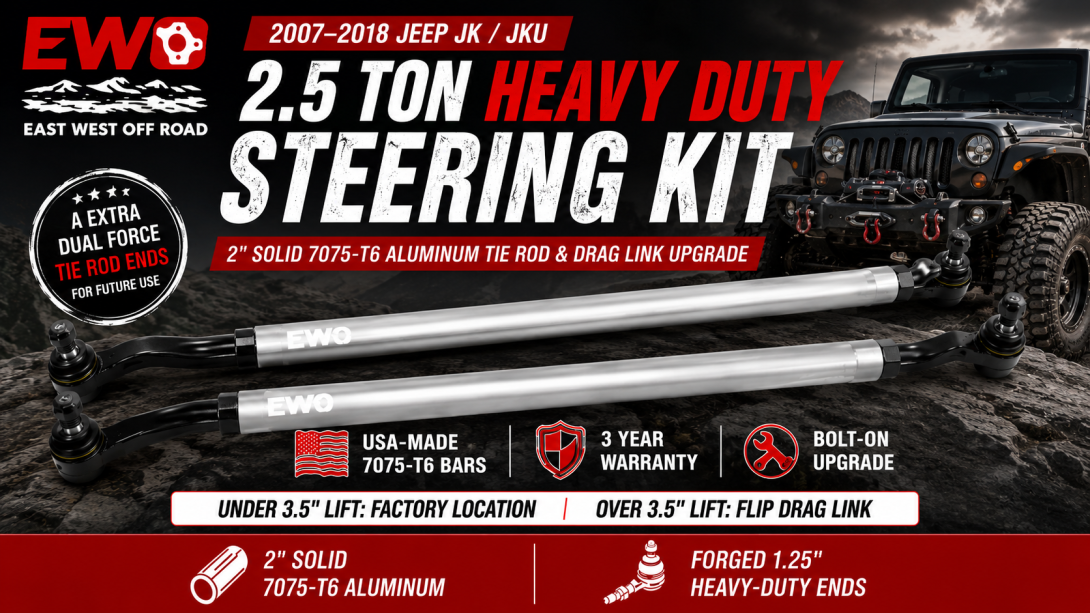
Buy Now: Jeep JK / JKU Heavy Duty 7075 Aluminum Tie Rod & Drag Link Steering Kit
A Jeep JK tie rod and drag link kit is one of the most practical upgrades for a 2007–2018 Jeep Wrangler JK or JKU that sees serious trail use. Factory steering components can become a weak point when larger tires, additional wheel travel, heavy wheels, and rocky terrain increase steering loads. A properly engineered heavy-duty tie rod and drag link combination gives your Jeep stronger steering linkage while helping maintain dependable control both on the street and off road.
Modern aftermarket kits are available in several configurations, including steel, chromoly, and large-diameter aluminum designs. The best choice depends on tire size, lift height, axle setup, steering geometry, and how aggressively the Jeep is driven.
Why Upgrade the JK Tie Rod and Drag Link?
The front steering system takes substantial abuse during off-road driving. A tire wedged against a rock can transmit significant force through the knuckle, tie rod, drag link, and steering box.
A stock-style steering system can work well for a relatively stock Wrangler, but a modified Jeep may benefit from substantially stronger components.
Common Reasons for a Steering Upgrade
A Jeep JK tie rod and drag link kit can be worth considering when you have:
- Larger-than-stock tires
- Heavy aftermarket wheels
- Increased suspension lift
- Frequent rock crawling
- Trail obstacles that load the front axle
- Repeated steering component damage
- Loose or vague steering feel
- A desire for stronger steering linkage
The objective is not simply to install the biggest bar available. The entire steering system should work together without creating clearance or geometry problems.
Tie Rod vs. Drag Link: What's the Difference?
The tie rod and drag link perform different jobs.
The tie rod connects the steering knuckles and controls the relationship between the left and right front wheels. Its condition has a direct effect on steering response and toe.
The drag link transfers steering input from the steering box's pitman arm to the steering knuckle. If the drag link becomes bent or its joints develop excessive play, steering can become less precise.
For a serious off-road build, upgrading only one component may leave another part of the system vulnerable. That's why a complete tie rod and drag link solution can make more sense than replacing individual components.
What to Look for in a Heavy-Duty JK Steering Kit
Not every aftermarket steering kit is designed for the same type of Jeep. Consider several important factors before purchasing.
Bar Diameter and Construction
Large-diameter steering bars provide increased material compared with the relatively small factory components.
High-performance kits may use 7075-T6 aluminum, chromoly steel, or other high-strength materials. For example, current JK steering products on the market include 1.5-inch solid 7075 aluminum bars as well as 2-inch 7075 aluminum designs.
A 7075 aluminum tie rod Jeep JK setup can provide a useful combination of strength and reduced weight, making it attractive for builds where durability matters without unnecessarily adding unsprung mass.
Stronger Tie Rod Ends
The ends are just as important as the center section. Heavy-duty kits may use larger forged tie rod ends with stronger threaded sections and serviceable joints.
When comparing a kit, look at the complete assembly rather than judging strength by bar diameter alone.
Adjustment
Adjustability is another important consideration. Opposing thread directions can allow toe or steering-wheel adjustments without completely removing the linkage, depending on the design.
Hex-shaped bar ends can also make installation and adjustment easier.
Stock Location or Drag Link Flip?
One of the biggest decisions when buying a Jeep JKU steering kit is whether you need a factory-location configuration or a flipped drag link.
A factory-location setup keeps the drag link beneath the steering knuckle. This can be appropriate for stock or mildly lifted vehicles.
A Jeep JK flip drag link kit, on the other hand, relocates the drag link above the knuckle and may be useful on certain lifted configurations. The correct setup depends on suspension height, axle geometry, wheel clearance, and the rest of the steering system.
Some aftermarket kits specifically recommend factory-location installation for lower lifts and a flip configuration for taller lifts.
Do not choose a flip kit solely because the Jeep has large tires. Steering geometry should be evaluated as a complete system.
Why 7075 Aluminum Is Popular for JK Builds
A 7075 aluminum steering kit is particularly popular among off-road enthusiasts because the material offers high strength with comparatively low weight.
A properly designed aluminum tie rod is very different from a lightweight stock-style component. High-quality steering bars can be manufactured with substantial diameter and machined ends to handle demanding applications.
This makes an aluminum system an appealing choice for:
- Rock crawlers
- Lifted JKs
- Trail rigs
- Larger tire applications
- High-clearance builds
- Dual-purpose street and trail Jeeps
Several current competitors market 7075 aluminum tie rod and drag link systems specifically for 2007–2018 JK/JKU applications, confirming that material choice and large-diameter construction are major considerations within this product category.
Choosing a Kit for a Lifted Jeep JK
Lift height changes more than ground clearance. It can also affect the angles and relationship between steering components and the front suspension.
A lifted Jeep JK steering kit should therefore be selected according to the actual suspension configuration.
Consider These Factors
Before ordering, check:
- Jeep model year
- JK two-door or JKU four-door configuration
- Front axle type
- Lift height
- Tire diameter
- Wheel backspacing
- Steering stabilizer configuration
- Drag link mounting position
- Available clearance
- Whether additional steering modifications are installed
Some aftermarket systems are specifically designed as bolt-on solutions, while others require drilling, tapered sleeves, or additional modifications. Current JK steering products show that installation requirements can vary considerably between factory-location and flipped configurations.
Heavy-Duty Steering for Off-Road Use
A heavy duty tie rod Jeep Wrangler upgrade is especially useful when the vehicle regularly encounters rocks, ledges, deep ruts, and other obstacles that can place the steering linkage under abnormal loads.
The goal is improved resistance to bending and damage—not simply creating an unnecessarily rigid steering system.
For serious trail builds, it is also important to inspect the steering box, pitman arm, ball joints, wheel bearings, axle-side mounting points, and steering stabilizer. Upgrading one component cannot compensate for excessive play elsewhere.
A Complete Tie Rod and Drag Link Solution
For drivers looking for a complete system rather than individual Jeep Wrangler steering parts, a matched tie rod and drag link setup can simplify the upgrade.
A complete Jeep JK steering upgrade should ideally provide compatible dimensions, appropriate steering ends, sufficient clearance, and an installation configuration suited to the vehicle.
For a more aggressive application, consider the 2.5 Ton Jeep JK / JKU Heavy Duty 7075 Aluminum Tie Rod & Drag Link Steering Kit as a complete heavy-duty steering solution for 2007–2018 JK/JKU builds.
1 Ton vs. 2.5 Ton Steering Kits
The "ton" rating used in aftermarket steering terminology generally describes the intended heavy-duty application rather than literally converting the Jeep into a one-ton or 2.5-ton vehicle.
A 1-ton steering system can be an excellent upgrade for many trail Jeeps, while a larger 2.5 ton tie rod and drag link kit may be aimed at substantially more demanding builds.
The right choice depends on the complete vehicle rather than tire size alone.
When a Larger System Makes Sense
A larger steering system may be worth considering when the Jeep has:
- Very large tires
- Heavy beadlock wheels
- Significant suspension modifications
- Aggressive rock-crawling use
- High steering loads
- Axle upgrades
- Frequent off-road abuse
At the same time, oversized components can create clearance, weight, and installation considerations. Bigger is not automatically better if the rest of the Jeep cannot accommodate the system.
Installation and Setup Tips
Before installation, inspect all existing steering components for wear or damage.
After installing a Jeep JK tie rod and drag link kit:
- Verify all fasteners are properly torqued according to the manufacturer's specifications.
- Check tie rod and drag link clearance throughout suspension travel.
- Verify wheel and tire clearance at full steering lock.
- Check steering stabilizer compatibility.
- Inspect the steering wheel position.
- Verify toe after installation.
- Recheck fasteners after initial trail use.
- Inspect the joints regularly.
If a drag link flip or other geometry-changing modification is performed, the complete steering and suspension geometry should be checked rather than treating the installation as a simple parts swap.
Why East West Off Road?
For an enthusiast building a Jeep for demanding trail use, the steering system should be selected around the actual vehicle configuration and intended use.
An East West Off Road steering kit provides an option for Jeep JK/JKU owners looking for a heavy-duty tie rod and drag link assembly rather than relying exclusively on factory-style components.
The available heavy-duty kit is designed for 2007–2018 Jeep Wrangler JK/JKU applications and combines a tie rod and drag link into one steering upgrade.
You can explore the complete Jeep JK / JKU heavy-duty steering kit for a stronger steering setup designed around off-road applications.
Frequently Asked Questions (FAQs)
What is a Jeep JK tie rod and drag link kit?
It is a replacement or upgraded steering assembly containing the tie rod, drag link, and associated steering components. Heavy-duty versions are designed to withstand greater loads than factory-style linkage.
What years does a Jeep JK steering kit fit?
The Jeep Wrangler JK platform covers 2007–2018 model years, including two-door JK and four-door JKU models. Always verify the specific product's fitment before ordering.
Is a heavy-duty tie rod worth it on a Jeep JK?
For a Jeep that regularly runs large tires or challenging trails, a stronger tie rod can reduce the risk of bending and provide a more robust steering system.
Is aluminum strong enough for Jeep steering?
High-strength 7075 aluminum is widely used in aftermarket off-road steering applications. The overall design, diameter, end construction, and manufacturing quality are just as important as the material itself.
Should I upgrade the tie rod and drag link together?
For heavily modified Jeeps, upgrading both can provide a more balanced steering system and avoid leaving one original component as the weak link.
Do I need a drag link flip kit?
Not necessarily. The appropriate configuration depends on lift height, axle setup, steering geometry, and available clearance. Some factory-location kits are designed for lower lifts, while flipped systems may be better suited to taller builds.
Can a steering upgrade improve steering feel?
A worn or bent steering component can contribute to loose or vague steering. Replacing damaged components with properly engineered heavy-duty linkage can restore more precise steering response, although steering feel also depends on ball joints, wheel bearings, steering box condition, alignment, and suspension geometry.
Is a steering stabilizer required?
A steering stabilizer is not a substitute for properly functioning steering components. It may help dampen steering feedback, but the underlying tie rod, drag link, joints, and steering geometry should be addressed first.
What should I check before buying a JK steering kit?
Confirm the model year, JK or JKU configuration, front axle, lift height, tire and wheel combination, drag-link position, stabilizer setup, and required installation modifications.
Final Thoughts
A Jeep JK tie rod and drag link kit can be a smart investment for a Wrangler that has moved beyond stock-duty use. Whether your Jeep is a daily driver with larger tires or a dedicated rock crawler, the steering system deserves the same attention as the axle, suspension, and drivetrain.
The most important factors are appropriate sizing, strong construction, quality steering ends, correct geometry, adequate clearance, and compatibility with the rest of the build. Choosing the right complete system can help create a more durable and dependable steering setup for both highway driving and demanding off-road terrain.