

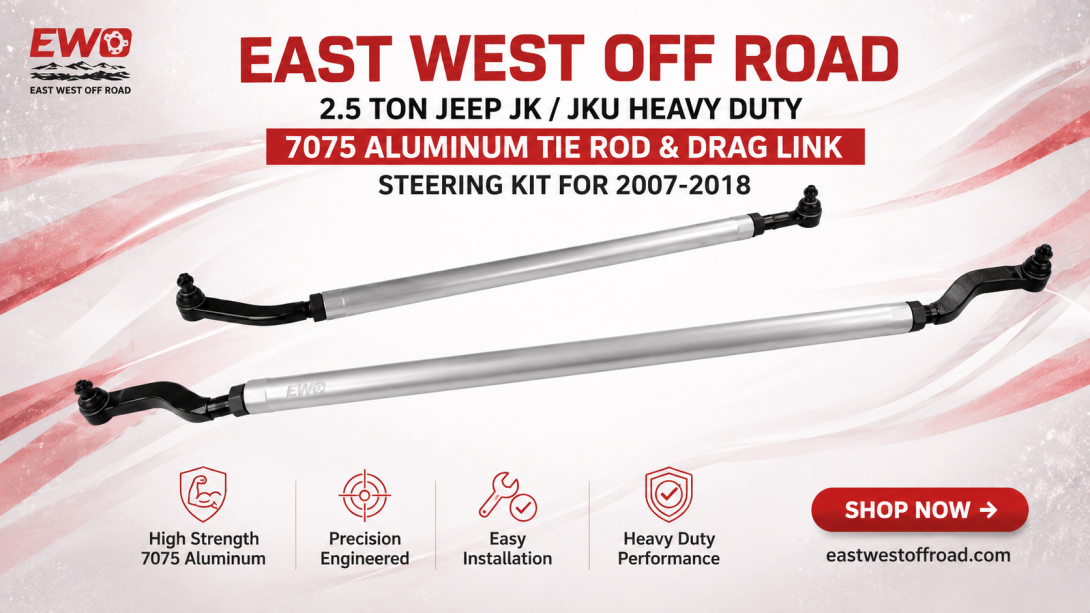
A Jeep JK tie rod and drag link kit is one of the most complete steering-linkage upgrades available for a modified 2007–2018 Wrangler JK or JKU. Larger tires, suspension lifts, heavier wheels, added armor, rock crawling, and regular trail use can place substantially more load on the steering system than a stock Jeep experiences. Replacing the tie rod and drag link together gives owners a coordinated heavy-duty setup rather than upgrading one major steering component while leaving the other factory link in place.
The East West Off Road E35115 2.5 Ton Jeep JK/JKU Heavy Duty 7075 Aluminum Tie Rod & Drag Link Steering Kit is designed for the 2007–2018 Wrangler generation and offers both factory-location and over-the-knuckle configurations for different lift setups.
What Is a Jeep JK Tie Rod and Drag Link Kit?
The tie rod and drag link are the two major links that transfer steering movement across the front axle.
Although they work together, they perform different jobs.
What the Tie Rod Does
The tie rod connects the driver-side and passenger-side steering knuckles.
Its primary responsibilities include:
- Keeping both front wheels steering together
- Maintaining the relationship between the steering knuckles
- Helping establish toe alignment
- Transferring steering movement across the axle
What the Drag Link Does
The drag link transfers movement from the steering box and pitman arm toward the front steering knuckle.
It also plays an important role in steering-wheel centering.
A complete Jeep JK tie rod and drag link kit upgrades both major links so the steering system uses a more consistent heavy-duty architecture.
Why Upgrade the Tie Rod and Drag Link Together?
A modified Jeep can place greater load on both steering links.
Upgrading only one component can leave another factory component as the lighter-duty link in the system.
A complete package offers several advantages.
Matched Steering Architecture
The tie rod and drag link are designed around the same general steering philosophy.
Consistent Upgrade Level
Both major links are upgraded instead of pairing one heavy-duty part with one aging stock component.
Easier Long-Term Service Planning
A complete system can simplify future inspection and replacement-part planning.
One Coordinated Steering Project
Owners can address the primary steering linkage during the same front-end upgrade.
For a Jeep already receiving larger tires, suspension changes, or extensive trail modifications, this approach can make more sense than replacing steering pieces one at a time.
Why Jeep JK Steering Gets More Demanding After Modification
The factory JK steering system was engineered around the Jeep's original:
- Tire diameter
- Wheel weight
- Suspension height
- Vehicle weight
- Front axle configuration
Once those variables change, steering loads can change too.
Common modifications include:
- 35-inch tires
- 37-inch or larger tires
- Heavy aftermarket wheels
- Suspension lifts
- Steel bumpers
- Winches
- Rock sliders
- Recovery equipment
- Overlanding gear
Larger tires create additional leverage through the steering knuckles and linkage.
That becomes especially noticeable during low-speed off-road maneuvers where a tire may be loaded against rocks or uneven terrain.
Jeep JK Tie Rod Upgrade
A Jeep JK tie rod upgrade is particularly popular because the tie rod sits relatively low across the front axle.
This location makes it vulnerable to direct contact with:
- Rocks
- Ledges
- Ruts
- Trail obstacles
Even when the tie rod does not physically hit an obstacle, larger tires can transmit greater steering loads through it.
For that reason, a heavy-duty tie rod is often one of the first steering upgrades considered on a serious trail Jeep.
Wrangler JK Drag Link Upgrade
A Wrangler JK drag link upgrade strengthens the steering path between the steering box and front axle.
The drag link can become especially important as suspension height changes because lift height can alter steering-link geometry.
For a complete steering upgrade, tie rod strength and drag-link geometry should be considered together.
Heavy Duty Steering Linkage Jeep Wrangler
A Heavy duty steering linkage Jeep Wrangler system should be matched to the actual build.
A daily-driven JK running mild modifications does not necessarily need the same steering architecture as a Wrangler running large tires through difficult rock trails.
Important considerations include:
- Tire size
- Vehicle weight
- Lift height
- Front axle
- Wheel backspacing
- Trail difficulty
- Intended vehicle speed and use
The goal is not simply to install the largest steering components available. The goal is a steering system that fits the complete Jeep correctly.
Why 7075 Aluminum Is Popular in Jeep Steering
7075 aluminum has become a popular material for premium off-road steering links.
It provides a high strength-to-weight ratio and does not develop conventional red iron rust like ordinary uncoated steel.
Its elastic behavior is another reason it appears in many rock-crawling steering systems.
Within the material and component's designed range, an aluminum link may deflect under load and return toward its original shape after the load is removed.
No steering component is indestructible, however.
Any steering system should be inspected after a significant trail impact.
7075 Aluminum vs. Steel Steering
Both aluminum and steel can work extremely well in heavy-duty steering applications.
7075 Aluminum Steering
Common advantages include:
- High strength-to-weight ratio
- Resistance to conventional steel rust
- Large solid-link designs available
- Useful elastic behavior under some trail loads
Heavy-Duty Steel Steering
Common advantages include:
- Very high structural strength
- Extensive off-road use history
- Familiar construction
- Broad aftermarket availability
Material name alone should not decide the purchase.
Link dimensions, steering ends, machining, threads, geometry, and fitment all matter.
7075-T6 Aluminum Steering Kit
Shoppers frequently search for a 7075-T6 aluminum steering kit.
7075 identifies the alloy family, while T6 refers to a specific heat-treatment condition.
The EWO E35115 product is identified as a 7075 aluminum steering kit. Buyers who specifically require confirmation of a particular temper should verify that specification directly with EWO rather than assuming every 7075 steering system uses identical material processing.
Aluminum Tie Rod Jeep Wrangler
An Aluminum tie rod Jeep Wrangler setup can be attractive for serious off-road use because a high-strength aluminum link combines substantial material strength with different deformation characteristics from conventional steel.
For buyers comparing aluminum systems, useful specifications include:
- Alloy
- Link diameter
- Steering-end design
- Thread dimensions
- Adjustment method
- Wheel-clearance requirements
A large aluminum bar does not eliminate the importance of the joints at each end.
What Does 2.5-Ton Steering Mean?
The term “2.5-ton steering” describes a heavy-duty aftermarket steering component class.
It does not increase the Jeep's factory payload or gross vehicle weight rating.
The term is commonly associated with substantially larger steering links and rod ends compared with factory JK components.
Current competing 2.5-ton JK systems frequently use very large aluminum links and oversized forged steering ends.
Exact EWO dimensions should always be taken from EWO's own current specification rather than copied from competing kits.
2.5-Ton vs. 1-Ton Jeep Steering
Both are heavy-duty upgrades, but they serve slightly different buyer priorities.
1-Ton Steering
A 1-ton steering system commonly offers:
- Larger-than-stock steering ends
- Heavy-duty tie rod
- Heavy-duty drag link
- Improved aftermarket serviceability
2.5-Ton Steering
A 2.5-ton system is generally aimed at buyers looking for an even more substantial steering architecture.
It is particularly relevant to:
- Large-tire builds
- Serious trail Jeeps
- Rock crawlers
- Highly modified Wranglers
- Builds where steering durability is a major priority
The larger system is not automatically right for every Jeep because component clearance becomes increasingly important.
2-Inch Aluminum Tie Rod Jeep Systems
The phrase 2 inch aluminum tie rod Jeep is becoming common in the 2.5-ton steering market.
Several competitor systems use approximately 2-inch-diameter solid 7075 aluminum links.
This illustrates how far heavy-duty JK steering has moved beyond factory-size linkage.
However, buyers should not assume EWO uses the exact dimensions of another manufacturer's kit.
Always verify actual product dimensions before making clearance decisions.
Forged Tie Rod Ends Jeep Wrangler
Forged tie rod ends Jeep Wrangler is another common search phrase in this category.
Forged steering joints can provide strong component construction when correctly engineered.
When comparing steering ends, buyers should look beyond the word “forged” and consider:
- Threaded shank size
- Ball-stud geometry
- Taper
- Articulation
- Greaseability
- Replacement availability
The steering end must work with the complete linkage and knuckle arrangement.
Chromoly Tie Rod Ends Jeep
Chromoly tie rod ends Jeep searches generally come from owners looking for very high-strength steering joints.
Chromoly is widely used in demanding automotive components, but the exact construction varies by manufacturer.
A product's center link and its steering ends may also use completely different materials.
Always evaluate the component as a complete assembly.
1.25-Inch Tie Rod Ends Jeep JK
Some leading 2.5-ton aftermarket steering systems use steering ends with approximately 1.25-inch threaded shanks.
That explains buyer interest in 1.25 inch tie rod ends Jeep JK.
Those dimensions should not automatically be attributed to EWO E35115 unless specifically confirmed in EWO's current technical data.
The important lesson is that 2.5-ton steering ends are substantially larger than stock-style joints and therefore need additional clearance.
Larger Steering Ends and Wheel Clearance
Oversized steering joints can sit much closer to the wheel than factory components.
Before purchasing a 2.5-ton system, verify:
- Wheel diameter
- Wheel backspacing
- Wheel offset
- Inner wheel-barrel profile
- Tie rod end clearance
- Full-lock clearance
A wheel can have enough overall diameter but still interfere with a large steering joint because of its backspacing or inner shape.
Wheel Backspacing Explained
Backspacing describes how far the wheel mounting surface is positioned relative to the inner wheel edge.
More backspacing can position the inside of the wheel closer to steering components.
That becomes especially important with large 2.5-ton steering ends.
Some competing systems recommend aftermarket wheels or specific backspacing limits for this reason.
The actual EWO/wheel combination should be verified on the Jeep.
Jeep JK Dana 30 Steering Kit
Many non-Rubicon JK models use a Dana 30 front axle.
A Jeep JK Dana 30 steering kit upgrade may be considered when the vehicle receives:
- Larger tires
- Trail-use modifications
- Lift suspension
- Replacement of damaged linkage
The steering system should remain appropriate to the overall front axle build.
Upgrading the linkage does not make every surrounding axle component indestructible.
Jeep JK Dana 44 Steering Kit
Dana 44-equipped JKs, including many Rubicon builds, are frequently modified for serious trail use.
A Jeep JK Dana 44 steering kit may therefore be paired with:
- Larger tires
- Suspension lifts
- Heavy-duty track bars
- Stronger ball joints
- Other axle upgrades
Fitment still depends on the actual knuckles, wheels, differential cover, and aftermarket suspension components.
Jeep JK Factory Location Drag Link
The current EWO E35115 provides a Factory Location / Under the Knuckle configuration for Jeeps with 3.50 inches of lift or less.
A Jeep JK factory location drag link keeps the linkage near its original under-knuckle arrangement.
This can be attractive for owners who want a major steering-strength upgrade without moving the drag-link attachment over the knuckle.
Jeep JK Flip Drag Link Kit
For lifts over 3.50 inches, the current EWO product listing offers a Flip Kit / Over the Knuckle configuration.
A Jeep JK flip drag link kit raises the knuckle-side drag-link connection.
This changes:
- Drag-link position
- Steering-link angle
- Clearance
- Relationship with the track bar
It should therefore be viewed as a geometry modification, not only a strength upgrade.
Why Lift Height Matters
Suspension lift changes the relationship between the chassis and axle.
As lift height increases, steering and suspension links can operate at steeper angles.
The correct Lifted Jeep JK steering kit should therefore be selected around:
- Lift height
- Track-bar geometry
- Axle brackets
- Tire size
- Wheel clearance
- Suspension travel
EWO's current separation between 3.50 inches or less and over 3.50 inches gives buyers a clear starting point for selecting between its two steering configurations.
Drag Link and Track Bar Geometry
The drag link transfers steering input from the steering box.
The track bar controls lateral axle movement.
As the suspension moves, both travel through arcs.
Their geometry needs to work together to avoid unwanted steering behavior as the axle moves through its travel.
This is why changing the drag-link height should be evaluated alongside the track bar.
Off Road Steering Kit Jeep JK
An Off road steering kit Jeep JK needs to deal with both steering loads and trail exposure.
The tie rod can be struck by rocks.
The drag link can experience increased loads from large tires.
Steering ends also operate while the axle articulates.
A heavy-duty system is attractive because it upgrades all of these primary steering connections together.
Rock Crawling and Tie Rod Exposure
Rock crawling places the tie rod in one of the most vulnerable positions on the Jeep.
A trail obstacle can load the center link directly.
At the same time, a tire can become wedged against a rock while steering input is applied.
This combination is one reason heavy-duty tie rod and drag link packages are popular on dedicated trail builds.
After a major impact, the steering system should still be inspected before returning to normal road speeds.
Jeep Wrangler Unlimited Steering Upgrade
A Jeep Wrangler Unlimited steering upgrade is also relevant to four-door JKU overland and trail builds.
The JKU may carry:
- More passengers
- Additional cargo
- Camping equipment
- Storage systems
- Roof equipment
- Larger spare tire
- Recovery gear
A heavier finished vehicle should have the entire steering, axle, and suspension system inspected regularly.
Steering Stabilizer Compatibility
A large aftermarket tie rod may require a different stabilizer mounting clamp.
Before purchasing a complete steering package, check:
- Tie rod diameter
- Clamp diameter
- Stabilizer configuration
- Axle-side mount
- Full-lock clearance
- Suspension-travel clearance
The stabilizer must not contact the drag link, differential cover, axle, or other suspension components.
A Steering Stabilizer Is Not a Structural Upgrade
A steering stabilizer damps rapid steering movement.
It does not increase the structural strength of the tie rod or drag link.
It also does not repair loose:
- Track-bar joints
- Ball joints
- Tie rod ends
- Drag link ends
The mechanical steering system must be sound first.
Complete Kit vs. Tie Rod Only
A tie-rod-only upgrade can make sense when the Jeep already has an appropriate heavy-duty drag link.
A complete kit makes more sense when:
- Both factory links remain
- The Jeep is receiving larger tires
- The vehicle is being prepared for serious off-road use
- The owner wants matching heavy-duty linkage
The 2.5 ton tie rod and drag link kit approach upgrades the entire primary linkage at the same time.
EWO E35115 Overview
East West Off Road currently lists:
2.5 TON JEEP JK / JKU HEAVY DUTY 7075 ALUMINUM TIE ROD & DRAG LINK STEERING KIT FOR 2007–2018
Item Number: E35115
Current verified configuration choices include:
Factory Location / Under the Knuckle
For 3.50-inch lift or less.
Flip Kit / Over the Knuckle
For lift over 3.50 inches.
Current product imagery also states that the package includes 4 extra dual-force tie rod ends.
Why Extra Tie Rod Ends Matter
Steering ends are service and wear components.
Having matching replacement ends available can be useful for Jeep owners who:
- Travel long distances off road
- Keep vehicles for many years
- Want spare steering components on hand
Regular inspection is still essential.
Look for:
- Joint play
- Damaged boots
- Grease loss
- Impact damage
- Loose hardware
Jeep JK Steering Parts Upgrade
A Jeep JK steering parts upgrade should never be treated as an isolated cosmetic modification.
The tie rod and drag link directly affect vehicle control.
The rest of the front end should also be checked, including:
- Track bar
- Ball joints
- Wheel bearings
- Steering box
- Knuckles
- Control arms
- Wheels and tires
A heavy-duty steering kit works best as part of a properly maintained front suspension.
Does a Heavy-Duty Tie Rod and Drag Link Fix Death Wobble?
Not automatically.
Severe front-end oscillation can involve multiple components.
Possible inspection areas include:
- Track bar
- Track-bar mounts
- Ball joints
- Wheel bearings
- Tie rod ends
- Drag link ends
- Alignment
- Wheels
- Tires
A new steering kit may replace worn or damaged linkage, but the underlying cause still needs to be correctly diagnosed.
Tie Rod Adjustment and Toe
Tie rod length affects the relationship between the two steering knuckles and therefore influences toe.
Incorrect toe can contribute to:
- Uneven tire wear
- Wandering
- Poor tracking
- Unstable road feel
After steering-linkage replacement, alignment should be verified professionally.
Drag Link and Steering-Wheel Centering
The drag link performs a different adjustment function.
Its effective length affects steering-wheel centering.
Tie rod and drag-link adjustments should not be confused.
A complete steering upgrade should finish with verification of both alignment and steering-wheel position.
Daily Driving With Heavy-Duty Steering
A 2.5-ton steering system is not limited to trail-only Jeeps.
A street-driven Wrangler can use heavy-duty linkage when it is correctly fitted and aligned.
Important priorities include:
- Predictable steering feel
- Correct toe
- Centered steering wheel
- Wheel clearance
- No binding
- Proper linkage geometry
Heavy-duty components still require precise fitment.
What to Check Before Buying
Check
Why It Matters
Model year
Confirms 2007–2018 JK/JKU fitment
JK or JKU
Helps define vehicle configuration
Dana 30 or Dana 44
Important for complete axle evaluation
Tire size
Larger tires increase steering leverage
Wheel diameter
Affects steering-end clearance
Wheel backspacing
Large joints may need more space
Lift height
Determines EWO configuration selection
Track-bar setup
Important with drag-link flips
Steering stabilizer
Larger tie rods may need another clamp
Differential cover
Can affect linkage clearance
Suspension travel
Confirms there is no binding or contact
Intended use
Helps determine whether 2.5-ton steering is appropriate
Why Consider the EWO JK/JKU Kit?
The EWO E35115 provides a complete steering-linkage solution rather than one replacement component.
Current verified product positioning includes:
- 2007–2018 JK/JKU application
- 2.5-ton steering category
- 7075 aluminum tie rod
- 7075 aluminum drag link
- Factory-location configuration for 3.50-inch lift or less
- Flip configuration for lifts over 3.50 inches
- Four extra dual-force tie rod ends referenced in product imagery
For a heavily modified Wrangler, upgrading the tie rod and drag link together can create a more consistent steering package than gradually replacing factory-style linkage one component at a time.
Installation, Alignment, and Final Inspection
Tie rods and drag links directly control the front wheels.
The completed system should be professionally checked for:
- Correct component fitment
- Wheel clearance
- Tire clearance
- Stabilizer clearance
- Differential-cover clearance
- Full steering travel
- Suspension-travel clearance
- Toe
- Steering-wheel centering
- Drag-link/track-bar geometry
Professional installation or final inspection and alignment are recommended before returning the Jeep to normal road use.
Frequently Asked Questions (FAQs)
What is a Jeep JK tie rod and drag link kit?
It is a complete steering-linkage package that replaces both major steering links connecting the steering box and front steering knuckles.
Why replace the tie rod and drag link together?
Replacing both provides a more consistent heavy-duty steering system instead of leaving one major factory component in place.
What years does the EWO E35115 kit fit?
The current product is listed for 2007–2018 Jeep Wrangler JK and JKU models.
What is EWO E35115?
E35115 is East West Off Road's 2.5 Ton Jeep JK/JKU Heavy Duty 7075 Aluminum Tie Rod & Drag Link Steering Kit.
Is the EWO kit made from 7075 aluminum?
Yes. The current product title identifies it as a 7075 aluminum tie rod and drag link steering kit.
What does 2.5-ton steering mean?
It refers to the heavy-duty aftermarket steering-component class. It does not change the Jeep's payload or factory vehicle-weight rating.
Is 2.5-ton steering stronger than 1-ton steering?
It generally represents a larger heavy-duty component class, but overall performance depends on component design, fitment, materials, and the complete Jeep setup.
What is the difference between the tie rod and drag link?
The tie rod connects the two steering knuckles. The drag link transfers movement from the steering box and pitman arm toward the front axle.
Does the EWO kit fit a JK with a Dana 30?
The product is listed for the JK/JKU platform, but exact axle, knuckle, wheel, and modified-vehicle compatibility should be verified before ordering.
Does it work with a Dana 44?
Dana 44 JK builds are common candidates for heavy-duty steering, but exact vehicle configuration should still be confirmed.
What EWO configuration should I consider for 3.5 inches of lift or less?
The current EWO listing specifies Factory Location / Under the Knuckle for 3.50 inches of lift or less.
What configuration is listed for more than 3.5 inches of lift?
EWO currently specifies Flip Kit / Over the Knuckle for lifts over 3.50 inches.
What is a drag link flip?
A drag link flip moves the relevant drag-link attachment above the steering knuckle and changes steering-link position and geometry.
Does every lifted Jeep need a drag-link flip?
No. Lift height, track-bar geometry, suspension configuration, and axle setup should all be considered.
Why does track-bar geometry matter?
The track bar controls lateral axle movement while the drag link transfers steering input. Their movement paths need to work together as the suspension cycles.
Will 2.5-ton steering work with factory wheels?
Compatibility depends on steering-end size, wheel diameter, backspacing, offset, and the wheel's inner shape. Clearance should be verified before ordering.
Do large steering ends require more wheel clearance?
Generally, yes. Oversized heavy-duty steering joints occupy more space than factory components.
Do I need a different steering stabilizer clamp?
Possibly. A larger-diameter tie rod may require a compatible aftermarket clamp.
Does a steering stabilizer strengthen the tie rod?
No. A stabilizer damps steering movement but does not structurally reinforce the steering linkage.
Is 7075 aluminum good for off-road steering?
7075 is widely used in premium aftermarket steering because of its strength-to-weight ratio and useful elastic behavior under certain loads.
Is aluminum better than steel steering?
Neither is universally better. Link dimensions, material, rod ends, fitment, and design all matter.
Does the EWO kit include extra tie rod ends?
Current EWO product imagery states that the package includes four extra dual-force tie rod ends.
Is this steering kit useful with 35-inch tires?
It can be relevant to larger-tire builds, especially those used off road. The rest of the axle and suspension should remain appropriate to the tire size and use.
What about 37-inch or larger tires?
Larger tires increase steering leverage and commonly make heavy-duty linkage more attractive, but fitment and front-end condition remain critical.
Is a 2.5-ton steering kit good for rock crawling?
This class of heavy-duty 7075 steering system is commonly targeted toward serious off-road and rock-crawling applications where steering loads and trail impacts can be substantial.
Can the kit be used on a daily-driven Jeep?
It can be used on a road-driven Jeep when correctly fitted, aligned, and inspected.
Will a new tie rod and drag link fix death wobble?
Not automatically. Track-bar components, ball joints, wheel bearings, steering joints, alignment, wheels, and tires can all contribute to severe steering oscillation.
Do I need an alignment after installing a tie rod and drag link kit?
Yes. Toe, steering-wheel centering, linkage clearance, and overall front-end geometry should be checked.
Should a Jeep JK steering kit be professionally installed?
Professional installation or final inspection and alignment are recommended because the tie rod and drag link directly affect vehicle control.