

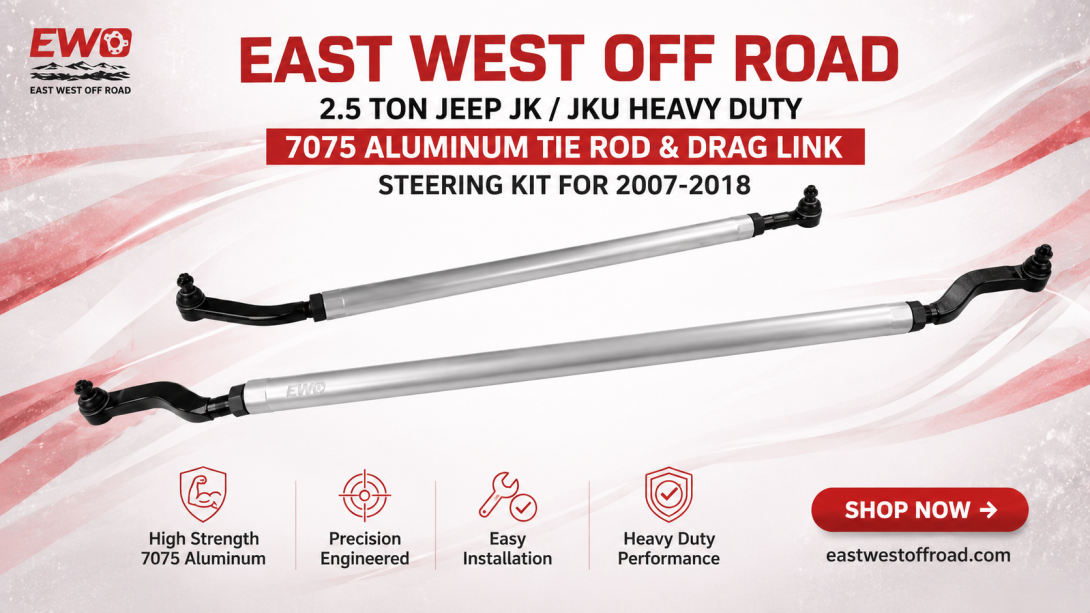
Buy Now: Jeep JK / JKU 2.5 Ton Heavy Duty 7075 Aluminum Steering Kit
A Jeep JK heavy duty steering kit is a practical upgrade for 2007–2018 Jeep Wrangler JK and JKU owners who use larger tires, suspension lifts, and demanding off-road trails. Factory steering components can become vulnerable to impacts, flex, and increased loads as a JK is modified. Upgrading the tie rod and drag link together creates a stronger steering system while improving steering feel and durability. Current aftermarket options range from heavy-duty steel systems to large-diameter 7075-T6 aluminum designs, with some kits also supporting factory-location or flipped drag-link configurations.
Why Upgrade the Jeep JK Steering System?
The factory steering system is adequate for a stock or lightly modified Wrangler, but off-road use changes the demands placed on the front-end components.
Larger tires have more leverage against steering components. Rocks can directly impact the tie rod, while increased suspension travel can put additional stress on the drag link and its joints.
A quality Jeep JK tie rod upgrade can provide a stronger connection between the steering knuckles, while a matching drag link upgrade helps strengthen the steering connection between the steering box and axle.
For serious trail use, upgrading both components as a system is generally more practical than replacing only one component.
What Makes a Jeep JK Heavy Duty Steering Kit Different?
A heavy-duty steering system typically improves on the factory design through larger tubing, stronger materials, upgraded rod ends, and improved joint construction.
Larger Steering Components
A larger-diameter tie rod and drag link can provide greater resistance to bending and deformation compared with lightweight factory components.
Depending on the design, aftermarket systems may use:
- 1.5-inch or larger tubing
- 2-inch aluminum steering components
- 7075-T6 aluminum
- DOM steel tubing
- Heavy-duty rod ends
- Forged or chromoly steering ends
- Replaceable hardware
The goal is not simply to make the components larger. The steering system needs appropriate strength, articulation, clearance, and compatibility with the JK axle.
Stronger Rod Ends
The rod ends are critical because they connect the steering links to the steering knuckles and pitman arm.
For demanding builds, forged tie rod ends Jeep Wrangler owners use can provide a more robust alternative to factory-style components. Some systems use Chromoly tie rod ends Jeep applications are commonly paired with heavy-duty fabricated steering links.
7075-T6 Aluminum Steering for Jeep JK
One of the most popular approaches to a modern steering upgrade is a 7075-T6 aluminum steering kit.
7075 aluminum is known for its high strength-to-weight ratio and is commonly used in demanding aerospace and motorsport applications. In the Jeep aftermarket, large-diameter aluminum steering links are designed to provide substantial strength without the weight associated with similarly sized steel components.
The EWO product is a 2.5-ton Jeep JK / JKU heavy-duty 7075 aluminum tie rod and drag link steering kit for 2007–2018 applications.
For a complete system, see the East West Off Road steering kit.
Jeep JK Tie Rod Upgrade vs Drag Link Upgrade
The tie rod and drag link perform different jobs.
Tie Rod
The tie rod connects the steering knuckles across the front axle. It transfers steering movement from one knuckle to the other.
Because it sits relatively low on the axle, the tie rod can be exposed to rocks and other trail obstacles.
A stronger tie rod is especially useful for JKs running larger tires and aggressive off-road terrain.
Drag Link
The drag link connects the steering box's pitman arm to the steering knuckle.
It controls the steering input from the steering box and is therefore an important part of steering geometry.
A Wrangler JK drag link upgrade can increase strength while also providing an opportunity to change the drag-link position on lifted vehicles.
Lifted Jeep JK Steering Kit: Factory Position vs Flip
Lift height is an important consideration when selecting steering components.
A Jeep JK factory location drag link remains in the original general position, while a flipped configuration moves the drag link above the steering knuckle.
A Jeep JK flip drag link kit can be useful for certain lifted applications because raising the drag-link mounting point can improve its relationship with the front suspension geometry.
However, a drag-link flip is not automatically better for every Jeep.
Some high-steer configurations require a front track-bar relocation or other geometry changes. Manufacturers specifically note that flipped drag-link systems may require track-bar modifications to maintain appropriate steering and suspension geometry.
When Does a JK Need a Steering Upgrade?
There is no single mileage number that determines when a steering upgrade is necessary. The better approach is to evaluate the vehicle's use and modifications.
Consider upgrading when your Jeep has:
- 35-inch or larger tires
- Significant suspension lift
- Heavy beadlock wheels
- Frequent rock crawling
- Regular trail impacts
- Increased front-end weight
- Repeatedly bent factory steering components
- Noticeable steering looseness
- Worn steering joints
- A need for stronger off-road steering components
A heavy-duty system can also make sense during a broader front-end rebuild when multiple factory components are already being replaced.
Jeep JK Dana 30 Steering Kit vs Jeep JK Dana 44 Steering Kit
The 2007–2018 Wrangler JK platform was offered with different front axle configurations, including Dana 30 and Dana 44 applications.
A Jeep JK Dana 30 steering kit and Jeep JK Dana 44 steering kit should not automatically be treated as interchangeable.
Before purchasing a steering upgrade, verify:
- Model year
- JK or JKU configuration
- Front axle
- Steering-knuckle configuration
- Factory or aftermarket axle housing
- Wheel diameter
- Wheel backspacing
- Lift height
- Drag-link configuration
- Steering stabilizer arrangement
This is especially important if the Jeep has already received aftermarket axle or suspension modifications.
2 Inch Aluminum Tie Rod Jeep Applications
Large aluminum steering links are increasingly popular among off-road Jeep builders.
A 2 inch aluminum tie rod Jeep setup can offer substantial material volume while keeping overall steering-link weight relatively low.
The important factor is the complete engineering of the component—not simply the outside diameter.
Thread engagement, end design, material quality, joint construction, and connection hardware all contribute to the final strength of the assembly.
The EWO 2.5-ton system is designed around large, heavy-duty steering components for JK and JKU applications.
1.25 Inch Tie Rod Ends Jeep JK Builds
Some custom steering systems use 1.25 inch tie rod ends Jeep JK applications for high-strength fabricated steering.
These are generally more relevant to custom builds than simple factory-replacement upgrades.
When using large rod ends, the builder must make sure the steering knuckle, tubing, weld bungs, spacers, and mounting hardware are all compatible.
A larger joint should never be installed simply because its size appears stronger.
Heavy Duty Steering Linkage Jeep Wrangler
A complete heavy duty steering linkage Jeep Wrangler setup should be considered as one system.
The major components include:
Tie Rod
Provides steering movement between the knuckles and needs sufficient resistance to bending and impact.
Drag Link
Transfers steering input from the pitman arm to the axle.
Tie Rod Ends
Provide the required articulation while maintaining a secure connection.
Steering Stabilizer
Can help control steering feedback and vibration, but it should not be used to compensate for worn or improperly designed steering components.
A stabilizer is not a substitute for a properly functioning steering system.
East West Off Road 2.5 Ton Steering Kit
For JK and JKU owners looking for a complete upgrade, the EWO system combines the tie rod and drag link into one heavy-duty steering package.
The product is designed for 2007–2018 Jeep JK/JKU applications and uses 7075 aluminum construction. The company's product listing specifically identifies it as a 2.5-ton heavy-duty tie rod and drag link steering kit.
You can review the complete 2.5 ton tie rod and drag link kit before selecting your steering configuration.
Installation Considerations
A steering upgrade should be installed carefully because the steering system is safety-critical.
Before installation, inspect:
- Ball joints
- Unit bearings
- Steering knuckles
- Track bar
- Pitman arm
- Steering box
- Steering stabilizer
- Wheel clearance
- Existing steering joints
After installation, verify steering wheel centering, toe, steering travel, and clearance.
If using a flipped drag link, suspension and steering geometry should be checked through the complete range of suspension travel. Some aftermarket flip systems require specific wheel-backspacing limitations or track-bar relocation components.
Common Jeep JK Steering Upgrade Mistakes
Choosing Parts Without Checking Fitment
A steering component can be strong but still be unsuitable for a particular axle or wheel setup.
Ignoring Wheel Clearance
Large steering components may change the clearance between the steering linkage and wheel.
Flipping the Drag Link Without Addressing Geometry
A flip can change the relationship between the drag link and track bar. The complete suspension system needs to be considered.
Using a Steering Stabilizer to Hide Problems
A stabilizer should not be used to cover up worn ball joints, loose rod ends, bent steering components, or poor geometry.
Mixing Incompatible Components
Combining steering arms, rod ends, adapters, and linkage from unrelated systems can create fitment and geometry problems.
Frequently Asked Questions (FAQs)
What is a Jeep JK heavy duty steering kit?
A Jeep JK heavy duty steering kit replaces factory steering linkage with stronger components, typically including an upgraded tie rod and drag link designed for increased durability and off-road use.
Is a heavy-duty steering kit worth it on a Jeep JK?
For a JK used for serious off-roading, especially with larger tires and suspension modifications, stronger steering components can provide greater resistance to trail impacts and bending.
Does a 7075 aluminum tie rod work for Jeep JK?
Yes. Large-diameter 7075 aluminum steering links are available specifically for Jeep JK and JKU applications. The material provides a high strength-to-weight ratio and is used in several aftermarket heavy-duty steering designs.
Should I upgrade the tie rod and drag link together?
For a serious Jeep JK steering upgrade, upgrading both components together creates a more balanced steering system and avoids leaving one relatively weak factory component in the system.
Is a Jeep JK flip drag link necessary with a lift?
Not necessarily. The appropriate steering configuration depends on lift height, suspension geometry, axle setup, track-bar position, and the specific steering kit. Some manufacturers offer both factory-location and flipped configurations.
Does a heavy-duty steering kit fit both JK and JKU?
Many aftermarket kits are designed for both 2007–2018 JK and JKU models, but fitment should always be verified against the specific vehicle and front axle configuration.
Can I use a heavy-duty steering kit with Dana 30?
Many JK steering kits are compatible with Dana 30 applications, but compatibility depends on the exact steering design and whether the axle has been modified.
Can I use a heavy-duty steering kit with Dana 44?
Yes, heavy-duty JK steering systems are available for Dana 44-equipped vehicles. Always verify the specific kit's fitment before installation.
What is better: steel or 7075 aluminum steering?
Both materials can work well when properly engineered. Steel can offer excellent impact resistance and is common in fabricated steering systems, while 7075 aluminum provides a high strength-to-weight ratio and can reduce overall component weight.
Does a steering stabilizer make the steering stronger?
No. A steering stabilizer can damp steering movement and vibration, but it does not replace the structural function of the tie rod or drag link.
Final Thoughts
A Jeep JK heavy duty steering kit is one of the most practical upgrades for a Wrangler that regularly sees larger tires, suspension modifications, and demanding off-road conditions. The right system should provide more than oversized tubing—it should combine strong materials, reliable rod ends, appropriate geometry, proper clearance, and verified vehicle fitment.
For JK and JKU owners looking for a complete 7075 aluminum solution, the EWO 2.5-ton system provides an upgraded tie rod and drag link designed specifically for 2007–2018 applications.
When choosing an upgrade, prioritize the complete steering system rather than focusing on a single component. Verify axle configuration, lift height, wheel clearance, drag-link position, and steering geometry before installation.