

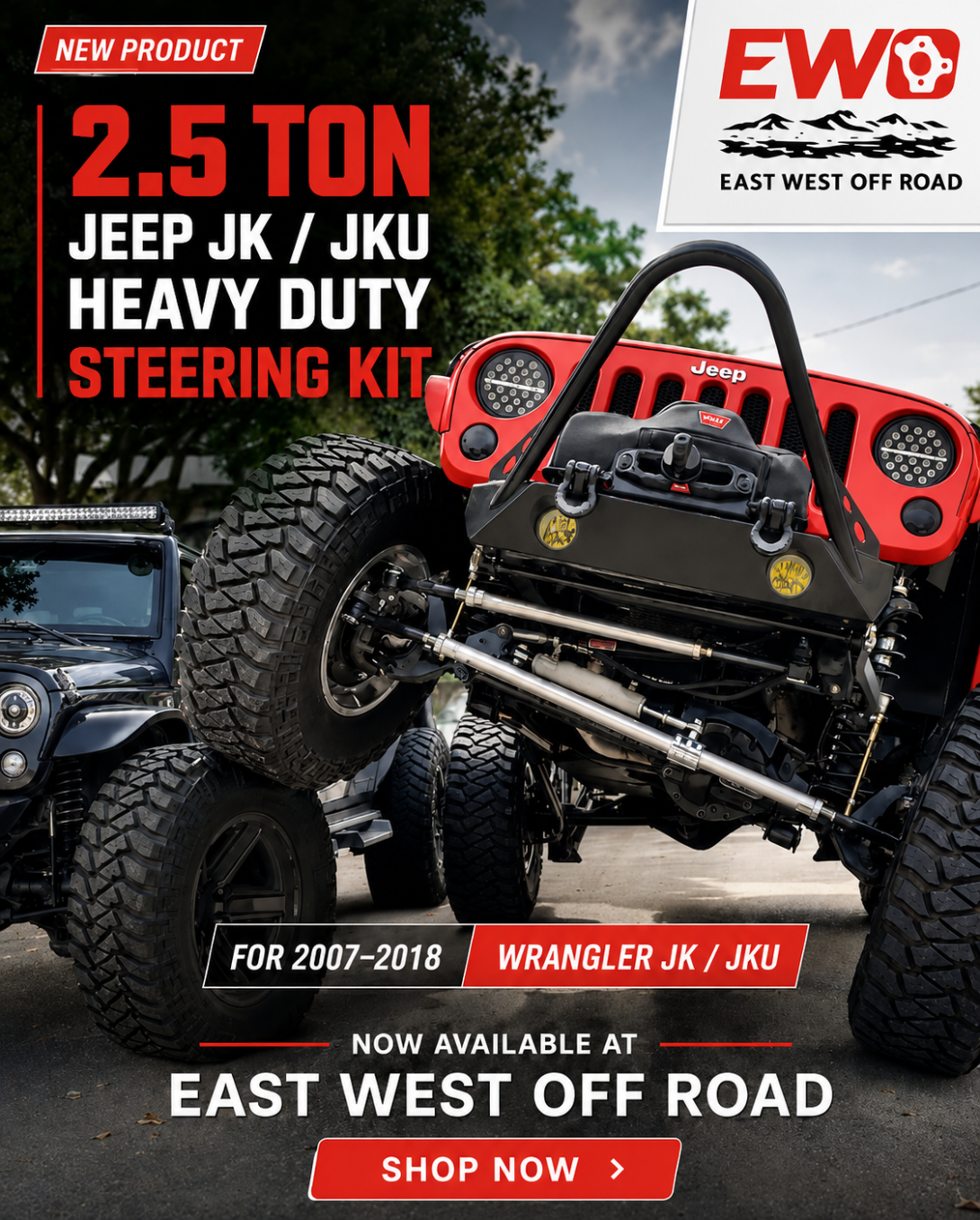
A Jeep JK heavy duty steering kit is a major front-end upgrade for 2007–2018 Wrangler JK and JKU owners running larger tires, suspension lifts, heavier wheels, armor, overlanding equipment, or demanding off-road trails. Instead of replacing only one factory steering component, a complete heavy-duty system upgrades the tie rod and drag link together, creating a more consistent steering-linkage package for modified Jeeps. For serious JK and JKU builds, 7075 aluminum linkage and 2.5-ton steering architecture have become especially popular because buyers are looking for substantially stronger components without giving up adjustability or vehicle-specific fitment.
The East West Off Road E35115 is a 2.5 Ton Jeep JK/JKU Heavy Duty 7075 Aluminum Tie Rod & Drag Link Steering Kit for 2007–2018 applications, with separate factory-location and over-the-knuckle configurations depending on the Jeep's suspension setup.
Why Upgrade the Steering on a Jeep JK?
The factory JK steering system was engineered around the Wrangler's original tire size, wheel dimensions, suspension height, vehicle weight, and intended operating range.
Once a Jeep is modified, the loads transmitted through its steering linkage can change dramatically.
Common modifications include:
- 35-inch tires
- 37-inch or larger tires
- Heavy aftermarket wheels
- Suspension lifts
- Steel bumpers
- Winches
- Underbody armor
- Larger spare tires
- Overlanding equipment
- Rock-crawling upgrades
Larger tires create additional leverage at the steering knuckles, while trail impacts can place direct loads into the tie rod and drag link.
That is why a complete Jeep JK heavy duty steering kit can make more sense for a heavily modified Wrangler than repeatedly replacing individual factory-style components.
What Parts Make Up the JK Steering Linkage?
The two major steering links are the tie rod and drag link.
Tie Rod
The tie rod connects the driver-side and passenger-side steering knuckles.
Its major functions include:
- Making both front wheels steer together
- Maintaining the relationship between the steering knuckles
- Helping establish toe alignment
- Transferring steering movement across the front axle
Drag Link
The drag link transfers steering input from the steering box and pitman arm toward the steering knuckle.
It also plays an important role in steering-wheel centering.
Both links operate together every time the Jeep changes direction.
Jeep JK Tie Rod Upgrade
A Jeep JK tie rod upgrade is one of the most common steering modifications for off-road Wranglers because the tie rod sits in a relatively exposed location across the front axle.
Trail obstacles can contact it directly.
A stronger tie rod can be especially relevant for Jeeps used for:
- Rock crawling
- Technical trails
- Large-tire builds
- Overlanding
- Heavy trail use
However, the tie rod should not be considered separately from the drag link, steering ends, wheels, knuckles, track bar, and suspension geometry.
Wrangler JK Drag Link Upgrade
A Wrangler JK drag link upgrade strengthens the link that transfers steering-box movement to the axle.
A heavy-duty drag link becomes particularly relevant when the Jeep also receives a stronger tie rod.
Replacing both components together avoids a situation where one major steering link is significantly more robust than the other.
For heavily modified JKs, this creates a more complete steering-system upgrade.
Jeep JKU Steering Kit for Wrangler Unlimited Builds
The four-door Wrangler Unlimited uses the same general steering architecture as the JK but is commonly built into a heavier trail or overland vehicle.
A Jeep JKU steering kit can be relevant when the vehicle carries additional equipment such as:
- Roof racks
- Recovery gear
- Camping equipment
- Storage systems
- Steel bumpers
- Larger spare tire
- Tools
A Jeep Wrangler Unlimited steering upgrade should therefore be selected around the actual finished vehicle rather than simply the JKU model name.
What Does “2.5-Ton Steering” Mean?
The term “2.5-ton steering” describes the heavy-duty class and dimensions of the aftermarket steering components.
It does not mean the Wrangler becomes a 2.5-ton-rated truck or receives a higher factory GVWR.
The terminology is commonly associated with substantially oversized steering links and rod ends compared with factory JK hardware.
Current leading aftermarket 2.5-ton systems often use large steering-end shanks and approximately 2-inch-diameter 7075 links.
Exact dimensions and material specifications should always be verified for the specific product being purchased.
2.5-Ton vs. 1-Ton Jeep Steering
Both styles represent upgrades over lighter factory-style linkage, but they target somewhat different buyer priorities.
1-Ton Steering
A 1-ton system commonly provides:
- Larger-than-stock steering joints
- Heavy-duty tie rod
- Heavy-duty drag link
- Stronger aftermarket architecture
It can be an excellent choice for many modified JKs.
2.5-Ton Steering
A 2.5-ton system generally moves farther toward oversized steering architecture.
Buyers commonly consider it for:
- Larger tire builds
- Hard trail use
- Rock crawling
- High-impact environments
- Builds where steering durability is a major priority
The correct choice should still be based on fitment rather than simply choosing the largest available component.
7075 Aluminum Steering Linkage
7075 aluminum is one of the most popular materials in premium off-road steering systems.
It combines high strength with relatively low density and useful elastic characteristics.
A properly engineered aluminum steering link can deflect under certain impacts within its elastic range and return toward its original position after the load is removed.
That characteristic is one reason 7075 has become popular in rock-crawling steering systems.
7075-T6 Aluminum Steering Kit: What Buyers Should Know
The phrase 7075-T6 aluminum steering kit frequently appears in aftermarket searches.
7075 identifies the aluminum alloy, while T6 refers to a particular heat-treatment condition.
These details should not be assumed based only on the words “7075 aluminum.”
The current indexed EWO product information identifies the E35115 system as 7075 aluminum, but buyers looking specifically for a particular temper specification should verify that detail directly with the manufacturer rather than assuming it.
Aluminum Tie Rod Jeep Wrangler Benefits
An Aluminum tie rod Jeep Wrangler setup can offer several advantages when properly engineered:
- High strength-to-weight ratio
- Resistance to conventional red steel rust
- Strong off-road aftermarket support
- Elastic response to some trail impacts
- Large-diameter solid-link designs available
Material alone does not determine component strength.
Diameter, threaded sections, steering ends, machining, geometry, and installation all matter.
2-Inch Aluminum Tie Rod Jeep Systems
A 2 inch aluminum tie rod Jeep system is becoming a recognizable category in 2.5-ton steering.
Several current competitors use approximately 2-inch-diameter solid 7075 links.
The larger diameter can substantially affect resistance to bending.
However, buyers should not assume every 2.5-ton kit uses exactly the same diameter.
Always verify the specifications of the individual product.
Aluminum vs. Chromoly Steering
The JK aftermarket offers both heavy-duty aluminum and chromoly/steel steering systems.
Neither material is automatically best for every vehicle.
Aluminum Steering
Potential advantages include:
- High strength-to-weight ratio
- Corrosion resistance
- Large solid-link designs
- Elastic response under certain impacts
Chromoly Steering
Potential advantages include:
- Very high material strength
- Proven off-road use
- Broad aftermarket support
- Familiar steel construction
A complete steering system should be evaluated by design, not material name alone.
Chromoly Tie Rod Ends Jeep
The keyword Chromoly tie rod ends Jeep often appears when shoppers compare high-end steering systems.
Chromoly may be used in studs, joints, housings, or other steering components depending on the manufacturer.
A buyer should verify:
- Exact material
- Joint design
- Shank diameter
- Taper
- Greaseability
- Replacement availability
Do not assume the center link and the rod ends use the same material.
Forged Tie Rod Ends Jeep Wrangler
Forged tie rod ends Jeep Wrangler systems are also common in premium steering products.
Forging can produce strong steering-end components when properly designed and manufactured.
Current 2.5-ton competitors frequently emphasize forged ends as an important part of their durability story.
For buyers, the important question is not simply whether a component is forged but whether the complete end matches the knuckle taper, steering-link threads, articulation requirements, and intended application.
1.25-Inch Tie Rod Ends Jeep JK
The phrase 1.25 inch tie rod ends Jeep JK generally refers to oversized steering-end shanks found in some 2.5-ton aftermarket systems.
Current competitors such as CavFab and CORE 4x4 specifically market 1.25-inch threaded-shank architecture in this category.
That demonstrates the commercial intent behind the search term.
However, dimensions from one manufacturer's system should never automatically be attributed to another product.
Verify EWO's exact end dimensions directly from its current product specification before ordering based on that measurement.
Why Larger Steering Ends Affect Fitment
Larger steering ends occupy more physical space around the knuckle and wheel.
That can create clearance issues involving:
- Wheel backspacing
- Wheel diameter
- Differential cover
- Steering stabilizer
- Sway-bar hardware
- Suspension brackets
Heavy-duty steering should therefore be treated as both a strength upgrade and a fitment project.
Dana 30 and Dana 44 JK Steering
The Jeep JK platform commonly uses Dana 30 or Dana 44 front-axle configurations depending on model and trim.
Current competitor heavy-duty steering systems frequently advertise compatibility with both platforms.
When researching a Jeep JK Dana 30 steering kit or Jeep JK Dana 44 steering kit, the buyer should still confirm the exact axle, knuckles, wheels, and aftermarket modifications on the Jeep.
Jeep JK Dana 30 Steering Kit Considerations
A Dana 30-equipped JK may receive a steering upgrade as part of:
- Larger tire installation
- Suspension lift
- Trail-build preparation
- Replacement of damaged factory linkage
Before upgrading, inspect the complete axle and front end.
Steering strength should remain appropriate to the rest of the build.
Jeep JK Dana 44 Steering Kit Considerations
A Dana 44-equipped JK or Rubicon is frequently modified for more demanding off-road use.
That can make a heavy-duty steering system particularly attractive.
However, the steering kit should still be checked against:
- Factory or aftermarket knuckles
- Wheel specifications
- Differential cover
- Track bar
- Stabilizer mounting
Fitment details matter even on a stronger axle.
Factory Location vs. Flip Drag Link
One of the most important decisions when buying heavy-duty JK steering is drag-link position.
The current EWO E35115 listing offers two configurations:
- Factory Location / Under the Knuckle for 3.50-inch lift or less
- Flip Kit / Over the Knuckle for lift over 3.50 inches
These options address different suspension configurations.
Jeep JK Factory Location Drag Link
A Jeep JK factory location drag link keeps the drag link in the general factory under-the-knuckle arrangement.
The current EWO listing positions this version for Jeeps with 3.50 inches of lift or less.
This can appeal to buyers who want stronger steering linkage without moving the drag-link attachment above the knuckle.
Jeep JK Flip Drag Link Kit
A Jeep JK flip drag link kit moves the relevant drag-link attachment to an over-the-knuckle position.
The current EWO listing positions its flip configuration for lifts over 3.50 inches.
Moving the drag link changes more than component strength—it changes steering geometry.
The relationship between the drag link and track bar becomes particularly important.
Why Drag-Link and Track-Bar Geometry Matter
The drag link transfers steering input.
The track bar controls lateral axle movement.
As the suspension cycles, both travel through arcs.
Their geometry should work together to minimize unwanted steering input during suspension movement.
This is why a drag-link flip should not be selected solely because the Jeep is lifted.
Track-bar configuration, axle brackets, steering angles, and suspension travel all need to be considered.
Lifted Jeep JK Steering Kit
A Lifted Jeep JK steering kit must work with more than just the front axle.
Important variables include:
- Lift height
- Tire size
- Wheel offset
- Wheel backspacing
- Track-bar position
- Differential cover
- Stabilizer mount
- Full bump and droop clearance
The higher and more modified the Jeep becomes, the more important complete-system geometry becomes.
Steering Clearance at Full Lock
Clearance should be checked with the steering turned fully left and fully right.
Potential interference areas include:
- Wheel barrel
- Tire
- Differential cover
- Track bar
- Stabilizer
- Sway-bar hardware
- Control-arm brackets
A heavy-duty link provides little benefit if it contacts another component during normal steering travel.
Wheel Backspacing and Heavy-Duty Steering
Large steering ends commonly need more room than factory joints.
Current competitor 2.5-ton kits sometimes specify maximum wheel backspacing or recommend wheel spacers with stock wheels.
That is a strong indication that wheel clearance should be treated as a primary buying consideration.
Check:
- Wheel diameter
- Wheel backspacing
- Wheel offset
- Inner barrel shape
- Tie rod end clearance
Never assume that a wheel fits merely because its diameter is large enough.
Steering Stabilizer Compatibility
A larger tie rod can require a new steering-stabilizer clamp.
Current competing 2.5-ton systems often specify larger stabilizer clamps because of their oversized links.
Before ordering, determine:
- Existing stabilizer type
- Clamp diameter
- Mount location
- Full-lock clearance
- Suspension-travel clearance
A steering stabilizer should never become a physical steering stop.
What the Steering Stabilizer Actually Does
A stabilizer damps rapid steering movement.
It does not structurally reinforce the tie rod or drag link.
A larger stabilizer cannot compensate for:
- Worn tie rod ends
- Loose track-bar hardware
- Damaged ball joints
- Incorrect alignment
- Poor steering geometry
The mechanical steering system needs to be correct first.
Heavy Duty Steering Linkage Jeep Wrangler
A Heavy duty steering linkage Jeep Wrangler system should be selected according to the actual demands of the build.
A daily-driven Wrangler on 33-inch tires has different requirements from a heavily armored JK on 40-inch tires.
Important variables include:
- Tire diameter
- Tire weight
- Vehicle weight
- Trail difficulty
- Lift height
- Front axle
- Wheel offset
The purpose is to create an appropriately matched steering system rather than simply install the biggest parts available.
Off Road Steering Kit Jeep JK
An Off road steering kit Jeep JK application needs to account for direct trail impacts as well as steering loads.
The tie rod is particularly exposed to:
- Rocks
- Ledges
- Ruts
- Trail debris
A heavy-duty tie rod and drag link can provide additional durability, but every major trail impact should still be followed by an inspection.
Rock Crawling and 7075 Steering
Rock crawling creates unique steering loads.
A tire can be wedged against an obstacle while steering force is applied.
At the same time, the steering links may contact rocks directly.
This is one reason large-diameter 7075 steering systems are popular in crawling applications.
No steering link is indestructible, though.
Damage should be inspected before the Jeep returns to highway speeds.
Overlanding and Heavy-Duty Steering
An overland JK or JKU may not encounter rock impacts as frequently as a dedicated crawler, but it can carry substantially more weight.
Common additions include:
- Bumpers
- Winch
- Roof equipment
- Camping gear
- Recovery tools
- Storage systems
- Oversized spare tire
That additional weight should be considered when evaluating the entire front suspension and steering system.
Daily Driving With 2.5-Ton Steering
Heavy-duty steering can also be used on a street-driven Wrangler when properly fitted and aligned.
Important road-use priorities include:
- Predictable steering response
- Correct toe
- Centered steering wheel
- Sufficient wheel clearance
- No linkage binding
- Secure steering hardware
Strength does not replace precision.
Jeep JK Steering Parts Upgrade: Complete Kit vs. Individual Parts
A Jeep JK steering parts upgrade can be approached two ways.
Individual Component Replacement
Replacing only the tie rod or drag link can make sense when:
- One component is damaged
- The remaining linkage is already upgraded
- The Jeep is lightly modified
Complete Steering System
A complete tie rod and drag link kit is attractive when:
- Both factory links remain
- The Jeep runs larger tires
- The steering is being upgraded for serious trails
- Matching components are preferred
Replacing both major links creates a more consistent system.
Why the 2.5-Ton Kit Is Different From EWO's 1-Ton Kit
East West Off Road also offers a 1-ton JK/JKU steering product.
The 2.5-ton E35115 occupies a heavier-duty position in the product range.
That distinction gives buyers a choice between different steering architectures based on the level of modification and intended use.
The decision should account for fitment and clearance as much as component size.
EWO E35115 Steering Configuration
The current EWO product is identified as:
2.5 TON JEEP JK / JKU HEAVY DUTY 7075 ALUMINUM TIE ROD & DRAG LINK STEERING KIT FOR 2007–2018
Item Number: E35115
Current configuration choices are:
Factory Location / Under the Knuckle
EWO currently positions this option for 3.50-inch lift or less.
Flip Kit / Over the Knuckle
EWO currently positions this option for lift over 3.50 inches.
This makes lift height an important first-level configuration choice when evaluating the product.
Four Extra Dual-Force Tie Rod Ends
Current EWO product imagery also references four extra dual-force tie rod ends.
Replacement steering ends can be useful to Jeep owners who travel far from convenient parts access or intend to keep the steering system for a long period.
Steering ends remain wear components and should still be inspected for:
- Joint play
- Boot damage
- Grease loss
- Impact damage
- Loose hardware
East West Off Road Steering Kit
The East West Off Road steering kit is designed as a complete tie rod and drag link upgrade rather than a single replacement steering link.
For buyers comparing complete systems, that approach offers several advantages:
- Matching steering links
- One system architecture
- Consistent upgrade level
- Coordinated configuration selection
- Replacement of both major factory links
The 2007–2018 fitment also targets the full JK/JKU generation.
2.5-Ton Tie Rod and Drag Link Kit
A 2.5 ton tie rod and drag link kit is particularly relevant to Wrangler owners who want a more substantial steering upgrade than a basic OEM-style replacement.
It can be considered for builds involving:
- Large tires
- Serious trail use
- Rock crawling
- Lifted suspension
- Heavy accessories
- Long-term front-end upgrades
The “2.5 ton” term describes the aftermarket steering-component class, not a change to the Jeep's payload or vehicle-weight rating.
Signs It May Be Time to Inspect or Upgrade JK Steering
Steering components should be inspected whenever the vehicle develops abnormal front-end behavior.
Potential warning signs include:
- Excessive steering play
- Clunking
- Visible tie rod damage
- Worn rod ends
- Damaged boots
- Uneven tire wear
- Steering wheel no longer centered
- Changed steering response after a trail impact
The cause should be diagnosed rather than assuming one component is responsible.
Will Heavy-Duty Steering Fix Death Wobble?
Not automatically.
A stronger tie rod and drag link can replace worn or vulnerable components, but severe front-end oscillation can involve many areas.
Inspection may include:
- Track bar
- Track-bar brackets
- Ball joints
- Wheel bearings
- Tie rod ends
- Drag link ends
- Control arms
- Alignment
- Wheels
- Tires
Installing the heaviest steering kit available is not a substitute for finding the actual cause.
Toe and Tie Rod Adjustment
The tie rod helps establish the relationship between the front steering knuckles.
Changing its length affects toe.
Incorrect toe can contribute to:
- Tire wear
- Wandering
- Poor tracking
- Unstable steering feel
Final alignment should be professionally verified after major steering changes.
Drag Link and Steering-Wheel Centering
The drag link performs a different adjustment function.
Its length affects steering-wheel centering.
Tie rod and drag-link adjustments should therefore not be treated as interchangeable.
After installation, both toe and steering-wheel position need to be checked.
What to Check Before Buying a JK Heavy-Duty Steering Kit
Check
Why It Matters
Jeep model year
Confirms JK/JKU generation fitment
JK or JKU
Helps define vehicle configuration
Front axle
Confirms Dana 30/Dana 44 and knuckle setup
Tire size
Larger tires increase steering leverage
Wheel diameter
Affects rod-end clearance
Wheel backspacing
Larger steering ends may need more space
Lift height
Helps determine factory-location vs. flip configuration
Track-bar setup
Important for drag-link geometry
Steering stabilizer
Oversized links may require another clamp
Differential cover
Can affect linkage clearance
Full suspension travel
Prevents hidden interference
Intended use
Helps determine the appropriate steering architecture
Why Consider the EWO 2.5-Ton Steering Kit?
The EWO E35115 targets JK/JKU owners looking for a complete heavy-duty steering-linkage upgrade rather than a factory-style replacement.
Current verified product positioning includes:
- 2007–2018 Jeep JK/JKU fitment
- 2.5-ton steering category
- 7075 aluminum tie rod and drag link
- Factory-location/under-knuckle configuration for 3.50-inch lift or less
- Flip/over-knuckle configuration for lift over 3.50 inches
- Four extra dual-force tie rod ends referenced in current product imagery
For the right Jeep, these options allow the steering package to be selected around the suspension configuration rather than applying one layout to every build.
Installation and Professional Inspection
Tie rods and drag links directly control the direction of the front wheels.
Any heavy-duty steering upgrade should be checked for:
- Correct component fitment
- Wheel clearance
- Tire clearance
- Stabilizer clearance
- Differential-cover clearance
- Full steering travel
- Full suspension travel
- Toe
- Steering-wheel centering
- Track-bar/drag-link geometry
Because steering is safety-critical, professional installation or final inspection and alignment are recommended before returning the Jeep to normal road use.
Frequently Asked Questions (FAQs)
What is a Jeep JK heavy duty steering kit?
It is an upgraded steering-linkage system that typically replaces the factory tie rod and drag link with substantially heavier-duty components designed for modified Jeep JK/JKU applications.
What years does the EWO E35115 steering kit fit?
The current EWO product is listed for 2007–2018 Jeep Wrangler JK and JKU models.
What is EWO E35115?
E35115 is East West Off Road's 2.5 Ton Jeep JK/JKU Heavy Duty 7075 Aluminum Tie Rod & Drag Link Steering Kit.
What does 2.5-ton steering mean?
It describes the heavy-duty aftermarket class of the steering linkage and steering ends. It does not change the Jeep's factory weight rating.
Does the EWO kit replace both the tie rod and drag link?
Yes. The product is listed as a complete tie rod and drag link steering kit.
Is the EWO kit made from 7075 aluminum?
The current EWO product title specifically identifies the tie rod and drag link steering kit as 7075 aluminum.
Is the EWO aluminum specifically 7075-T6?
The indexed current EWO product information confirms 7075 aluminum but does not explicitly identify the T6 temper in the product data reviewed for this article. Buyers needing that exact specification should verify it directly with EWO.
What is a 2-inch aluminum tie rod?
Several competing 2.5-ton Jeep steering systems use approximately 2-inch-diameter 7075 aluminum links. Exact EWO link dimensions should be confirmed directly rather than inferred from competitor specifications.
What are 1.25-inch tie rod ends?
The term commonly refers to oversized 1.25-inch threaded steering-end shanks used by some current 2.5-ton steering systems. Verify the exact EWO end dimensions before purchasing based on this specification.
Are forged tie rod ends good for a Jeep Wrangler?
Forged steering ends can provide strong component construction when correctly designed, but material, taper, shank size, articulation, and fitment all matter.
Are chromoly tie rod ends good for off-road steering?
Chromoly is commonly used in high-strength steering components. Buyers should verify the actual material and design of the individual steering ends being considered.
Does the EWO kit fit a Jeep JK with a Dana 30?
The EWO product is listed broadly for 2007–2018 JK/JKU models, but exact axle, knuckle, wheel, and modified-vehicle fitment should be verified before ordering.
Does it work with a Dana 44 JK?
Dana 44 JK builds are common candidates for heavy-duty steering. Exact vehicle and axle configuration should still be confirmed with EWO.
What EWO configuration is listed for 3.5 inches of lift or less?
The current EWO page lists Factory Location / Under the Knuckle for a 3.50-inch lift or less.
What EWO configuration is listed for more than 3.5 inches of lift?
The current EWO page lists Flip Kit / Over the Knuckle for lifts over 3.50 inches.
What is a Jeep JK drag link flip?
A drag-link flip relocates the relevant drag-link connection above the steering knuckle, changing its position and steering geometry.
Does every lifted JK need a drag-link flip?
No. Lift height, track-bar configuration, axle setup, wheel clearance, and suspension geometry all need to be considered.
Why does track-bar geometry matter with a drag-link flip?
The drag link and track bar move through arcs as the axle cycles. Their geometry needs to remain appropriately coordinated for predictable steering behavior.
Will heavy-duty steering fit factory JK wheels?
It depends on the steering-end dimensions, wheel diameter, backspacing, offset, and internal wheel profile. Oversized 2.5-ton steering components can require more clearance than factory linkage.
Will I need a different steering-stabilizer clamp?
Possibly. Larger-diameter steering links commonly require a larger clamp. Verify the actual EWO link diameter and your stabilizer mounting system before ordering a clamp.
Is heavy-duty steering useful with 35-inch tires?
It can be relevant, particularly for Jeeps that see frequent trail use. The entire front steering and suspension system should still be inspected.
What about 37-inch or larger tires?
Larger tires increase steering leverage and commonly make heavy-duty steering more attractive, especially when combined with demanding off-road use.
Is a 2.5-ton steering kit good for rock crawling?
Heavy-duty 7075 steering systems are commonly marketed toward rock-crawling and serious off-road builds because those vehicles can experience high steering loads and direct linkage impacts.
Is it suitable for daily driving?
It can be used on a road-driven Jeep when properly fitted, aligned, and inspected. Correct steering geometry and clearance remain essential.
Will a heavy-duty steering kit fix death wobble?
Not automatically. Track-bar movement, ball joints, bearings, steering joints, alignment, wheels, tires, and other front-end components can all contribute to severe steering oscillation.
Does EWO include extra steering ends?
The current EWO product imagery references four extra dual-force tie rod ends with E35115.
Do I need an alignment after replacing the tie rod and drag link?
Yes. Toe, steering-wheel centering, component clearance, and overall front-end geometry should be checked after steering-linkage replacement.
Should a heavy-duty steering kit be professionally installed?
Professional installation or final inspection and alignment are recommended because tie rods and drag links are safety-critical vehicle-control components.