

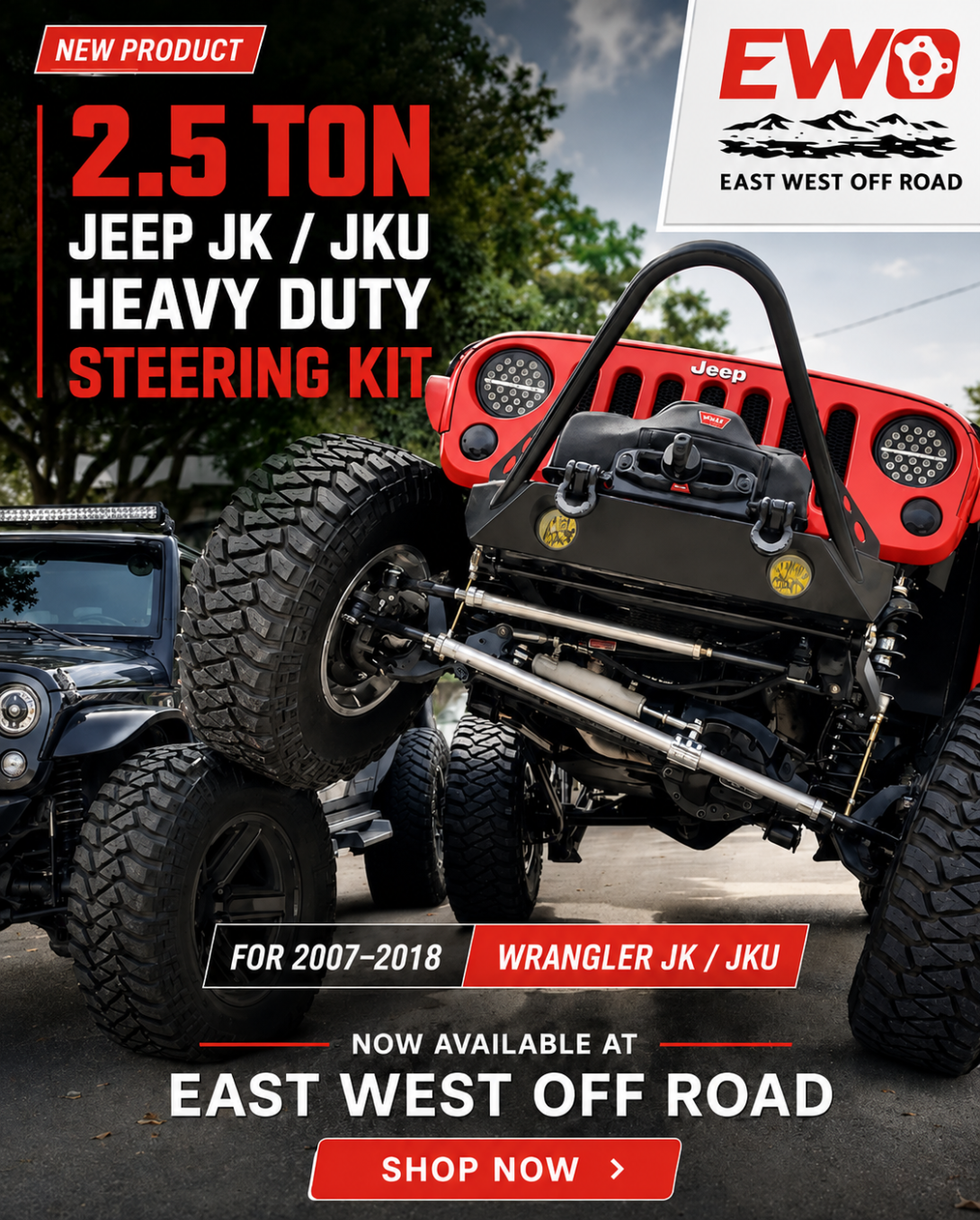
A Jeep JK heavy duty steering kit is one of the most important upgrades to consider when your 2007–2018 Jeep Wrangler JK or JKU starts running larger tires, added suspension lift, heavier wheels, or spending more time on demanding trails. The factory steering linkage works well for a stock Wrangler, but modified Jeeps can place substantially greater loads on the tie rod, drag link, steering ends, and related front-end components. Upgrading both major steering links with a properly configured heavy-duty system gives you a more complete approach than replacing individual factory components one at a time.
The East West Off Road 2.5 Ton Jeep JK / JKU Heavy Duty 7075 Aluminum Tie Rod & Drag Link Steering Kit is designed specifically for 2007–2018 Wrangler JK and JKU applications. With heavy-duty 7075 aluminum steering links and configurations available for different lift heights, it is built for Jeep owners looking for a serious steering linkage upgrade for street, trail, and off-road use.
Why Upgrade the Factory Jeep JK Steering Linkage?
The steering system on a Wrangler JK works as an interconnected assembly. Every time you turn the steering wheel, forces are transferred through the steering box, drag link, tie rod, steering knuckles, wheels, and tires.
Once you begin modifying the vehicle, those forces can increase.
Common reasons owners look for a Jeep Wrangler JK steering upgrade include:
- Larger and heavier tires
- Suspension lifts
- Increased trail use
- Rock crawling
- Heavy aftermarket wheels
- Repeated contact with rocks and trail obstacles
- Bent or worn factory steering linkage
- Worn steering ends
- Steering looseness caused by aging components
- Building a Jeep for combined daily-driving and trail use
A stronger steering linkage does not replace the need to inspect ball joints, track bars, wheel bearings, steering-box components, alignment, tire condition, or suspension geometry. However, a properly selected Jeep JK steering linkage upgrade can replace two of the most heavily loaded mechanical links in the steering system.
For modified Jeeps, installing a complete Jeep JK heavy duty steering kit can make more sense than continuing to replace stock-style linkage components individually.
What Does a Jeep JK Tie Rod and Drag Link Kit Do?
Understanding the two main components makes it easier to decide whether a complete steering kit is right for your Jeep.
What the Tie Rod Does
The tie rod connects the front steering knuckles and helps keep both front wheels moving together when you steer.
It also plays a direct role in setting front toe.
On the Jeep JK, the tie rod sits relatively low on the axle. That makes it one of the steering components most exposed to rocks, trail debris, ledges, and other obstacles.
For that reason, a Jeep Wrangler JKU tie rod kit or complete Jeep JK tie rod replacement kit is a common upgrade on trail-driven Wranglers.
When larger tires are installed, additional leverage is also applied through the wheel and steering system. A stronger tie rod can therefore become increasingly valuable as the Jeep moves further away from its factory configuration.
What the Drag Link Does
The drag link transfers steering movement from the pitman-arm side of the steering system toward the passenger-side steering knuckle.
Its angle and mounting position become especially important on lifted Jeeps.
This is why selecting the correct Jeep JKU drag link kit cannot be based only on strength. Lift height, steering geometry, axle configuration, track-bar relationship, wheel clearance, and mounting position all matter.
Instead of upgrading one component and leaving the other factory link in place, many owners choose a matched Jeep JK tie rod and drag link kit.
Why 7075 Aluminum Is Popular for Jeep Steering Upgrades
Material selection matters when building steering components intended for demanding off-road use.
A 7075 aluminum tie rod Jeep JK configuration offers an attractive combination of high material strength and relatively low weight. That has made 7075 aluminum popular across serious off-road steering applications.
Unlike simply choosing a steering system because it looks larger than stock, buyers should evaluate the entire assembly.
Important considerations include:
- Material
- Bar diameter
- Bar construction
- Steering-end size
- Thread engagement
- Adjustability
- Lift-height compatibility
- Knuckle mounting location
- Wheel and tire clearance
- Axle compatibility
- Replacement-part availability
A 7075-T6 aluminum steering kit can be particularly attractive on a Jeep that needs substantial steering linkage without automatically adding the weight associated with some large steel assemblies.
The EWO system uses 7075 aluminum tie rod and drag link components for its 2007–2018 JK/JKU application.
What Does “2.5 Ton” Jeep Steering Mean?
Drivers searching for a 2.5 ton Jeep steering kit are generally looking for steering hardware that is substantially more robust than factory JK linkage.
The term should not be interpreted as changing the Jeep's Gross Vehicle Weight Rating or giving the vehicle a literal additional load capacity of 2.5 tons.
In the off-road steering market, “2.5 ton” is commonly used to identify a heavy-duty steering component class.
A 2.5 ton Jeep steering kit is most relevant to owners who want a more substantial tie rod and drag link setup for a modified JK or JKU.
This type of upgrade can make sense for:
- Jeeps running larger-than-stock tires
- Lifted Jeep JK and JKU builds
- Rock crawlers
- Trail rigs
- Dual-purpose daily-driver and trail Jeeps
- Vehicles that have previously bent stock steering linkage
- Owners upgrading multiple worn steering components at once
For serious builds, a 2.5 ton heavy duty steering kit for Jeep Wrangler JK can provide a more complete foundation than installing another stock-style replacement.
2007–2018 Jeep Wrangler JK and JKU Fitment
The East West Off Road kit is designed around the 2007–2018 Jeep Wrangler JK and Wrangler Unlimited JKU platform.
That makes it relevant to owners searching for:
- 2007-2018 Jeep Wrangler JK steering kit
- 2007-2018 Jeep Wrangler JKU tie rod kit
- Jeep JKU 2007-2018 steering upgrade
- Jeep Wrangler JK Unlimited drag link kit
- Jeep JKU steering kit
- Jeep Wrangler Unlimited steering upgrade
JK refers to the two-door Wrangler platform, while JKU commonly refers to the four-door Wrangler Unlimited from the same generation.
Regardless of body configuration, you should verify your specific axle, suspension, wheel, tire, and lift setup before ordering steering components.
Factory Location vs. Flip Drag Link: Which Configuration Do You Need?
One of the most important considerations when ordering an upgraded steering system is drag-link position.
The EWO kit provides different steering configurations based on suspension lift height.
Factory Location / Under the Knuckle
For Jeeps with 3.5 inches of lift or less, EWO offers the factory-location / under-the-knuckle configuration.
A Jeep JK factory location drag link keeps the knuckle-side drag link connection in the lower factory-style position.
An under the knuckle steering kit for Jeep JK may be the appropriate solution when your suspension height and steering geometry do not require relocating the drag link above the knuckle.
Keeping the correct relationship among the drag link, track bar, axle, and suspension remains important.
Flip Kit / Over the Knuckle
For Jeeps with more than 3.5 inches of lift, EWO offers a flip-kit / over-the-knuckle configuration.
A Jeep JK flip drag link kit changes the mounting position of the drag link at the steering knuckle.
Owners searching for a flip drag link kit for Jeep JK with over 3.5 inch lift are typically attempting to configure the steering geometry around a taller suspension setup.
An over the knuckle drag link kit Jeep Wrangler JKU should not be installed solely because higher steering components appear more desirable. Track-bar geometry, mounting requirements, clearance, axle-side components, and suspension configuration should all be evaluated as a system.
If you are unsure which version applies to your Jeep, verify your actual suspension lift and front-end configuration before purchasing.
Why Lifted Jeeps Put More Demands on Steering Components
A lifted Jeep changes more than ride height.
Suspension modifications can alter steering angles, component relationships, available clearance, and the forces experienced by the linkage.
A heavy duty steering kit for lifted Jeep JK becomes particularly relevant when the Jeep combines lift height with larger tires.
Larger tires increase leverage at the steering knuckle. Wider wheels and different backspacing can change clearance. Off-road terrain can put the exposed tie rod directly in contact with obstacles.
The more extensively a Jeep is modified, the more important it becomes to evaluate the entire system rather than treating the tie rod or drag link as an isolated component.
Steering Upgrades for Jeeps Running Larger Tires
A steering kit for Jeep JK running larger tires needs to handle more than basic parking-lot steering.
Larger tires can create additional leverage and increase the effort transmitted through steering components, especially at low speeds or while crawling over uneven terrain.
That is one reason factory linkage may become more noticeable as a weak point after installing larger off-road tires.
For a trail-focused build, pairing stronger steering linkage with properly maintained:
- Ball joints
- Unit bearings
- Track bar
- Steering box
- Control arms
- Suspension joints
- Tires and wheels
creates a more complete front-end strategy.
Replacing the linkage while ignoring worn surrounding components can leave steering problems unresolved.
Why a Complete Steering Kit Can Be Better Than Replacing Only the Tie Rod
If your factory tie rod is damaged, replacing only the tie rod may appear to be the cheapest solution.
That approach can work when the rest of the steering system remains in excellent condition.
However, on an older or heavily modified Wrangler, replacing the tie rod and drag link together provides several advantages.
Matched Components
A complete steering package gives you tie rod and drag link components designed around the same overall system.
One Installation Project
Instead of returning later to replace the drag link, both primary links can be addressed during the same steering upgrade.
Better Upgrade Planning
Installing the complete system encourages owners to inspect alignment, lift geometry, clearance, steering ends, and surrounding front-end components at the same time.
More Appropriate for Hard-Used Jeeps
A heavy duty drag link and tie rod for 2007 to 2018 Wrangler can be especially useful when both factory links have accumulated years of street and trail use.
Jeep JK Dana 30 and Dana 44 Steering Considerations
Jeep JK models may be equipped with different front axle configurations depending on model and trim.
Owners frequently search for a:
- Jeep JK steering upgrade for stock Dana 30 axle
- Jeep JK Dana 30 steering kit
- Jeep JKU steering kit for stock Dana 44 front axle
- Jeep JK Dana 44 steering kit
- Dana 30 Dana 44 steering kit
Never assume that a steering kit fits simply because the vehicle is a JK.
Verify your exact axle, knuckle configuration, lift, wheel backspacing, steering stabilizer setup, and other modifications before installation.
This becomes even more important if your Jeep has received an axle swap or aftermarket axle housing.
Heavy-Duty Tie Rod Ends Matter Too
A steering system is only as useful as the complete collection of components transferring steering force.
The bars receive considerable attention, but steering ends are also critical.
When shopping for heavy duty tie rod ends Jeep JK, evaluate:
- Joint construction
- Stud size
- Material
- Serviceability
- Dust-boot availability
- Replacement availability
- Articulation
- Thread specifications
- Intended steering configuration
During comparison shopping, you may see phrases such as forged 1.25 inch tie rod ends for Jeep Wrangler JK, 4130 chromoly tie rod ends for Jeep JK steering, or 4340 hardened ball stud tie rod ends Jeep Wrangler.
Those specifications should be verified against the actual product being considered instead of assuming every heavy-duty steering kit uses the same end construction.
The same applies when searching for Jeep Wrangler JK replacement tie rod ends or trying to shop heavy duty tie rod ends for Jeep applications. Replacement parts need to match the specific steering system.
Aluminum vs. Chromoly Steering Linkage
Both aluminum and chromoly are used successfully in aftermarket steering systems, but they represent different design approaches.
Aluminum Steering Links
A heavy-duty aluminum tie rod Jeep Wrangler configuration can deliver substantial material strength with lower material weight.
7075 aluminum has become particularly popular for premium off-road steering bars.
Chromoly Components
Chromoly steel is also widely used in steering systems, especially for tubes, rod ends, studs, and other highly loaded parts.
Neither material name alone tells you whether a steering system is appropriate for your Jeep.
The entire design matters.
When comparing a 7075-T6 aluminum tie rod and drag link kit for Jeep JKU against chromoly alternatives, look at configuration, component dimensions, steering ends, lift compatibility, serviceability, and actual vehicle fitment rather than comparing material names alone.
Hexed Aluminum Bars Make Adjustment Easier
Toe adjustment is part of correctly setting up a Jeep after tie rod replacement.
A hexed aluminum tie rod bar for toe adjustment Jeep JK can give the installer a practical surface for making adjustments without relying on improvised gripping methods.
After installing a new tie rod, toe needs to be checked and adjusted correctly.
The drag link will also need to be adjusted so the steering wheel is properly centered.
Does a Heavy-Duty Steering Kit Fix Death Wobble?
Not necessarily.
Death wobble is a rapid front-end oscillation that can involve multiple components and conditions.
Potential contributors can include:
- Worn track-bar joints
- Loose track-bar hardware
- Worn ball joints
- Worn steering linkage
- Damaged control-arm bushings
- Wheel or tire problems
- Loose hardware
- Alignment issues
- Worn wheel bearings
- Steering-system play
Installing a stronger steering kit may replace worn linkage, but it should not be marketed as a guaranteed cure for death wobble.
If your Jeep is experiencing severe vibration or oscillation, diagnose the entire front suspension and steering system.
Will a Heavy-Duty Steering Kit Eliminate Bump Steer?
Again, not automatically.
Bump steer is strongly influenced by steering and suspension geometry.
On a track-bar-equipped Jeep, the relationship between the drag link and track bar is particularly important.
Installing a heavy duty drag link Jeep Wrangler without correctly evaluating its position and angle can leave geometry problems unresolved.
This is why factory-location and flip configurations should be selected based on the actual Jeep setup, not appearance alone.
A Strong Choice for Rock Crawling and Trail Builds
A heavy duty steering kit for rock crawling Jeep JK needs to cope with conditions very different from those experienced by a stock commuter.
Rock crawling can expose steering components to:
- Direct obstacle contact
- High steering loads at low speeds
- Large tires wedged against terrain
- Uneven suspension articulation
- Repeated trail impacts
A trail ready steering kit for Jeep Wrangler Unlimited should therefore be selected as part of the complete front-end build.
For a dedicated trail Jeep or dual-purpose rig, a 2.5 ton steering kit for Jeep JKU rock crawler can provide the kind of heavy-duty linkage many owners want before tackling more demanding terrain.
Daily Driver and Trail Jeep: Can One Steering Kit Handle Both?
Many Jeep owners do not have a dedicated trail-only rig.
Their JKU may commute during the week and hit the trails on weekends.
For a steering kit for daily driven and trail used Jeep JKU, the goal should be properly matched components and correct installation rather than simply installing the largest components available.
Street use makes alignment, steering-wheel centering, joint condition, torque checks, and predictable geometry especially important.
Trail use adds durability, clearance, and serviceability requirements.
A well-planned steering upgrade should consider both.
Installation and Alignment After a Jeep JK Steering Upgrade
Steering components are safety-critical parts.
Correct installation matters.
After replacing the tie rod and drag link, several items should be checked.
Toe Alignment
Tie rod length directly affects toe.
A Jeep JK steering kit installation should be followed by proper toe adjustment.
Steering Wheel Centering
Drag-link length affects steering-wheel position.
After installation and alignment, the steering wheel should be correctly centered.
Component Clearance
Cycle and inspect the steering to verify clearance around:
- Differential covers
- Wheels
- Tires
- Sway-bar components
- Steering stabilizer
- Suspension brackets
- Other aftermarket components
Fastener Inspection
All steering hardware must be installed and torqued correctly according to applicable instructions and specifications.
Professional Alignment
A Jeep JK steering kit that requires professional alignment should be treated as exactly that: a major steering change requiring proper post-installation setup.
Professional installation or alignment is especially advisable if you do not have experience working with steering geometry.
What to Check Before You Buy a Jeep JK Steering Kit
Before clicking “Add to Cart,” confirm these details.
1. Model Year
Verify that your Jeep falls within the 2007–2018 JK/JKU range.
2. Two-Door or Four-Door
Confirm whether you have a JK or Wrangler Unlimited JKU and verify product fitment.
3. Front Axle
Identify your Dana 30, Dana 44, aftermarket axle, or swapped axle configuration.
4. Suspension Lift
Know your actual lift height.
This is particularly important when choosing between factory-location and flip drag-link configurations.
5. Wheel Backspacing
Larger steering ends and bars may require additional clearance.
6. Tire Size
Consider the additional leverage created by larger tires.
7. Steering Stabilizer
Verify how your current stabilizer is mounted and whether any relocation or clamp changes are required.
8. Existing Front-End Condition
Inspect the track bar, ball joints, steering box, unit bearings, wheels, tires, and control-arm components.
9. Intended Use
A stock commuter and a 37-inch-tire rock crawler do not place identical demands on the steering system.
Why Choose the East West Off Road Jeep JK / JKU Steering Kit?
The East West Off Road kit targets Jeep owners looking for a complete heavy-duty steering linkage upgrade instead of another factory-style replacement.
Key reasons it deserves consideration include:
- Designed for 2007–2018 Jeep Wrangler JK / JKU applications
- 7075 aluminum tie rod
- 7075 aluminum drag link
- Heavy-duty 2.5-ton steering architecture
- Tie rod and drag link upgraded together
- Factory-location / under-knuckle configuration available for 3.5-inch lift or less
- Flip / over-knuckle configuration available for lifts over 3.5 inches
- Built around modified Jeep and off-road applications
For owners searching for an East West Off Road steering kit, the E35115 provides a vehicle-specific option rather than requiring you to piece together unrelated steering components.
Is This Steering Kit Right for Your Jeep?
This type of upgrade is most worth considering if your JK or JKU:
- Runs larger-than-stock tires
- Has a suspension lift
- Sees regular trail use
- Is being built for rock crawling
- Has damaged or worn factory linkage
- Needs both tie rod and drag link replacement
- Is undergoing a broader front-end upgrade
- Needs a stronger steering foundation for an off-road build
A relatively stock Wrangler used mainly for normal commuting may not require the same level of steering hardware.
The best upgrade is always the one that properly matches the vehicle.
Buying a Jeep JK Heavy Duty Steering Kit Online
If you are ready to buy Jeep JK steering kit components, avoid shopping by price alone.
Compare:
- Product fitment
- Tie rod and drag link material
- Steering-end design
- Lift-height configuration
- Replacement-part support
- Adjustment method
- Wheel clearance requirements
- Installation requirements
- Warranty information
- Manufacturer support
Buyers searching for a Jeep JK heavy duty steering kit for sale, 2.5 ton steering kit for sale, or Jeep JKU drag link kit for sale should first confirm that the configuration actually matches their Jeep.
Similarly, before you buy 7075 aluminum tie rod kit, order Jeep JKU steering upgrade kit components, or buy Jeep JK flip drag link hardware, verify the intended mounting arrangement.
Jeep JK Steering Upgrade Kit Price: What Should You Compare?
A Jeep JK steering upgrade kit price makes more sense when you compare what is actually included.
A less expensive kit may include only a tie rod.
Another package may provide both the tie rod and drag link.
Other systems may require additional clamps, adapters, stabilizer mounts, drilling, reaming, or track-bar changes.
Compare the complete installed package instead of comparing only the advertised base price.
For the current EWO price, available configurations, and stock status, check the product page before ordering.
The Bottom Line
A Jeep JK or JKU running larger tires, suspension lift, and regular off-road trails asks more from its steering system than a stock Wrangler.
Upgrading the tie rod and drag link together provides a complete approach to replacing two of the major mechanical steering links.
The EWO 2.5 Ton Jeep JK / JKU Heavy Duty 7075 Aluminum Tie Rod & Drag Link Steering Kit gives 2007–2018 Wrangler owners a purpose-built 7075 aluminum option with different configurations for lower-lift and taller-lift applications.
Whether you are building a lifted daily driver, weekend trail Jeep, or dedicated rock crawler, focus on proper fitment, steering geometry, component clearance, professional alignment, and the condition of the entire front end.
Strength matters—but the best Jeep JK steering parts upgrade is the one that works correctly as part of the complete vehicle.
Frequently Asked Questions (FAQs)
What is the best heavy-duty steering upgrade for a Jeep JK?
A good Jeep JK steering upgrade should match your year, axle, suspension lift, wheel clearance, tire size, and intended use. For modified 2007–2018 JK/JKU builds, upgrading both the tie rod and drag link is often more comprehensive than replacing only one factory component.
Does the EWO steering kit fit both Jeep JK and JKU models?
The East West Off Road E35115 kit is listed for 2007–2018 Jeep Wrangler JK and JKU applications. Always verify your axle and other front-end modifications before ordering.
What is included in a Jeep JK tie rod and drag link kit?
A complete package centers around the upgraded tie rod and drag link. Included steering ends and related hardware depend on the specific manufacturer and kit, so review the current product listing before purchasing.
Is 7075 aluminum good for a Jeep JK tie rod?
7075 aluminum is a high-strength aluminum alloy widely used in demanding mechanical applications. Its strength-to-weight characteristics make it popular for premium off-road steering bars.
What does a 2.5-ton steering kit mean?
“2.5 ton” describes a heavy-duty aftermarket steering component class. It does not increase your Jeep's rated payload, axle rating, or GVWR.
Do I need a flip drag link on my Jeep JK?
It depends primarily on your suspension and steering geometry. EWO currently lists its factory-location / under-knuckle setup for Jeeps with 3.5 inches of lift or less and its flip / over-knuckle setup for Jeeps with more than 3.5 inches of lift.
What is an over-the-knuckle drag link?
An over-the-knuckle configuration relocates the knuckle-side drag-link mounting point above the steering knuckle instead of using the factory-style lower position. The modification needs to work correctly with the rest of the vehicle's steering and track-bar geometry.
What is an under-the-knuckle steering setup?
An under-the-knuckle configuration retains the drag-link connection in the lower, factory-style mounting location. It is commonly used on stock-height and moderately lifted Jeeps where a flipped configuration is not required.
Will a heavy-duty steering kit fix death wobble?
Not necessarily. Death wobble can result from several worn, loose, damaged, or incorrectly configured front-end components. The entire steering and suspension system should be inspected rather than assuming a new tie rod and drag link will automatically eliminate the problem.
Will upgrading my tie rod and drag link eliminate bump steer?
Not automatically. Bump steer is closely related to suspension and steering geometry. Drag-link and track-bar relationships need to be correctly configured.
Should I replace the tie rod and drag link together?
For an older, lifted, or heavily trail-used Jeep, replacing both together can provide a more complete steering-linkage upgrade. A Jeep with one recently replaced component may not always require both.
Is this type of steering kit good for larger tires?
Heavy-duty steering systems are particularly popular on Jeeps running larger tires because larger tires can place additional leverage and load on steering components. The rest of the front end should still be inspected and maintained appropriately.
Can I use a heavy-duty steering kit on a daily-driven Jeep JKU?
Yes, provided the system is correctly matched, installed, aligned, and maintained. Daily-driven Jeeps make correct steering geometry and alignment especially important.
Does a steering kit require an alignment afterward?
Yes. Replacing or adjusting a tie rod changes toe, while drag-link adjustment affects steering-wheel centering. Proper alignment should be performed after installation.
Can I install a Jeep JK steering kit myself?
Experienced owners with the correct tools and understanding of steering geometry may perform their own installation, but steering is a safety-critical system. Professional installation and alignment are recommended when you are uncertain about any part of the process.
Does this kit fit a Jeep JK with a Dana 30?
Compatibility should be confirmed against the specific product instructions and your exact axle and knuckle configuration. Do not rely solely on the vehicle model when aftermarket axle or steering modifications may be present.
Does this kit work with a Dana 44 front axle?
Many JK/JKU builds use Dana 44 front axles, but exact fitment should always be confirmed based on model, axle, knuckles, lift, wheels, and existing modifications before purchasing.
Is a 7075 aluminum steering kit better than steel?
Neither material is automatically best for every build. 7075 aluminum provides an excellent strength-to-weight combination, while quality steel and chromoly systems have their own advantages. Compare the complete steering system rather than material alone.
How often should heavy-duty tie rod ends be inspected?
Inspect steering ends regularly and after hard trail use. Look for damaged boots, looseness, abnormal movement, impact damage, and loose fasteners. Inspection frequency should increase on Jeeps that see frequent off-road use.
Where can I buy the EWO 2.5-ton Jeep JK steering kit?
The kit can be purchased directly from East West Off Road through the product link at the beginning of this guide.