
The Japan Semiconductor Market is gaining momentum as demand for advanced electronic components increases across automotive, industrial automation, telecommunications, data centers, and consumer electronics. Japan has an established semiconductor ecosystem supported by expertise in precision manufacturing, electronic materials, image sensors, and power devices. Increasing investment in domestic chip production and growing demand for high-performance computing are also creating new opportunities for the industry.
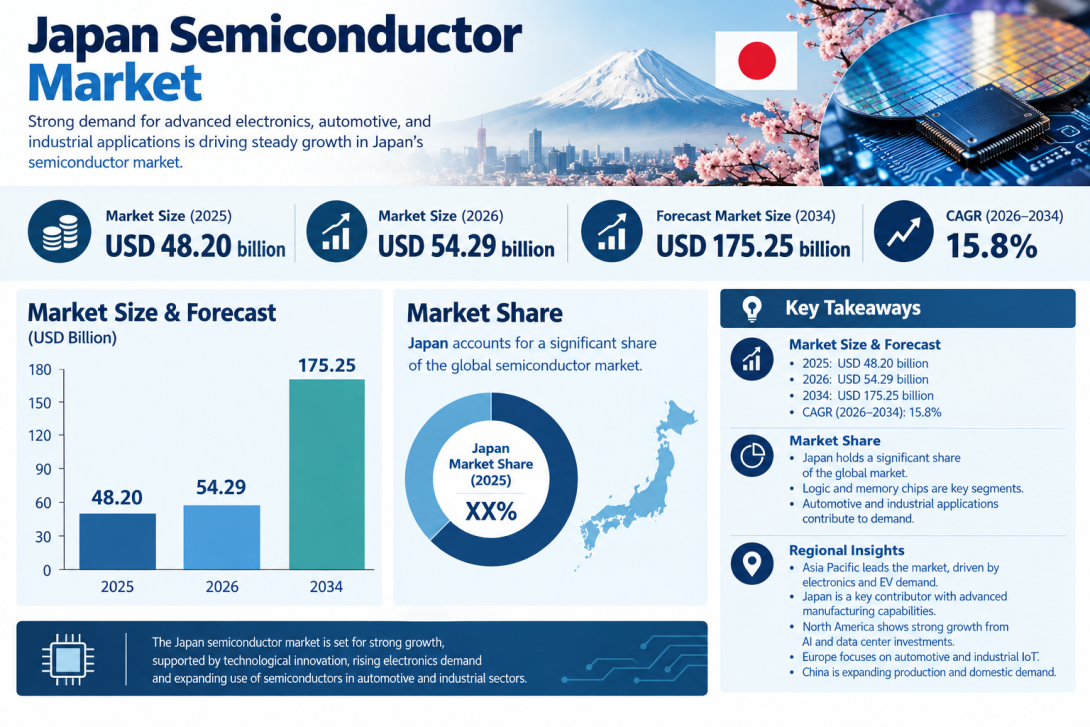
According to Fortune Business Insights, the Japan semiconductor market size was valued at USD 48.20 billion in 2025. The market is projected to grow from USD 54.29 billion in 2026 to USD 175.25 billion by 2034, registering a CAGR of 15.8% during the forecast period. This expansion reflects the growing importance of semiconductors in digital infrastructure, vehicle electrification, and next-generation industrial technologies.
Growing Demand for Advanced Semiconductor Technologies
Semiconductors are essential components in modern electronic systems, enabling data processing, power management, sensing, and communication. Japanese manufacturers are benefiting from rising demand for components that deliver greater efficiency, reliability, and processing performance.
The expansion of artificial intelligence (AI), cloud computing, and connected devices is increasing requirements for memory, logic devices, sensors, and advanced integrated circuits. These technologies support applications ranging from data center infrastructure to smart manufacturing equipment.
Japan's established capabilities in semiconductor materials and production equipment also strengthen its position in the global supply chain. Continued investment in research, manufacturing capacity, and international partnerships is expected to support further market development.
Automotive Electrification and Industrial Automation
The automotive industry is an important source of semiconductor demand in Japan. Modern vehicles rely on microcontrollers, sensors, analog integrated circuits, and power semiconductor devices for battery management, advanced driver-assistance systems, infotainment, and electronic safety features.
Electric vehicles are increasing the need for efficient power conversion and high-voltage components. Silicon carbide and gallium nitride technologies are attracting attention because they can improve power efficiency in suitable applications.
Industrial automation is another important growth driver. Robots, intelligent production lines, motor-control systems, and connected factory equipment depend on reliable semiconductor components. As Japanese manufacturers modernize production processes, demand for sensors, microcontrollers, and power-management devices is expected to increase.
For detailed market insights : https://www.fortunebusinessinsights.com/japan-semiconductor-market-114819
Component Analysis
The Japan Semiconductor Market is segmented by component into memory devices, logic devices, analog integrated circuits (ICs), microprocessor units (MPUs), discrete power devices, microcontroller units (MCUs), sensors, and others.
Memory devices support data storage in computers, servers, consumer electronics, and industrial systems. Increasing data center capacity and AI-related workloads are strengthening the need for efficient, high-density memory technologies.
Logic devices and microprocessors provide processing and control capabilities across computing, networking, and embedded systems. Their importance is increasing as electronic products incorporate more sophisticated functions.
Analog ICs and microcontrollers support power regulation, signal processing, motor control, and real-time operations. These components are particularly important in automotive electronics and industrial automation.
Discrete power devices and sensors also represent important areas of opportunity. Power devices help manage electrical energy efficiently, while sensors enable image capture, motion detection, environmental monitoring, and advanced vehicle safety functions.
Application Analysis
The market serves several major applications, including networking and communications, data centers, industrial systems, consumer electronics, automotive electronics, and government-related uses.
Networking and communications require semiconductors for Ethernet controllers, switches, routers, and other infrastructure. According to Fortune Business Insights, this application segment accounted for 32.7% of Japan's semiconductor market in 2025.
Data centers are creating additional demand as AI applications and cloud services require greater computing capacity, memory, and power efficiency.
Industrial applications use semiconductors in robotics, factory automation, intelligent control systems, and equipment monitoring. Meanwhile, consumer electronics depend on chips for appliances, personal devices, entertainment products, and connected home technologies.
Automotive applications continue to expand as vehicles incorporate more electronic systems for safety, electrification, connectivity, and driver assistance.
Regional and Industry Ecosystem Analysis
Japan's semiconductor industry benefits from a network of technology companies, research institutions, equipment manufacturers, and specialized materials suppliers. Regions with established electronics and manufacturing industries play an important role in supporting chip development and production.
Government initiatives aimed at strengthening domestic manufacturing and supply-chain resilience are encouraging investment in semiconductor fabrication facilities and advanced technologies. International partnerships are also helping expand production capabilities and improve access to next-generation manufacturing processes. <Cite refs={["turn642404search0","turn642404search3"]}/>
Competitive Landscape
The Japan Semiconductor Market includes established domestic manufacturers and international companies investing in the country's semiconductor ecosystem. Competition is shaped by product performance, manufacturing efficiency, technological innovation, and the ability to meet the requirements of automotive, industrial, and data center customers.
Major companies operating in the Japanese semiconductor market include:
- Renesas Electronics Corporation
- Sony Semiconductor Solutions
- Kioxia Holdings Corporation
- ROHM Semiconductor
- Toshiba Electronic Devices & Storage Corporation
These companies participate in areas such as microcontrollers, image sensors, memory, and power semiconductors. Industry participants are focusing on research and development, manufacturing improvements, strategic partnerships, and next-generation chip technologies to strengthen their market positions. <Cite refs={["turn642404search0"]}/>
Recent Industry Developments
Japan is strengthening its semiconductor manufacturing ecosystem through investments, international collaborations, and government-supported initiatives. These efforts aim to increase domestic production capacity, reduce supply-chain vulnerabilities, and improve access to advanced chip technologies.
The expansion of AI infrastructure and data centers is also creating new requirements for memory, processing components, and power-efficient semiconductor solutions. Meanwhile, progress in automotive electrification and industrial automation is encouraging continued development of specialized chips.
Get Free Sample PDF: https://www.fortunebusinessinsights.com/enquiry/request-sample-pdf/japan-semiconductor-market-114819
Future Outlook
The Japan Semiconductor Market is expected to experience substantial growth through 2034 as demand for advanced electronics expands across multiple industries. The market is projected to increase from USD 54.29 billion in 2026 to USD 175.25 billion by 2034, representing a CAGR of 15.8% during the forecast period.
AI computing, data center expansion, electric vehicles, industrial robotics, and next-generation communication infrastructure are likely to remain important demand drivers. Investment in domestic manufacturing and international technology partnerships may further strengthen Japan's role in the global semiconductor ecosystem.
However, high manufacturing costs, international competition, specialized equipment requirements, and shortages of skilled professionals could present challenges. Companies that continue to invest in innovation, manufacturing efficiency, and reliable supply chains will be better positioned to respond to changing market requirements.
Overall, the Japan Semiconductor Market is positioned for significant development as semiconductors become increasingly important to digital transformation, advanced manufacturing, and transportation technologies. Continued investment and technological progress are expected to shape the industry's long-term growth trajectory.
Related Reports
Explore Japan’s Market Opportunities - Latest - Japan Semiconductor Market - Insights