
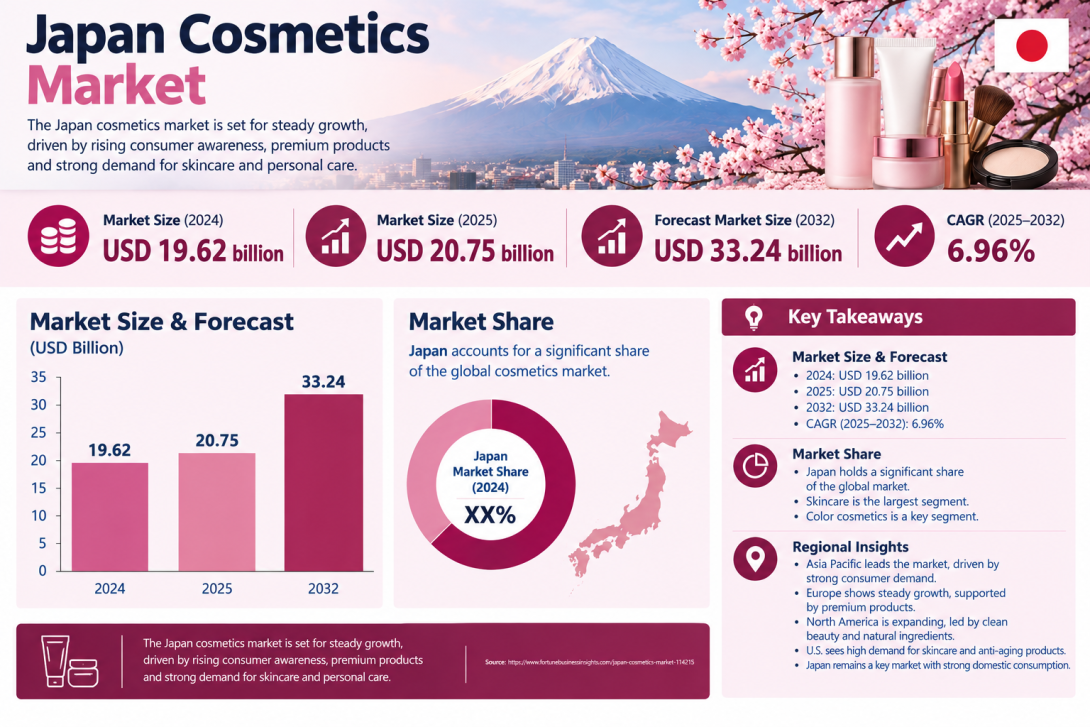
The Japan cosmetics market is experiencing steady growth, supported by increasing consumer interest in skincare, beauty innovation, premium products, and effective cosmetic formulations. Japan has a well-established beauty industry in which consumers place considerable importance on product quality, safety, and skin health. The growing popularity of anti-aging products, sun protection solutions, natural ingredients, and multifunctional cosmetics is creating new opportunities for manufacturers and retailers.
According to Fortune Business Insights, the Japan cosmetics market size was valued at USD 19.62 billion in 2024. The market is estimated to grow from USD 20.75 billion in 2025 to USD 33.24 billion by 2032, registering a CAGR of 6.96% during the forecast period. The market's expansion is supported by changing beauty preferences, digital retail growth, and continued product development.
Growing Demand for Skincare Products
Skincare is an important part of Japan's beauty industry. Consumers increasingly prioritize maintaining healthy skin through regular cleansing, moisturizing, sun protection, and specialized treatments. Products such as serums, facial creams, sunscreens, and anti-aging solutions are gaining attention as consumers seek effective additions to their daily routines.
The aging population is also influencing demand for products designed to address wrinkles, dryness, uneven skin tone, and other age-related concerns. Manufacturers are responding by investing in research, ingredient development, and formulations that combine cosmetic benefits with skin protection.
According to Fortune Business Insights, skincare accounted for 33.14% of the Japan cosmetics market in 2024, highlighting the importance of this product category.
Rising Interest in Natural and Functional Cosmetics
Japanese consumers are increasingly interested in cosmetic products that combine performance with carefully selected ingredients. Demand for products featuring botanical extracts, moisturizing ingredients, and formulations designed for sensitive skin is encouraging manufacturers to diversify their offerings.
Functional cosmetics, including products designed to provide sun protection, improve hydration, and address visible signs of aging, are also attracting attention. Companies are focusing on research and development to improve product performance and meet consumer expectations regarding safety and efficacy.
Sustainable packaging and responsible ingredient sourcing are becoming additional considerations for brands seeking to respond to evolving purchasing preferences.
For detailed market insights : https://www.fortunebusinessinsights.com/japan-cosmetics-market-114215
Product Type Analysis
Based on product type, the Japan cosmetics market is segmented into haircare, skincare, makeup, and others.
Skincare represents a leading segment because of strong consumer interest in skin maintenance, hydration, sun protection, and anti-aging solutions. Haircare products also contribute to market demand through shampoos, conditioners, scalp treatments, and specialized hair products.
The makeup segment includes foundations, lipsticks, powders, eye makeup, and other color cosmetics. Consumers' changing fashion preferences and interest in natural-looking beauty are influencing product development. Other products, including fragrances and related cosmetic categories, serve additional consumer needs.
Manufacturers are increasingly developing multifunctional products that combine cosmetic coverage with skincare benefits to differentiate their offerings.
Gender-Based Market Analysis
By gender, the market is divided into men and women. Women represent the dominant consumer group, supported by established skincare routines and demand for makeup, facial care, sun protection, and premium beauty products.
However, men's grooming is creating additional opportunities for market participants. Growing awareness of skincare and personal grooming is supporting demand for facial cleansers, moisturizers, sunscreens, and other products designed for male consumers.
Brands are responding with broader product selections and targeted marketing strategies to address different age groups, lifestyles, and skincare requirements.
Distribution Channel Analysis
The Japan cosmetics market is distributed through specialty stores, hypermarkets and supermarkets, online channels, and others.
Physical retail outlets remain important because consumers can examine products, compare formulations, and receive personalized recommendations. Supermarkets and other mass-market retailers provide convenient access to everyday beauty products, while specialty stores and department stores serve consumers seeking premium brands and specialized assistance.
Online channels are becoming increasingly significant as consumers use digital platforms to compare prices, read reviews, and explore new products. Fortune Business Insights projects that online channels will register a CAGR of 7.25% during the forecast period.
The combination of physical stores and e-commerce is helping brands improve accessibility and reach a wider range of consumers.
Regional and Consumer Market Trends
Japan's cosmetics industry benefits from established retail networks, advanced product development capabilities, and strong consumer interest in personal care. Major urban centers, including Tokyo and Osaka, provide important markets for premium beauty products, specialty cosmetics, and innovative skincare solutions.
Consumer demand is influenced by lifestyle changes, demographic trends, tourism, and exposure to international beauty trends. Social media and digital content also help introduce new products and influence purchasing decisions, particularly among younger consumers.
At the same time, Japan's aging population and declining overall population present challenges for long-term domestic demand. Companies are addressing these pressures through product innovation, premium offerings, and opportunities in international markets.
Competitive Landscape
The Japan cosmetics market includes established domestic manufacturers and international beauty companies. Competition is shaped by brand reputation, product quality, research capabilities, pricing, distribution networks, and customer loyalty.
Key industry participants include:
- Shiseido Company, Limited
- Kao Corporation
- KOSÉ Corporation
- L'Oréal S.A.
- Estée Lauder Companies Inc.
- Procter & Gamble Company
- Coty Inc.
Companies are focusing on advanced skincare formulations, product diversification, digital retail, and premium beauty offerings. Investment in research and development also supports the introduction of products designed for specific skin concerns and changing consumer expectations.
Recent Industry Developments
The Japanese cosmetics industry continues to evolve through product innovation, e-commerce expansion, and growing interest in functional beauty products. Manufacturers are developing formulations that address hydration, sun protection, skin aging, and sensitivity while exploring more sustainable packaging options.
Digital platforms are also changing how consumers discover and purchase cosmetics. Online product information, customer reviews, and cross-border e-commerce are helping brands expand their reach beyond traditional retail channels.
These developments are encouraging companies to combine technological innovation with consumer-focused product design.
Get Free Sample PDF: https://www.fortunebusinessinsights.com/enquiry/request-sample-pdf/japan-cosmetics-market-114215
Future Outlook
The Japan cosmetics market is expected to maintain its growth trajectory through 2032 as demand for skincare, premium cosmetics, functional formulations, and online beauty shopping continues to expand. The market is projected to increase from USD 20.75 billion in 2025 to USD 33.24 billion by 2032, registering a CAGR of 6.96%.
Skincare innovation, anti-aging solutions, men's grooming, and e-commerce are likely to remain important growth opportunities. However, demographic changes and strong competition will require companies to adapt their strategies and respond to evolving consumer preferences.
Manufacturers that prioritize product quality, research, effective formulations, and convenient distribution channels may be better positioned to benefit from the long-term development of Japan's cosmetics industry.
Related Reports
What Everyone Should Know About Japan’s Market - Japan Cosmetics Market - Insights