
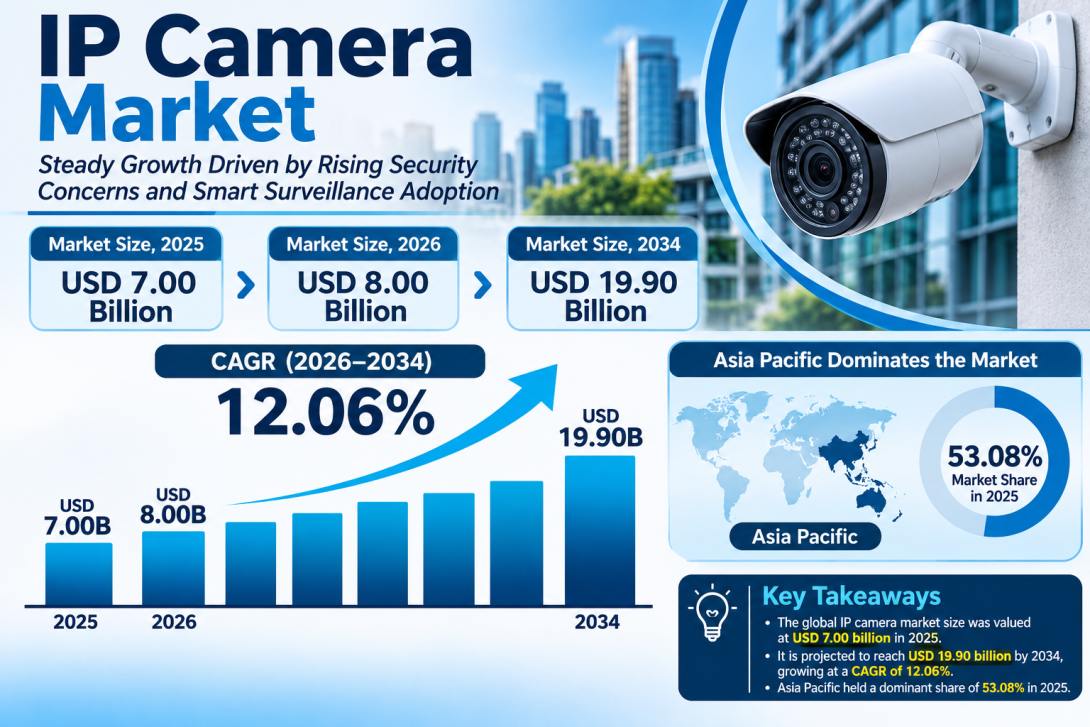
The global IP Camera Market Size is witnessing significant growth as demand for advanced security and video surveillance solutions increases across residential, commercial, and government sectors. Internet Protocol (IP) cameras are network-connected surveillance devices that transmit video footage through wired or wireless internet connections. These cameras offer high-resolution imaging, remote monitoring, cloud storage, and advanced video analytics, making them an important part of modern security infrastructure.
According to Fortune Business Insights, the global IP camera market size was valued at USD 7.00 billion in 2025. The market is projected to grow from USD 8.00 billion in 2026 to USD 19.90 billion by 2034, exhibiting a CAGR of 12.06% during the forecast period (2026–2034). Asia Pacific dominated the global market with a share of 53.08% in 2025. Increasing smart city investments, rising security concerns, and growing adoption of artificial intelligence (AI)-enabled surveillance technologies are supporting market expansion.
Increasing Demand for Advanced Video Surveillance Solutions
The growing need for reliable security systems is one of the major factors driving the IP Camera Market. Residential buildings, offices, shopping centers, industrial facilities, and public infrastructure increasingly require continuous monitoring to prevent theft, unauthorized access, and other security incidents.
IP cameras provide several advantages over traditional analog surveillance systems. Features such as remote access, high-definition video recording, motion detection, and real-time notifications allow users to monitor properties from different locations. Furthermore, integration with mobile applications and cloud-based platforms is improving the accessibility and efficiency of modern surveillance systems.
Growing Adoption of AI and Smart Home Technologies
Technological advancements in artificial intelligence, machine learning, and Internet of Things (IoT) technologies are creating new growth opportunities for the market. AI-powered IP cameras can analyze video footage, recognize unusual activities, detect movements, and generate automated security alerts.
The increasing adoption of smart home technologies is also supporting demand for connected surveillance devices. Consumers are installing IP cameras to monitor residential properties, entrances, parking areas, and indoor spaces. Similarly, businesses are adopting intelligent surveillance systems to improve workplace safety and operational monitoring.
For detailed market insights : https://www.fortunebusinessinsights.com/ip-camera-market-107356
Component Analysis
Based on component, the market is segmented into hardware and services.
Hardware: The hardware segment includes camera lenses, image sensors, mounting equipment, processors, and network connectivity components. It represents an important part of the market because these components are essential for installing and operating IP surveillance systems. Increasing demand for high-resolution and technologically advanced cameras is supporting segment growth.
Services: The services segment includes installation, maintenance, software customization, technical support, and operational training. Growing adoption of complex surveillance networks is increasing the need for professional services and system integration.
Product Type Analysis
By product type, the market is categorized into fixed cameras, pan-tilt-zoom (PTZ) cameras, and infrared cameras.
Fixed cameras are widely used in residential buildings, offices, retail stores, and industrial facilities because they provide continuous monitoring of specific locations. Their straightforward installation and reliable surveillance capabilities support their adoption.
PTZ cameras allow users to adjust camera direction, zoom, and viewing angles remotely. These features make them suitable for monitoring large areas, transportation facilities, and public infrastructure.
Infrared cameras are gaining attention because of their ability to capture images in low-light and nighttime conditions. They are particularly useful for security applications requiring continuous monitoring.
Connection Type Analysis
Based on connection type, the market is divided into centralized and distributed systems.
Centralized systems use a central server or network infrastructure to manage surveillance footage from multiple cameras. These solutions are commonly adopted by organizations that require centralized monitoring and video management.
Distributed systems use multiple connected servers or network resources to manage surveillance operations. Their flexible architecture supports larger installations and can improve system scalability and data management.
End User Analysis
Based on end users, the market is segmented into residential, commercial, and government and public sectors.
The residential segment is expanding due to increasing awareness of home security and growing smart home adoption. Commercial applications include offices, shopping malls, hotels, warehouses, and industrial facilities.
The government and public sector represents an important application area because of increasing investments in public safety and infrastructure monitoring. IP cameras are used in airports, railway stations, highways, government buildings, and other public locations to support continuous surveillance.
Regional Analysis
The global IP Camera Market covers Asia Pacific, North America, Europe, South America, and the Middle East & Africa.
Asia Pacific: Asia Pacific dominated the global market with a 53.08% share in 2025. Increasing smart city projects, expanding electronics manufacturing capabilities, and rising investments in security infrastructure are supporting regional growth. China, Japan, India, and South Korea are important markets.
North America: The region benefits from increasing investments in advanced security technologies, smart buildings, and commercial surveillance systems. Growing adoption of AI-powered monitoring solutions is also contributing to demand.
Europe: Rising security requirements, technological advancements, and increasing deployment of intelligent surveillance systems across commercial and public infrastructure are supporting market development.
South America: Growing urbanization, infrastructure development, and increasing awareness of security solutions are creating opportunities for IP camera manufacturers.
Middle East & Africa: Investments in smart city initiatives, transportation infrastructure, commercial developments, and public security systems are expected to support regional market expansion.
Competitive Landscape
The competitive landscape of the IP Camera Market is characterized by technological innovation, product development, strategic partnerships, and distribution expansion. Companies are focusing on high-resolution imaging, AI-based analytics, cloud connectivity, and improved cybersecurity features to strengthen their market positions.
Key companies operating in the market include:
- Sony Corporation
- Bosch Security Systems GmbH
- Honeywell International Inc.
- Samsung Electronics Co. Ltd.
- D-Link Corporation
- Hangzhou Hikvision Digital Technology Co. Ltd.
- Avigilon Corporation
- Belkin International Inc.
- CP Plus
- GeoVision Inc.
Recent Industry Developments
The IP camera industry is experiencing continuous technological advancements, particularly in AI-enabled video analytics, intelligent motion detection, and cloud-based surveillance. Manufacturers are introducing cameras with improved image quality, enhanced night vision, and advanced monitoring capabilities.
The integration of IP cameras with smart home platforms and IoT networks is also expanding their applications. Additionally, companies are increasingly focusing on cybersecurity improvements to address concerns regarding unauthorized access, data privacy, and network vulnerabilities.
Get Free Sample PDF: https://www.fortunebusinessinsights.com/enquiry/request-sample-pdf/ip-camera-market-107356
Future Outlook
The global IP Camera Market is expected to experience strong growth through 2034, supported by increasing security requirements, smart city investments, and the adoption of connected surveillance technologies. Growing demand from residential, commercial, and government applications will continue to create opportunities for industry participants.
Furthermore, advancements in artificial intelligence, cloud computing, video analytics, and network connectivity are expected to improve camera functionality and monitoring efficiency. As organizations and consumers increasingly prioritize safety, remote monitoring, and intelligent security infrastructure, IP cameras are likely to become an essential component of modern surveillance systems. With a projected CAGR of 12.06% during 2026–2034, the market presents promising long-term growth opportunities.
Related Report
What Everyone Should Know About Japan’s Market - IP Camera Market Size - Insights