

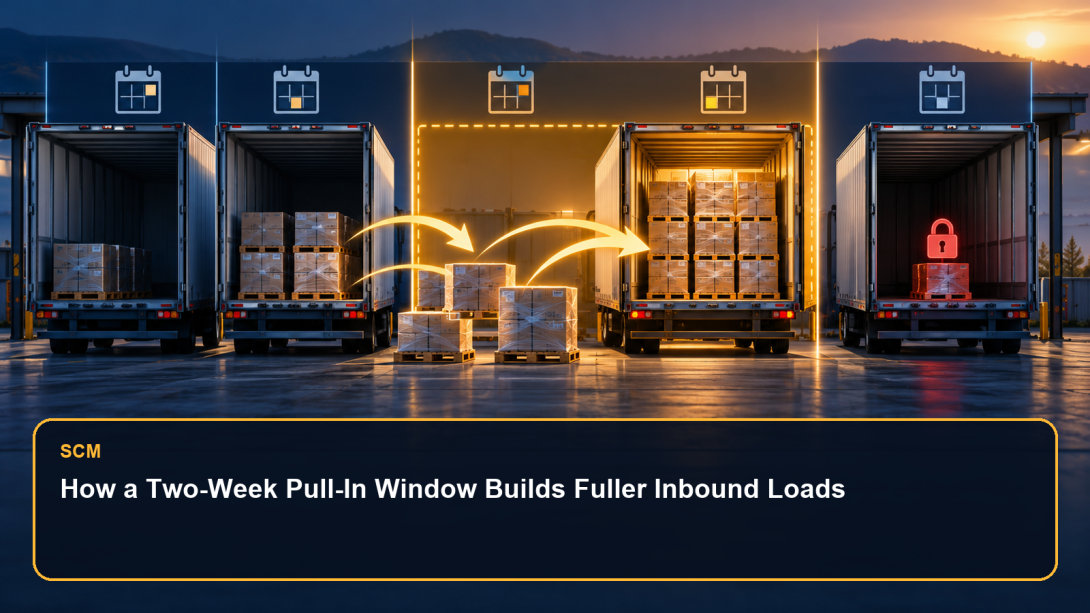
How a Two-Week Pull-In Window Builds Fuller Inbound Loads
A component planner may see three half-filled trailers leaving the same supplier on consecutive weeks while the receiving plant pays for unused capacity each time. Oracle Fusion SCM Training can introduce the underlying decision without turning it into a transport puzzle: selected unfirmed planned orders can move into an earlier load, but only within a controlled pull-in window and only when equipment, lane, date, and policy conditions fit. The mechanism is not a blanket instruction to buy early. It is a reviewable recommendation that trades a modest timing shift against fuller equipment, while preserving firm commitments and exposing orders that cannot be evaluated.
A Nearly Empty Trailer Is a Planning Signal
Consider a factory that receives pump housings from one supplier every week. The first week has enough orders to use sixty percent of a trailer, while the next two weeks each use about twenty percent. All three movements share the same lane and shipping method. A simple consolidation idea would pull everything forward, yet that could create excess inventory, consume dock space, or move commitments that must remain on their dates. A load recommendation is useful because it tests a bounded opportunity rather than assuming maximum trailer fill is always desirable. The planner still needs to judge whether earlier arrival is operationally acceptable.
Eligibility Comes Before Consolidation
The workspace evaluates a selected replenishment or supply plan and looks across the first eight weeks of its horizon. Orders need a supplier site and a suggested ship date inside that window. Eligible records include purchase orders and purchase requisitions that are not canceled or being canceled, plus planned orders that are ready or marked for release. This population boundary matters. A planner should not interpret an absent order as proof that consolidation was rejected on cost or capacity grounds. It may simply fall outside the horizon, lack the required state, or be missing a supplier site needed to place it on a lane.
The 26D Supply Planning Readiness page explains a second boundary: purchase orders and requisitions retain their current suggested ship dates, while only unfirmed planned orders can be pulled earlier, by no more than two weeks. Firmed planned orders also retain their dates, and the mechanism does not recommend push-outs. That distinction protects accepted commitments from being casually reshaped to improve utilization. In the housing example, a firmed second-week order stays put. An unfirmed third-week proposal may move into week one if it satisfies every other rule, but an order three weeks away cannot cross the documented limit merely because space remains.
Equipment Profiles Turn Volume Into a Real Constraint
A recommendation needs more than total weight. Equipment groups hold effective weight, effective volume, and maximum capacity for applicable shipping units, while equipment profiles connect those groups to planning. In the current mechanism, only the group assigned first priority in a profile is considered; there is no fallback to a second-priority group during recommendation generation. A poorly chosen first priority can therefore exclude practical freight or model the wrong capacity. Testing should use material that is heavy but compact, light but bulky, and pallet constrained. Those cases reveal whether the recommendation respects the limiting dimension instead of producing an attractive percentage that a real trailer cannot carry.
Lane and shipping-method data provide the travel context. The shipping method comes from the planning order, and unresolved lane, equipment, capacity, or unit-of-measure data can cause exclusion with an explanation. This is healthier than silently assigning a plausible vehicle. The planner should examine the reason, correct the governing source if appropriate, rerun the process, and compare the result. Manually forcing the order into a load would hide whether its pallets, weight, and volume were ever evaluated under a valid equipment profile.
The Pull-In Window Needs an Inventory Counterweight
Moving an unfirmed order forward changes more than trailer utilization. The plant may receive inventory earlier, pay sooner, occupy storage longer, and expose shelf-life-sensitive material to additional aging. For pump housings, those costs may be modest; for coated components with controlled storage, they may outweigh freight savings. A sound review therefore places projected utilization beside days of early inventory, receiving capacity, storage availability, working capital, and production need. The two-week maximum is a system boundary, not evidence that every movement within it is beneficial. Local policy can use a narrower window or require approval when early inventory exceeds a defined threshold.
Multi-Source Pickup Is an Explicit Design
A fuller load may collect from more than one source, but shared geography alone does not authorize that pattern. Multi-source pickup depends on explicit group setup covering participating sources, the lane and equipment context, and the allowed pickup-stop count. Imagine two nearby casting suppliers serving the same plant. Their orders should share a recommendation only when the configured group permits both sources and the route remains valid. This avoids treating every pin on a map as a feasible stop. Loading sequence, access hours, pallet compatibility, and pickup limits still affect whether the proposed movement can be executed as represented.
Approval Is the Boundary Between Advice and Change
The workspace presents recommendations for review, revision, and approval before changes are applied. It supports a planning decision; it does not dispatch transport or replace transportation execution. That line should remain visible in operating procedures. A planner can compare included orders, excluded candidates, equipment utilization, timing changes, and source stops, then adjust or reject the recommendation. After approval, downstream teams still need an executable arrangement and confirmation that suppliers, docks, and carriers can support it. Calling the recommendation a booked load would skip the commercial and physical commitments that occur outside the planning calculation.
Test the Edges of the Window
A focused test should create otherwise comparable orders at one, two, and three weeks beyond an earlier load. Leave one planned order unfirmed, firm another, and include a purchase order on its current date. The expected pattern is specific: eligible unfirmed proposals may move no more than two weeks earlier; the firmed proposal and purchase order retain their dates; no candidate is pushed out. Add an order with a missing lane and another that breaches volume before weight. Review exclusion reasons, first-priority equipment behavior, pallet totals, and resulting dates. This matrix proves the mechanism more clearly than a single highly utilized recommendation.
Measures should also distinguish recommendation quality from approval volume. Track capacity utilization before and after approved changes, orders excluded for data defects, days pulled forward, early-inventory exposure, and recommendations later rejected by operations. A rising fill rate paired with dock congestion is not success. Neither is a low approval rate automatically failure; it may reveal stale equipment profiles or a policy that ignores inventory cost. Reviewing these outcomes by lane can show where consolidation is repeatable and where weekly demand is too irregular. The aim is explainable trade-offs, not a dashboard that rewards every earlier shipment.
Conclusion
A two-week pull-in window can combine compatible unfirmed planned orders into fuller inbound loads without shifting firmed orders, purchase orders, or requisitions from their current dates. Reliable use depends on the eight-week evaluation horizon, valid supplier and lane data, a realistic first-priority equipment group, explicit multi-source rules, and review before approval. The planner must balance utilization against storage, cash, shelf life, and receiving capacity, then preserve the boundary between recommendation and transport execution. A Oracle Fusion SCM Cloud Online Training exercise built around one-, two-, and three-week candidates can make those limits visible while showing why the fullest trailer is not automatically the soundest supply decision.