

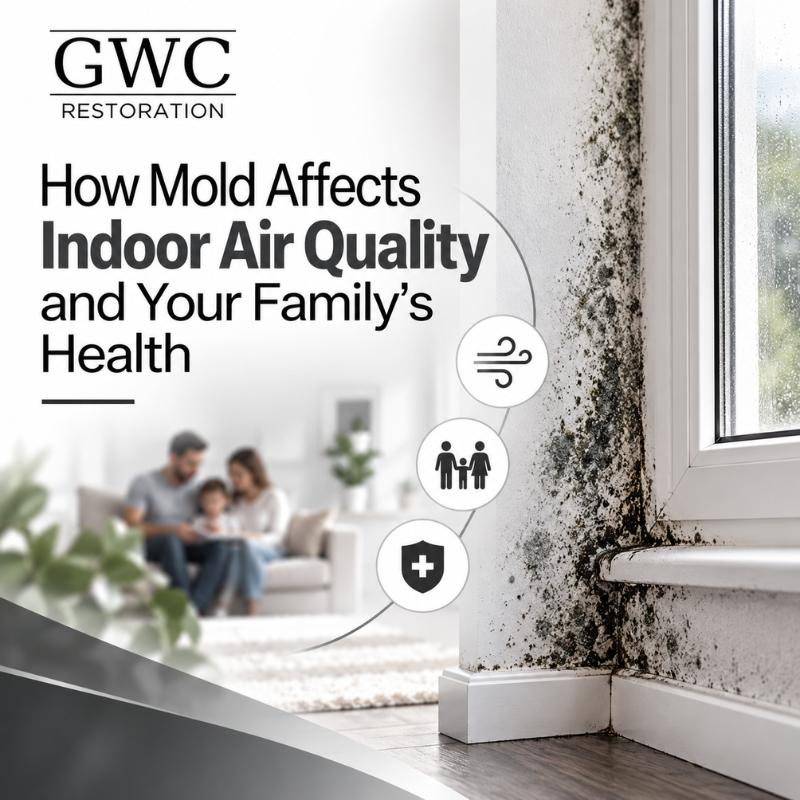
Quick answer: Mold affects indoor air quality by releasing microscopic spores, fragments, and microbial volatile organic compounds (MVOCs) into the air, which can be inhaled by anyone inside the home. For most people, this may cause allergy-like symptoms such as coughing, congestion, itchy eyes, and headaches that seem to worsen with time spent at home. For people with asthma, respiratory conditions, or weakened immune systems, exposure may be more concerning. The musty smell associated with mold is caused by MVOCs; however, being able to smell it does not necessarily mean you are inhaling mold spores or that harmful exposure is occurring.
If your family seems to catch every cold, wakes up congested, or has a cough that clears up on vacation and returns a day after getting home, mold is worth ruling out—particularly in a house that has experienced water damage, even minor damage, in the past year or two. Here's what's really happening in the air and what to do about it.
Why Mold Growth Becomes an Air Quality Problem
Mold reproduces by releasing spores into the air—that's essentially how it spreads. Indoors, without wind or rain to disperse them, these spores can circulate through the HVAC system, settle on surfaces, and become airborne again when disturbed. They may then be inhaled by people in the home.
Mold also produces microbial volatile organic compounds, or MVOCs, as part of its normal growth process. These can contribute to the musty, earthy smell that is frequently one of the first signs that something is wrong—long before mold is visible. If you can smell it, spores and MVOCs may be present in the air, whether or not you can see the source.
North Alabama's humidity can make this more common than many homeowners realize. Mold needs moisture and organic material to grow—such as drywall paper, wood, and dust—and a damp crawlspace, a slow leak behind a wall, or a bathroom without adequate ventilation can quietly provide both for months before anyone notices.
How Mold Exposure Actually Affects Your Family
Reactions to mold exposure vary a lot from person to person, which is part of why it's easy to overlook. Common symptoms include:
Who's Affected Typical Symptoms
Generally healthy adults & kids Nasal congestion, sneezing, coughing, itchy or watery eyes, throat irritation, headaches
People with allergies or asthma More frequent or severe flare-ups, wheezing, shortness of breath
Infants and young children Increased respiratory symptoms; more sensitive to indoor air quality generally
Older adults or immunocompromised individuals Greater risk of more serious respiratory response
One of the clearest signals isn't necessarily any single symptom—it's a pattern. Symptoms that consistently improve away from home, such as on vacation, at work, or at school, and return within a day of coming back can be a reason to investigate the home environment. However, this pattern alone does not confirm that mold is the cause.
Where Mold Typically Hides in a Home
Visible mold on a wall or ceiling is often the smallest part of the problem. Mold frequently grows in places that stay damp and go unchecked for long stretches:
- Behind walls near old or hidden leaks
- Under carpet padding and beneath flooring
- Inside HVAC ductwork and around AC units
- In attics with poor ventilation or roof leaks
- In crawlspaces with high humidity or standing moisture
- Behind bathroom tile and around tubs or showers
- Inside cabinets under sinks
Any place that has experienced a water event—a slow pipe leak, an overflow, or stormwater intrusion—is a candidate for hidden mold growth, even if it was "dried out" at the time. Surface-dry does not always mean mold-free, particularly inside wall cavities or under floors where airflow is restricted.
Why "I Don't See Mold" Doesn't Mean "There's No Mold"
Mold does not need to be visible to affect the air you are breathing. Spores are microscopic, and a colony can become established behind drywall, under a subfloor, or inside ductwork long before it becomes visible on a painted surface. By the time mold is visible, it may have already been growing—and potentially affecting the air—for weeks or months.
This is one of the more common misunderstandings homeowners encounter: wiping visible mold off a surface with a household cleaner might remove what you can see while leaving the underlying moisture problem. Mold growing on the unseen side of that surface may remain completely intact.
Signs Your Indoor Air Quality May Be Affected by Mold
Consider having your home checked if you notice:
- A persistent musty or earthy odor, especially in one area of the house or after rain.
- Family members with recurring respiratory symptoms that improve when they're away from home.
- Visible mold or discoloration on walls, ceilings, or around windows.
- A recent or past water event — a leak, flood, or storm intrusion — that wasn't professionally dried and inspected.
- Condensation on windows or high humidity that doesn't resolve with normal ventilation.
- Worsening allergy or asthma symptoms with no clear seasonal explanation.
What You Can Do to Protect Indoor Air Quality
- Control humidity. Keeping indoor humidity below roughly 50% makes it much harder for mold to establish itself.
- Fix leaks quickly. Even a small, slow leak behind a wall or under a sink can supply enough moisture for mold to take hold.
- Ventilate moisture-prone areas. Bathrooms, kitchens, and laundry rooms need working exhaust fans, used consistently.
- Have your HVAC system checked. Ductwork and coils can harbor mold and recirculate it through every room in the house.
- Don't rely on bleach or surface cleaning alone for anything beyond a very small, contained spot — it doesn't address moisture behind the surface and won't reach mold that's already spread further than it appears.
- Get a professional inspection after any water damage, even if everything looks dry within a day or two.
When to Call a Professional Instead of Handling It Yourself
DIY cleaning has its place for small, isolated stains on nonporous surfaces. There are cases where you should consider hiring a professional, including:
- Mold growth exceeds about 10 square feet
- Mold contamination has occurred in the HVAC system or ductwork
- The stained area is caused by an undetected leak
- Asthma, allergies, or an impaired immune system affect a family member
- Musty odors continue after cleaning visible mold
- You don't know how widespread the contamination is beyond walls, floors, or ceilings
Professional mold remediation identifies the cause of the moisture, safely removes contaminated materials, and evaluates whether additional steps are needed to address the affected area.
Protecting Your Family's Air Starts With Finding the Source
Mold is ultimately a moisture problem that can also become an air quality and health concern. Treating visible mold without finding and fixing what's feeding it often means it comes back—sometimes in the same spot, and sometimes worse.
If your home has a musty smell, a history of water damage, or unexplained respiratory symptoms, it's worth having it evaluated. GWC Restoration provides professional mold remediation in Madison, Huntsville, and surrounding North Alabama communities. Call (256) 509-6772 or request a free inspection to find out what's really in your air.
The Article “How Mold Affects Indoor Air Quality and Your Family’s Health” was originally posted here.